 Skip to content




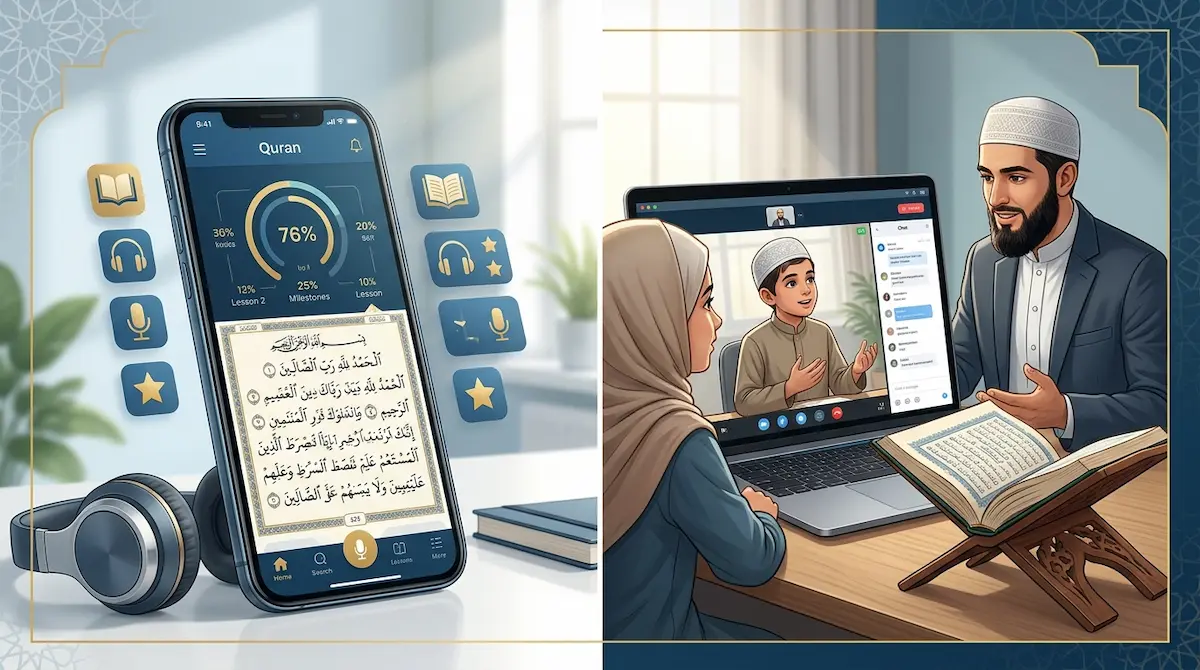
If you’ve typed something like “best way to learn Quran online” into Google recently, you already know how overwhelming the options are. Quran apps. YouTube channels. Live one-on-one classes. Weekend mosque programs. It’s a lot, and when it comes to something as sacred as learning the Book of Allah, the stakes feel high.
So let’s cut through the noise. This guide on Quran learning apps vs live online classes breaks down the real differences between the two, addresses the important Islamic question of whether online Quran learning is even permissible, and helps you make the right decision for yourself or your child, whether you’re based in New York, Houston, Los Angeles, Chicago, or anywhere else across the United States.
What Are Quran Learning Apps? A Quick Overview
Quran learning apps are self-paced, software-based tools designed to help users read, memorize, or recite the Quran independently without a live teacher. Popular examples include apps focused on Tajweed rules, Noorani Qaida lessons, Quran memorization (Hifz), and basic Arabic alphabet recognition.
What Quran Apps Typically Offer
- Pre-recorded audio recitations from well-known Qaris
- Interactive Tajweed rule modules with color-coded text
- Memorization tools with spaced repetition and audio playback
- Arabic alphabet and Noorani Qaida exercises for beginners
- Progress tracking dashboards for self-monitoring
- Offline access for use without an internet connection
These features make apps genuinely useful as supplementary tools; there’s no argument there. Many parents start their young children on Quran apps before transitioning them to structured classes, and that’s a perfectly reasonable approach.
But here’s where it gets honest.
The Real Limitations of Quran Learning Apps
Apps are built on algorithms. The Quran was revealed to and transmitted through human beings, with a chain of narration (Isnad) going back to the Prophet Muhammad ﷺ himself. That spiritual and pedagogical tradition isn’t something an app can replicate.
No Real-Time Tajweed Correction
Tajweed, the precise rules governing Quranic pronunciation, involve the Makharij al-Huruf (articulation points of Arabic letters), Sifaat (characteristics of letters), and rules like Idghaam, Ikhfa, Iqlab, and Madd. Mispronouncing even a single letter can alter the meaning of a verse entirely. An app cannot hear you recite and correct your tongue placement in real time. A qualified human teacher can and must.
No Accountability or Motivation System
Consistency is the single biggest challenge in Quran learning. Without a teacher expecting you at a specific time, most self-paced learners drift. Research consistently shows that students in structured, teacher-led environments maintain significantly higher completion rates than those using self-paced digital tools alone.
No Ijazah or Scholarly Chain
An Ijazah is an Islamic certification that authorizes a student to teach or transmit Quranic knowledge, granted by a qualified scholar whose chain connects back to the Prophet ﷺ. Apps cannot grant Ijazah. For Muslims who want to teach their own children or community members one day, this matters enormously.
No Emotional or Spiritual Connection
Learning the Quran isn’t just an academic exercise; it’s an act of worship. The relationship between a student and a qualified Quran teacher (Ustadh or Ustadha) carries profound spiritual weight in Islamic tradition. That human connection, that encouragement after a difficult Surah, that shared joy when a student finally masters a Makhrij, no app delivers that.
Live Online Quran Classes: How They Work and Why They’re Different
Live online Quran classes connect students directly with certified, qualified Quran teachers via platforms like Zoom, Skype, or dedicated learning portals in real time. At Quran Academy USA, our live sessions are conducted one-on-one or in small groups, with certified instructors who specialize in Tajweed, Hifz (memorization), Tafseer (Quranic exegesis), and Arabic language studies.
What Live Online Classes Offer That Apps Simply Cannot
Real-time recitation correction: Your teacher hears every word you recite and corrects your pronunciation, breath control, and rhythm immediately before mistakes become habits.
Personalized learning pace: A student learning Surah Al-Fatiha for the first time moves at a different pace than one memorizing Juz Amma. Live teachers adapt in real time. Apps run on fixed modules.
Structured curriculum: From Noorani Qaida for absolute beginners to advanced Tajweed and Hifz programs, live classes follow a structured, progressive curriculum that builds on itself, something apps rarely achieve effectively.
Two-way communication: Students can ask questions, request clarification, and engage in real dialogue with their teacher, a fundamental element of Islamic knowledge transmission that has been honored for over 1,400 years.
Parental visibility: Parents of younger students can monitor live sessions, track progress reports, and stay connected to their child’s learning journey in ways that a solo app session simply doesn’t allow.
Online Quran Classes vs Local Mosque Pros and Cons for US Muslim Families
This is a question that comes up constantly in Muslim communities across the United States, and it deserves a fair, honest answer, not one that dismisses the mosque or dismisses online learning.
The Case for Local Mosque Classes
Local mosque classes, whether at a masjid, Islamic center, or community madrasah, offer something genuinely valuable: physical community. Children sitting together, memorizing together, making friendships rooted in their faith. The barakah (blessing) of learning in a masjid environment is real and shouldn’t be minimized.
In major Muslim communities like Dearborn (Michigan), Fremont (California), Brooklyn (New York), and Irving (Texas), well-resourced Islamic centers often run excellent weekend and after-school Quran programs with qualified imams and teachers.
Advantages of local mosque classes:
- Physical Islamic community building
- In-person teacher-student relationship
- Exposure to the masjid environment and Islamic etiquette
- Free or low-cost in many communities
- Peer learning and group recitation environment
Limitations of local mosque classes:
- Group sizes can be large (sometimes 20–30 children per teacher), limiting individual attention
- Geographic limitation: Many US cities and suburbs have limited or no nearby qualified Quran teachers
- Fixed, inflexible schedules that clash with school, sports, and family commitments
- No option for female students to learn from female teachers in all settings
- The quality of teaching varies significantly between locations
- Commuting time and transportation challenges, especially in sprawling US cities like Phoenix, Dallas, or Atlanta
The Case for Live Online Quran Classes
For the millions of Muslim families spread across suburban and rural America, far from Islamic centers, live online classes aren’t just convenient, they’re often the only realistic option for quality Quranic education.
Advantages of live online classes:
- Access to certified, qualified teachers regardless of your ZIP code
- One-on-one attention ensures faster and more accurate learning
- Flexible scheduling around US school hours, time zones, and family routines
- Female students can learn with female teachers from the comfort and privacy of home
- Flight tracking for missed sessions and rescheduling flexibility
- Affordable monthly packages often more cost-effective than private in-person tutoring
- Parents can monitor sessions and receive regular progress reports
Limitations to be aware of:
- Requires a stable internet connection and a device
- Lacks the physical community element of a local masjid
- Requires self-discipline from older students in managing their schedules
Our recommendation: For many US Muslim families, the ideal approach is a combination of live online classes for structured, one-on-one learning throughout the week, supplemented by attending the local masjid for Friday prayers, Eid gatherings, and community events. You don’t have to choose one or the other entirely.
Is It Permissible to Learn the Quran Online? Islamic Scholarly Perspective
This is an important question, and it deserves a considered, scholarly answer, not a dismissal.
The Traditional View on Knowledge Transmission
Classical Islamic scholarship places enormous emphasis on learning directly from a qualified teacher with a connected chain of transmission (Isnad). Scholars like Imam Malik, Imam Shafi’i, and Ibn Sirin emphasized that knowledge should be taken from people, not just books or indirect sources. This principle remains central to Islamic learning.
Contemporary Scholarly Opinion on Online Quran Learning
The contemporary scholarly consensus, including opinions from institutions like Al-Azhar University in Egypt and respected Islamic jurisprudence bodies, holds that learning the Quran online from a qualified, certified teacher is permissible (halal) provided the teacher is genuinely qualified, and the transmission of knowledge is authentic.
The key condition is not the medium it is the qualification of the teacher and the quality of instruction. A live video session with a certified Hafiz or Hafiza who holds an Ijazah in Tajweed fulfills the essential conditions of proper Islamic knowledge transmission, regardless of whether the session takes place in a physical room or over a screen.
Sheikh Yusuf Weltch of SeekersGuidance and numerous other contemporary scholars have addressed this question, affirming that online learning from qualified teachers is an acceptable and often necessary means of accessing Islamic education, particularly for Muslims living as minorities in Western countries like the United States, Canada, and the United Kingdom.
The Clear Distinction Teacher vs. App
What Islamic scholars caution against is learning the Quran solely from pre-recorded audio, apps, or YouTube videos without any qualified human teacher providing real-time correction and guidance. An app is a tool, not a teacher. The permissibility of online Quran learning applies specifically to live, teacher-led instruction, which is exactly what live online classes provide.
At Quran Academy USA, every instructor holds verified credentials in Quranic sciences, ensuring that your learning meets both the scholarly and pedagogical standards that this sacred knowledge deserves.
Quran Learning Apps vs Live Online Classes Side-by-Side Comparison
| Feature | Quran Learning Apps | Live Online Classes |
| Real-time Tajweed correction | No | Yes |
| Certified qualified teacher | No | Yes |
| Personalized learning pace | Limited | Yes |
| Two-way communication | No | Yes |
| Ijazah eligibility | No | Yes |
| Progress accountability | Self-monitored only | Teacher-monitored |
| Female teacher option | No | Yes |
| Islamically permissible | As supplement only | Yes |
| Suitable for Hifz (memorization) | Not recommended alone | Yes |
| Suitable for Tafsir study | No | Yes |
| Cost | Free–Low | Moderate (flexible packages) |
| Best use | Revision & supplementary practice | Primary structured learning |
Who Should Choose Live Online Quran Classes?
Live online Quran classes are the right choice if:
You’re a Muslim Family in the USA Without a Nearby Qualified Teacher
Millions of American Muslim families live in cities and suburbs where qualified Tajweed teachers simply aren’t available locally. States like Montana, Wyoming, Vermont, and large swaths of the South and Midwest have minimal Islamic infrastructure. Online classes bridge that gap completely.
Your Child Needs One-on-One Attention
Children learning the Quran in a group of 20 at a local masjid may only get a few minutes of direct recitation time per session. In a live one-on-one online class, every single minute is focused instruction tailored to your child’s specific level and needs.
You’re an Adult Beginner
Many adult Muslims converts (reverts) to Islam, or those who grew up without a Quranic education, feel self-conscious about learning in a group setting. Live online classes provide a private, judgment-free environment to start from Alif Baa Taa with complete dignity.
You’re Pursuing Hifz (Quran Memorization)
Memorizing the entire Quran requires daily, personalized review sessions with a qualified Hafiz or Hafiza who can catch errors before they solidify. No app can perform this function. Hifz is one of the most teacher-dependent disciplines in all of Islamic education.
Female Students Seeking Female Teachers
Many Muslim women and girls prefer and are Islamically encouraged to learn from female teachers. At Quran Academy USA, we offer dedicated female Quran instructors for all age groups and levels.
Why Quran Academy USA: Our Credentials and Commitment
Our Teachers and Qualifications
Every instructor at Quran Academy USA holds verifiable credentials in Quranic sciences. Our teaching team includes certified Huffaz (those who have memorized the entire Quran), teachers with Ijazah in multiple Qira’at (recitation modes), and instructors trained at prestigious Islamic institutions. We don’t hire app-trained tutors; we hire scholars.
Our Curriculum
We offer structured programs in:
- Noorani Qaida: for complete beginners (children and adults)
- Tajweed Al-Quran: from basic to advanced levels
- Hifz Program: full Quran memorization with daily review
- Tafsir Classes: understanding the meaning and context of Quranic verses
- Arabic Language: foundational and conversational Modern Standard Arabic
- Islamic Studies: Aqeedah, Fiqh, Seerah, and Hadith sciences
Our Student Community Across the USA
We proudly serve Muslim families in New York, New Jersey, Texas, California, Illinois, Michigan, Florida, Virginia, Georgia, and all 50 states. Our flexible scheduling accommodates Eastern, Central, Mountain, and Pacific Time Zones, with morning, afternoon, and evening slots available.
Trial Class Zero Risk
We offer a free trial class with no commitment required. Experience our teaching methodology, meet your instructor, and decide for yourself. We’re confident enough in our teachers that we don’t need to lock you into anything before you’ve seen what we offer.
Frequently Asked Questions
Can I really learn proper Tajweed from an online class?
Absolutely. Tajweed correction requires a qualified teacher who can hear you recite, and live online classes provide exactly that. Many of our students have progressed from complete beginners to confident Quran reciters entirely through our online program.
Is learning the Quran online as effective as in-person classes?
For one-on-one learning, live online classes are often more effective than large in-person mosque groups, because every minute of the session is dedicated to the individual student. The quality of the teacher matters far more than the physical location of the classroom.
At what age can children start Quran classes?
Children as young as 4–5 years old can begin with basic Noorani Qaida lessons. We have experienced teachers who specialize in early childhood Islamic education, using age-appropriate methods to keep young learners engaged and motivated.
What if I’m a complete beginner who doesn’t know Arabic at all?
That’s exactly who we’re here for. Our beginner programs start from the Arabic alphabet and build systematically. No prior knowledge of Arabic or Quranic reading is required to enroll.
How long does it take to learn to read the Quran with Tajweed?
Most dedicated students achieve basic independent Quran reading within 6–12 months. Mastery of Tajweed rules takes longer and depends on practice consistency, age, and prior Arabic familiarity.
Do you offer classes for converts (reverts) to Islam?
Yes — and this is a priority for us. We understand that reverters often come to Quran learning as adults, sometimes without family support for their Islamic education. Our instructors are trained to teach with cultural sensitivity, patience, and genuine encouragement.
What is the cost of live online Quran classes at Quran Academy USA?
We offer flexible monthly packages to suit different budgets and family sizes. Family discounts are available for multiple children. Contact us or book a free trial class for current pricing details.
Apps Are Tools, Teachers Are Essential
Quran learning apps have a place. Use them to revise what you’ve learned, to listen to beautiful recitations, or to practice between sessions. But they cannot replace the human teacher who hears your mistakes, corrects your Tajweed, holds you accountable, celebrates your progress, and transmits this sacred knowledge to you the way it has been transmitted for over 1,400 years from heart to heart, from mouth to ear.
If you’re ready to learn the Quran the right way with a qualified teacher, a proven curriculum, and the flexibility that modern American Muslim life demands, Quran Academy USA is ready for you.
