 Skip to content


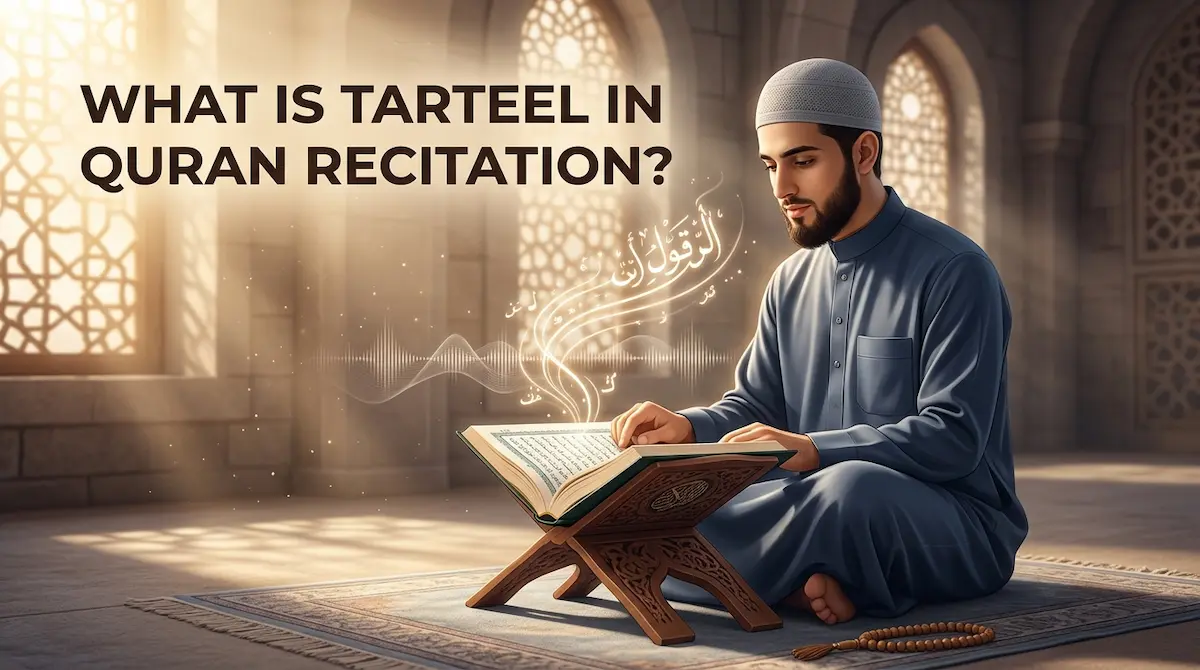
“Tarteel” in Quran recitation means reciting the Quran slowly, clearly, and in a measured rhythmic manner, where every letter is given its proper sound, every pause is observed with care, and the heart is fully present in the act of recitation.
If you have ever heard a skilled reciter and felt something shift inside you, something quiet and deep, that is not just a beautiful voice at work. That is tarteel doing what it was always meant to do.
The Meaning of Tarteel and Where It Comes From
The word tarteel comes from the Arabic root and is commonly understood in reference to the Quran as reciting “in proper order” and “with no haste.” It is not a modern concept that scholars invented. Allah used this word directly in Surah Al-Muzzammil (73:4): “Or add to it, and recite the Quran in slow, measured rhythmic tones.”
This was a direct divine command to the Prophet Muhammad (PBUH). Not a suggestion, not a preference. A command. And the reason is simple: the Quran was not revealed to be rushed through. It was revealed to be lived with.
Tarteel emphasizes proper articulation (makharij) and intonation, allowing the reciter to ponder the meanings of the verses. This method was taught by the Angel Jibreel to the Prophet Muhammad (PBUH) and remains a Sunnah for Muslims worldwide.
So when you practice what tarteel in Quran recitation is, you are not just following a scholarly opinion. You are following a tradition that goes back to Jibreel (AS) himself.
What Hazrat Ali (RA) and Ibn Kathir Said About Tarteel
The companions and scholars of Islam did not leave this concept vague. They explained it with precision.
The fourth Caliph, Ali ibn Abi Talib (RA), said that tarteel means delivering words according to their makharij, the correct outlets and intonation points for each Arabic sound. He emphasized that one should neither recite so fast that it becomes incomprehensible nor so slowly that it loses the listener. His principle was that following the middle path is a virtue.
Ibn Kathir interpreted the Quranic command for tarteel as an instruction to recite slowly and make the letters clear because this is an assistance in understanding and pondering the meaning of the Quran.
Both of these explanations point to the same truth. Tarteel is not about performance. It is about presence.
Tarteel vs Tajweed: They Are Not the Same Thing
This is one of the most common points of confusion among learners, and clearing it up will help you understand both better.
Tarteel means reciting the Quran slowly, clearly, and rhythmically, ensuring every word is pronounced correctly and thoughtfully. Tajweed, on the other hand, is a set of pronunciation rules for reading the Quran correctly. It teaches how each letter should be pronounced, from where it should originate, and how it should sound, helping avoid mistakes that could change the meaning of words.
Think of Tajweed as the grammar of recitation. It gives you the rules. Tarteel is how you apply those rules with the right pace, the right intention, and the right level of reflection.
Tajweed and Tarteel are not contradictory but complementary. Without Tajweed, Tarteel lacks precision. Without Tarteel, Tajweed misses its spiritual depth.
You need both. And the good news is that learning one naturally pushes you toward the other.
There is also a third term that often gets mixed in, and that is Qira’at. Qira’at refers to the different approved methods of recitation passed down through established chains of transmission, such as Hafs an Asim. Tarteel is not a Qira’at. It is a quality of recitation that applies across all Qira’at.
The Core Rules of Tarteel in Quran Recitation
Understanding what tarteel in Quran recitation is requires knowing what its actual rules are. These are not arbitrary guidelines. Each one serves a purpose.
Makharij al-Huruf (Points of Articulation)
“Tarteel” means reciting at a measured pace with correct articulation of every letter from its proper Makhraj (articulation point), along with its full Sifat (attributes). Rushing through recitation without attention to Makharij and Sifat, particularly the distinction between heavy letters (Tafkhim) and light letters (Tarqiq), is one of the most common errors among new students.
Arabic has letters that no other language shares. The letters “ع” (Ayn), “ح” (Ha), “ض” (Dhad), these letters each come from a specific place in the throat or mouth, and mispronouncing even one of them can change the meaning of a word entirely.
Waqf (Proper Pauses and Stops)
Knowing where to pause and stop is crucial in tarteel because stopping in the wrong place can alter the meaning of a verse. Proper Waqf (pauses) and Sakt (silence) allow smooth and meaningful recitation.
This is something many people underestimate until they hear a badly placed pause change the entire meaning of an ayah. Waqf is not optional. It is part of what makes tarteel tarteel.
Madd, Ghunnah, and Qalqalah
Understanding and applying ghunnah (nasal sounds), madd (elongation), and qalqalah (echoing sounds) gives beauty and rhythm to the recitation while preserving its original structure and meaning.
These rules are what give the Quran its distinctive sound. When you hear a reciter elongate a vowel at exactly the right moment or produce that distinct echoing sound on certain letters, you are hearing these rules in action.
Sifat al-Huruf (Letter Characteristics)
Beyond where a letter originates, each letter has qualities that define how it sounds in different positions and combinations. Heavy letters versus light ones, letters that carry breath versus those that do not. Tarteel requires honoring these qualities, not skipping over them.
Why Tarteel Matters Beyond Pronunciation
Here is what separates tarteel from simply reading carefully.
Tarteel recitation allows individuals to engage intellectually and emotionally with the Quran, fostering a profound connection to the divine message and reinforcing its significance in their lives.
When you slow down, something happens. You stop reading the Quran and start reading with it. You notice words you have passed over a hundred times. A verse about patience hits differently when you are not rushing to finish the page.
Listening to the Quran recited with tarteel is a healing for people and a cure for weary hearts. It strengthens faith, and the believers are those whose hearts tremble when Allah is mentioned.
This is not metaphorical language. Many Muslims who have gone through grief, illness, or despair have found that sitting with a reciter who practices tarteel properly brings something that nothing else can. There is a reason the Quran describes itself as a shifa, a healing. Tarteel is the delivery method.
The melodic and rhythmic quality of tarteel recitation enhances the emotional impact of the Quran’s verses, allowing the listener or reciter to experience its spiritual and transformative power. Through careful voice modulation and intonation, reciters can evoke awe, humility, gratitude, and repentance, enabling individuals to connect with the divine message on a deeper level.
Three Styles of Recitation You Should Know
Classical scholars identified three main speeds of recitation, and tarteel sits comfortably among them.
Tahqiq is the slowest style, often used for teaching purposes. Every letter is given its full weight and time. It is ideal for beginners who are still internalizing rules.
Tadwir is the moderate pace, sometimes called the famous tarteel. This style focuses on measured and rhythmic recitation at a slow and deliberate pace, allowing the listener to comprehend and reflect upon the meanings of the verses. It is considered one of the most beautiful and respectful ways of reciting the Quran.
Hadr is the fastest accepted speed. Even at this pace, Tajweed rules must be maintained. But the space for reflection narrows significantly.
Most scholars and reciters consider Tadwir, the measured tarteel pace, to be the ideal balance for daily recitation and listening.
How to Actually Learn and Improve Tarteel
Knowing the theory is one thing. Actually developing tarteel takes consistent, guided practice.
Listening to expert Qaris provides excellent models for proper tarteel. Over time, learners develop an intuitive sense of rhythm and pacing. Rushing through verses is the most common error. Tarteel requires deliberate pacing, not speed. Another common mistake is neglecting proper stops (waqf), which can change a verse’s meaning.
Start with short surahs. Al-Fatiha, Al-Ikhlas, Al-Falaq. Recite them slowly enough that you could stop at any word and explain its pronunciation. Then listen to a reciter like Sheikh Mahmoud Khalil al-Husary or Sheikh Abdul Basit Abdus-Samad, both known for their precise and deeply spiritual tarteel style.
The most important step is finding a qualified teacher with a proper ijazah. Self-study with apps and recordings helps, but the errors that damage meaning are often invisible to the learner until a trained ear catches them.
The Prophet Muhammad (PBUH) said: “The best of you are those who learn the Quran and teach it to others.” This hadith encourages Muslims to not only recite the Quran but also to understand its meanings and pass that knowledge on.
Common Mistakes to Avoid
New people to tarteel often make the same errors. Knowing them in advance saves a lot of frustration.
Reciting too fast is the biggest one. Many Muslims grew up hearing rapid recitation and mistakenly think speed shows mastery. It does not. Mastery is when you can slow down and still keep every rule intact.
Treating tarteel as purely technical is another mistake. If you are focused only on hitting the right sounds but your mind is elsewhere, you are missing the entire point. Reflection is not optional.
Ignoring waqf positions is a silent error. You may not notice you are pausing incorrectly until someone knowledgeable points it out, by which point the habit is already formed.
Start Your Tarteel Journey Today
Understanding what tarteel in Quran recitation is is only the beginning. The real transformation happens when you begin to practice it consistently, under proper guidance, with the intention of drawing closer to Allah.
Whether you are a complete beginner who has never formally studied recitation, or someone who has been reading the Quran for years and wants to go deeper, the path to tarteel is open to you right now.
Our online Quran recitation program teaches tarteel from the ground up, with certified teachers, structured lessons, and individual feedback designed to correct your specific errors, not just general ones. Join thousands of students who have improved their recitation and found a renewed connection with the Quran through focused, expert-guided tarteel practice.
