 Skip to content


If you want to learn beautiful Arabic words with meaning, you are a Muslim looking to understand the words you say every single day, and this guide is exactly what you need. Basic Arabic words every Muslim should know are not complicated vocabulary from a textbook. They are living, breathing expressions that flow through salah, conversations, duas, and daily life. Whether you grew up hearing these words without fully knowing their depth, or you are just beginning your journey with Arabic and Islam, understanding what these words actually mean will change how you experience your faith.
Arabic is not just a language for Arabs. It is the language of the Quran, the language in which Allah (SWT) revealed His final message to humanity, and the tongue in which Prophet Muhammad (peace be upon him) spoke. Every Muslim, regardless of nationality, is connected to this language through salah alone. You cannot perform your five daily prayers without Arabic. That alone tells you how essential these words are. For those who want to deepen this connection, the option to online learn Quran has made it easier than ever to understand Arabic words within their true context.
Why You Should Learn Beautiful Arabic Words With Meaning
Before jumping into the list, it is worth pausing on the “why.” This is exactly why every Muslim should take time to learn beautiful Arabic words with meaning early in their journey. Many Muslims have memorized certain phrases phonetically since childhood but have never truly connected with their meaning. Imagine saying “Alhamdulillah” fifty times a day and only vaguely knowing it means something good. Now imagine knowing it means “All praise belongs to Allah” in its most complete and comprehensive sense. That single shift in understanding transforms a habit into an act of worship.
Islamic scholars throughout history, from Ibn Kathir to Ibn al-Qayyim, emphasized that the heart can only properly engage with worship when the mind understands what the tongue is saying. That is the real reason this knowledge matters. It is not linguistic trivia. It is spiritual fuel.
Learn Beautiful Arabic Words With Meaning: Daily Greetings
Let’s begin to learn beautiful Arabic words with meaning starting with the greetings Muslims use daily.
As-Salamu Alaykum (السَّلَامُ عَلَيْكُمْ)
Translation: Peace be upon you.
This is the greeting of Islam, and it carries far more weight than a casual “hello.” When a Muslim says As-Salamu Alaykum, they are literally invoking peace upon you. The full extended version, As-Salamu Alaykum wa Rahmatullahi wa Barakatuh, adds “and the mercy of Allah and His blessings” to that peace. The Prophet (peace be upon him) described spreading salaam as one of the actions that increases love between Muslims. It is a full sentence of goodwill packed into a single greeting. The reply, Wa Alaykum As-Salam, should match or exceed the warmth of the original greeting. This is a perfect example of why it helps to learn beautiful Arabic words with meaning rather than just repeating sounds.
Jazakallahu Khayran (جَزَاكَ اللَّهُ خَيْرًا)
Translation: May Allah reward you with goodness.
This is the Islamic way of saying thank you, but it goes far beyond gratitude. When you say Jazakallahu Khayran, you are essentially leaving the recompense to Allah, acknowledging that no human reward can fully repay a favor. The appropriate reply is Wa Iyyakum, meaning “and to you as well.” This phrase is rooted in a hadith where the Prophet (peace be upon him) said it is the highest form of praise one can offer another person. Phrases like this show exactly how powerful it is to learn beautiful Arabic words with meaning behind them.
Barakallahu Feek (بَارَكَ اللَّهُ فِيكَ)
Translation: May Allah bless you.
Used to express appreciation or as a warm response to someone who has done something kind for you. You will hear this phrase constantly in Muslim households and Islamic gatherings. It is a natural verbal dua you make for someone in real time.
Learn Beautiful Arabic Words With Meaning: Dhikr and Praise
These remembrance phrases are some of the most important words to learn beautiful Arabic words with meaning attached. These are among the most important basic Arabic words every Muslim should know because they are mentioned in the Quran and Sunnah repeatedly, and their rewards are enormous.
Bismillah (بِسْمِ اللَّهِ)
Translation: In the name of Allah.
This is the gateway phrase of Islam. Muslims say Bismillah before eating, drinking, beginning any task, entering a home, starting to read, driving, cooking, or doing virtually anything with intention. The full phrase is Bismillahir Rahmanir Rahim, meaning “In the name of Allah, the Most Gracious, the Most Merciful.” This phrase opens 113 of the 114 surahs of the Quran. Simply saying it before any action invites divine blessing into that moment.
Alhamdulillah (الْحَمْدُ لِلَّهِ)
Translation: All praise and thanks are for Allah.
One of the four phrases the Prophet (peace be upon him) said fill the scale of good deeds on the Day of Judgment, Alhamdulillah is the Muslim response to every situation, good or difficult. After a meal, after waking up from sleep, when someone asks how you are, after a sneeze, after completing any task. It is a declaration that no matter what the circumstances look like, all gratitude belongs to Allah alone. This is one more reason to learn beautiful Arabic words with meaning that carry such spiritual weight.
SubhanAllah (سُبْحَانَ اللَّهِ)
Translation: Glory be to Allah / Allah is free from all imperfection.
Said when you witness something beautiful, something astonishing, or when you want to exalt Allah above any flaw or weakness. SubhanAllah is also a core component of tasbih, the repetitive remembrance of Allah. After each salah, Muslims are encouraged to say SubhanAllah 33 times as part of their post-prayer adhkar. Understanding moments like these helps you discover the beauty of Arabic words and their meaning that go far beyond translation.
Allahu Akbar (اللَّهُ أَكْبَرُ)
Translation: Allah is the Greatest.
This phrase is called the Takbir. It opens every unit of prayer. It is called out from minarets in the adhan five times a day. Muslims say it when they feel overwhelmed, when they witness something magnificent, or when they want to remind themselves that no problem, no fear, and no worldly concern is greater than Allah. In our current world, where this phrase has been misrepresented in media coverage, it is more important than ever for Muslims to reclaim its true meaning and say it with pride. This is why Muslims everywhere continue to seek out and learn beautiful Arabic words with meaning instead of saying them by habit alone.
La ilaha illallah (لَا إِلَهَ إِلَّا اللَّهُ)
Translation: There is no god worthy of worship except Allah.
This is the first half of the Shahadah, the declaration of faith that every Muslim must believe in their heart and say with their tongue. It is the statement of Tawhid, the absolute oneness of Allah. Scholars describe this as the most weighty and valuable statement in all of creation. Saying it with genuine understanding and conviction is an act of worship with no equal.
MashaAllah (مَا شَاءَ اللَّهُ)
Translation: Whatever Allah has willed (has come to pass).
Muslims say MashaAllah when they see something beautiful, admirable, or impressive. A newborn baby, a piece of good news, someone’s achievement. It serves as both praise and a protection against the evil eye, acknowledging that everything good comes from Allah’s will. It is also an expression that reminds both speaker and listener not to become arrogant about blessings.
Inshallah (إِنْ شَاءَ اللَّهُ)
Translation: If Allah wills.
Perhaps the most recognized Arabic phrase in the world, Inshallah, is said whenever making a plan or referring to something in the future. It comes directly from the Quran. In Surah Al-Kahf, Allah instructed the Prophet (peace be upon him) never to say he would do something tomorrow without adding Inshallah. It is a reminder that human beings do not control the future. Only Allah does.

Learn Beautiful Arabic Words With Meaning: Forgiveness and Repentance
It is equally important to learn beautiful Arabic words with meaning related to seeking forgiveness.
Astaghfirullah (أَسْتَغْفِرُ اللَّهَ)
Translation: I seek forgiveness from Allah.
No Muslim will ever go through a day without needing this one. Astaghfirullah is said after making a mistake, after a moment of heedlessness, after waking from sleep (as the night might have carried sins we are unaware of), and simply as a consistent habit of seeking closeness to Allah. The Prophet (peace be upon him) used to seek forgiveness more than 70 times a day. That alone tells you how central this word is, not just as a remedy for sin but as a lifestyle of humility. This is a powerful example of why every believer should take the time to understand beautiful Arabic words and their meaning tied to repentance.
Tawbah (تَوْبَة)
Translation: Repentance.
Tawbah is more than just saying sorry. In Islamic understanding, true tawbah involves feeling genuine remorse, stopping the sin, making a firm intention not to return to it, and restoring any rights you may have violated against others. Allah says in the Quran that He loves those who make tawbah and those who purify themselves. It is one of the most loving concepts in all of Islamic theology.
Learn Beautiful Arabic Words With Meaning: Words Every Muslim Encounters in Salah
As you continue to learn beautiful Arabic words with meaning, the words used in salah deserve special attention.
Ameen (آمِين)
Translation: O Allah, accept (our supplication) / So be it.
Said at the end of Surah Al-Fatiha during prayer and at the conclusion of any dua. Ameen is the seal of a supplication, the verbal signal that you mean what you just asked for. In congregation, when the imam says Ameen aloud, the entire row of worshippers says it together. There is a hadith that says when the Ameen of the worshippers coincides with the Ameen of the angels, all past sins are forgiven.
Rabb (رَبّ)
Translation: Lord / Sustainer / Cherisher.
Rabb is one of the most frequently occurring names in the Quran. Al-Fatiha itself begins with Alhamdulillahi Rabbil Alamin, meaning “All praise is for Allah, the Lord of all the worlds.” Rabb conveys the idea of a Lord who not only created but continually nurtures, sustains, and looks after His creation. It is a deeply personal name. When you call upon your Rabb in dua, you are addressing the One who raised you, fed you, and knows every detail of your existence.
Salah (صَلَاة)
Translation: Prayer / The ritual prayer performed five times daily.
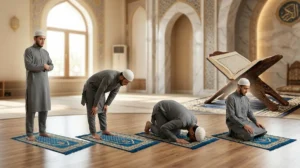
Salah is one of the Five Pillars of Islam. It is the direct connection between a Muslim and Allah, established five times every day. The Arabic word salah comes from a root that means connection. It is not merely religious exercise. It is communication.
Sujood (سُجُود)
Translation: Prostration.
The act of placing your forehead on the ground before Allah. Islamic scholars describe sujood as the moment a person is physically and spiritually closest to Allah. In salah, the position of complete submission is when the highest part of the body, the forehead, is placed on the lowest point, the ground. There is a profound spiritual lesson in that physical act. Moments like sujood show why it matters so much to learn beautiful Arabic words with meaning behind every act of worship.
Words Related to Islamic Faith and Belief (Aqeedah)
Faith-related vocabulary is essential when you learn beautiful Arabic words with meaning rooted in belief.
Iman (إِيمَان)
Translation: Faith / Belief.
Iman in Islamic theology is not merely intellectual agreement with a set of facts. It encompasses belief in the heart, declaration with the tongue, and action with the limbs. The six pillars of Iman are belief in Allah, His angels, His revealed books, His messengers, the Last Day, and divine decree. A Muslim who understands this word understands one of the most foundational concepts in their religion.
Tawakkul (تَوَكُّل)
Translation: Reliance upon Allah / Putting your trust in Allah.
Tawakkul is often misunderstood as passivity, as if it means doing nothing and waiting for Allah to act. In reality, tawakkul means doing everything within your capacity and then placing the outcome entirely in Allah’s hands. The Prophet (peace be upon him) told a Bedouin to tie his camel first, then put his trust in Allah. Action plus surrender. That is tawakkul. This concept alone proves why it is worth the effort to learn beautiful Arabic words with meaning like this one.
Sabr (صَبْر)
Translation: Patience / Perseverance.
Sabr appears in the Quran over 90 times in various forms. It is one of the most celebrated virtues in Islam. But sabr is not passive silence. It is an active, conscious choice to remain steadfast and not to act in ways that displease Allah when things are difficult. Allah promises in the Quran that He is with those who have sabr. That promise alone makes this word one of the most important in the vocabulary of a believer. Words like this remind us why Muslims continue to seek beautiful Arabic words and their meaning throughout their lives.
Shukr (شُكْر)
Translation: Gratitude.
Paired almost universally with sabr, shukr is the Islamic virtue of thankfulness. Allah says in the Quran, in Surah Ibrahim, that if you are grateful, He will increase His blessings upon you. Shukr is expressed through words like Alhamdulillah, through acts of worship, through using blessings in ways that please Allah, and through a mindset that recognizes all good as coming from Him.
Halal (حَلَال) and Haram (حَرَام)
Translation: Permissible and Forbidden.
These two words define the boundaries of Islamic life. Halal refers to what Allah has permitted. Haram refers to what He has forbidden. While most people associate these terms with food, they apply equally to financial transactions, relationships, speech, and behavior. A Muslim who understands these two words as theological concepts rather than mere labels is a Muslim who is actively engaging with the guidance of their religion.
Words for Community and Brotherhood
Let’s also learn beautiful Arabic words with meaning related to community and brotherhood.
Ummah (أُمَّة)
Translation: Community / Nation of believers.
The ummah refers to the global community of Muslims, transcending race, language, nationality, and culture. There are approximately 1.8 billion Muslims in the world today. Every single one of them is part of the same ummah. Understanding this word is understanding that Islam is not a private religion but a community-based way of life.
Dua (دُعَاء)
Translation: Supplication / Personal prayer to Allah.
Dua is the most direct and intimate form of communication a Muslim can have with Allah. Unlike salah, which follows a set format, dua is personal, unscripted, and can be made in any language at any time. The Prophet (peace be upon him) called dua “the essence of worship.” A Muslim who makes dua frequently is a Muslim who recognizes their own dependence on Allah and their trust in His generosity. This is one more reason to learn beautiful Arabic words with meaning connected to personal worship.
Khair (خَيْر)
Translation: Goodness / Good.
You will hear this constantly in Arabic-speaking communities. Kullu khair means “everything is good.” Inshallah khair means “I hope for good.” Jazakallahu Khayran includes it. It is one of those simple words that pops up everywhere and adds warmth to any conversation.
Words Related to the Quran and Knowledge
It is just as valuable to learn beautiful Arabic words with meaning tied directly to the Quran.
Ayah (آيَة)
Translation: Verse / Sign.
The Quran is made up of 6,236 ayat (plural of ayah). But the word itself means more than just “verse.” It also means a sign or evidence. Every verse of the Quran is, by name, a sign pointing to the truth of Allah. Every natural phenomenon is also described in the Quran as an ayah. Sunsets, rainstorms, the human body, the rotation of the earth. They are all ayat.
Surah (سُورَة)
Translation: Chapter of the Quran.
The Quran contains 114 surahs. Each has its own name, its own context of revelation, and its own lessons. When a Muslim says “Surah Al-Fatiha” or “Surah Al-Baqarah,” they are referring to specific chapters. Knowing the word surah is as basic as knowing the word chapter in any other context.
Hadith (حَدِيث)
Translation: A saying or report.
In Islamic scholarship, hadith refers specifically to the recorded sayings, actions, and approvals of the Prophet Muhammad (peace be upon him). The hadith literature, preserved through chains of narration by scholars like Imam Bukhari and Imam Muslim, forms one of the two primary sources of Islamic guidance alongside the Quran.
Ilm (عِلْم)
Translation: Knowledge.
The very first word revealed to the Prophet Muhammad (peace be upon him) was Iqra, meaning “read” or “recite.” The pursuit of ilm is made obligatory in Islam for every Muslim, male and female. The Prophet said that seeking knowledge is an obligation upon every Muslim. Ilm is not just religious knowledge. Islamic civilization historically embraced all forms of knowledge, from astronomy to medicine to mathematics, as extensions of understanding Allah’s creation. This is exactly the kind of depth you gain when you learn beautiful Arabic words with meaning instead of memorizing sounds.
A Few More Words You Will Hear Often
Here are a few more essential words as you continue to learn beautiful Arabic words with meaning.
Rahma (رَحْمَة) means: mercy.
Two of Allah’s most often repeated names, Ar-Rahman and Ar-Rahim, are both rooted in this word. The concept of divine mercy is central to how Muslims understand their relationship with God.
Niyyah (نِيَّة) means intention. The Prophet (peace be upon him) said that actions are judged by their intentions. Before prayer, before fasting, before any act of worship, a Muslim makes niyyah. It is the interior dimension of every outward action.
Zakat (زَكَاة) means purification and refers to obligatory almsgiving, one of the Five Pillars of Islam. It is the financial act of giving a defined portion of your wealth to those in need, purifying the remainder.
Sawm (صَوْم) means fasting and refers specifically to the Ramadan fast, another of the Five Pillars. Muslims fast from Fajr (dawn) to Maghrib (sunset), abstaining from food, drink, and intimate relations as an act of worship.
Hajj (حَجّ) is the annual pilgrimage to Makkah, the fifth pillar of Islam, obligatory once in a lifetime for those who have the physical and financial means.
How to Learn Beautiful Arabic Words With Meaning Effectively
Now that you have started to learn beautiful Arabic words with meaning, here is how to make it stick. Reading a list is a starting point, not a finish line. The best way to internalize these words is to use them consistently in your daily life. Say Bismillah before you eat tomorrow. Say Alhamdulillah when you finish. Say Astaghfirullah when you catch yourself falling short. Let these words become your reflexes rather than your recitations.
Many Muslims find that keeping a small journal of Arabic words and reviewing them weekly helps with retention. Others prefer listening to the Quran with a translation open so they can begin connecting the sounds they have heard their whole lives with actual meaning. Apps, online Islamic institutes, and local masjid classes can also accelerate this journey significantly. The most effective way to truly grasp beautiful Arabic words and their meaning is to use them daily, not just read them once.
The deeper goal is not to become an Arabic linguist. It is to understand what you are saying when you stand before Allah five times a day and in every moment of your daily life. That understanding is the bridge between going through the motions and truly worshipping with your whole heart.
Final Thought
To learn beautiful Arabic words with meaning is to transform habit into worship. The basic Arabic words every Muslim should know are not exotic or difficult. Most of them, you already say. The transformation comes when the meaning lives in you, not just the sound. Start with the words in this list. Say them with awareness. Teach them to your children. And over time, you will find that Arabic is not a foreign language at all. It is the language your soul already recognizes. Start today, and continue to discover and learn beautiful Arabic words with meaning every single day of your life.
