 Skip to content



Becoming Muslim is one of the most profound decisions a person can make. But for many new Muslims and reverts to Islam, the next step, actually connecting with the Quran, can feel overwhelming. Where do you begin? Do you read in Arabic or English first? Do you memorize before you understand? Do you need a teacher?
The honest answer is you do not need to learn everything at once. The Quran was revealed gradually over 23 years, and your relationship with it is also meant to grow gradually, with patience and consistency.
This beginner’s guide to the Quran for new Muslims gives you a clear, honest, and practical starting point. You will learn what the Quran is, how to approach it as a complete beginner, what mistakes to avoid, and how to build a daily Quran learning habit that actually lasts.
Enroll in a Free Trial Class Today, No Commitment
Quick Answer: What Should a New Muslim Know About the Quran?
The Quran is the literal word of Allah, revealed to the Prophet Muhammad (peace be upon him) in Arabic over 23 years. It contains 114 Surahs (chapters) and covers guidance on faith, worship, ethics, law, and the purpose of human life.
For new Muslims, the best starting point is reading the Quran in a trusted English translation to build understanding first. You do not need to memorize in Arabic before you understand what you are reading. Begin with short Surahs at the end of the Quran; they are brief, powerful, and easy to connect with. Enroll in beginner Quran classes with a qualified teacher to learn basic Arabic pronunciation and Tajweed gradually. Consistency matters far more than speed. Even ten minutes of daily Quran reading with reflection will build a meaningful connection over time.
Understanding What the Quran Really Is
Before opening the Quran, every new Muslim benefits from understanding what this Book actually is — because it is unlike anything else in human experience.
The Quran as Divine Guidance
The Quran is not a biography of the Prophet Muhammad (peace be upon him), nor is it a history book. It is the direct word of Allah preserved in its original Arabic language for over 1,400 years without a single letter of change. Muslims believe the Quran is the final and complete guidance for all of humanity, for all times.
The word “Quran” itself means “that which is recited,” reflecting that this Book was always meant to be read, heard, and internalized, not simply studied as a historical text.
How the Quran Differs from Other Books
Unlike any other religious or literary text, the Quran holds a living presence in Muslim daily life. It is recited in every prayer, five times a day. Its verses are spoken at births, marriages, and funerals. It is memorized in its entirety by millions of Muslims worldwide, children and adults alike, in a language many of them do not speak natively.
The Quran addresses the human heart directly. Readers, even those encountering it for the first time, often describe an immediate emotional response to its words, even before fully understanding their meaning.
Why Every Muslim Builds a Relationship With the Quran
Islam is not a passive faith. Muslims are called to engage with the Quran actively to read it, reflect on it, and allow it to shape their character and decisions. For new Muslims, especially, building a personal relationship with the Quran is the foundation of everything else: prayer, understanding of Islam, and spiritual growth all grow from this connection.
Where Should Beginners Start Reading the Quran?
This is the most common question in every beginner Quran learning guide — and the answer is simpler than most people expect.
Start With Translation Before Complexity
Do not begin with the first chapter of the Quran numerically and try to work through it like a novel. Instead, start with the final Juz (section 30) of the Quran the shortest Surahs are. These chapters, including Surah Al-Fatiha, Surah Al-Ikhlas, Surah Al-Falaq, and Surah An-Nas, are brief, deeply meaningful, and form the foundation of daily Islamic prayer.
Read them first in English translation. Understand what they mean. Then begin learning their Arabic recitation with a teacher.
Choose a Trusted Translation for Beginners
For English-speaking new Muslims, the following translations are widely recommended for clarity and accuracy:
- The Clear Quran by Dr. Mustafa Khattab, modern, readable English
- Sahih International is precise and widely used in academic and learning settings
- The Study Quran, edited by Seyyed Hossein Nasr, includes Tafseer notes ideal for deeper understanding
Avoid translations that use archaic language in your early stages. You want understanding to come easily so that engagement remains consistent.
Focus on Understanding Before Memorization
A very common mistake among new Muslims learning the Quran is prioritizing Quran memorization over comprehension. While memorization is a beautiful goal, understanding what you are reciting builds a far deeper connection to the Quran. Read with translation first. Reflect on the meaning. Then work on Arabic recitation and Tajweed with a qualified teacher.
A Simple Step-by-Step beginner’s guide to the Quran for new Muslims:
Here is a clear, beginner-friendly roadmap to help new Muslims starting their Quran journey with this beginner’s guide to the Quran for new Muslims:
Step 1: Read the Quran in Translation: Start with a trusted English translation. Read short Surahs from Juz 30 first. Focus entirely on meaning and reflection before worrying about Arabic.
Step 2: Learn the Arabic Alphabet: The Arabic alphabet has 28 letters. Learning to recognize and pronounce them is the gateway to reading the Quran in its original language. This can be achieved in a few weeks with a qualified Quran teacher or through a structured beginner Quran course.
Step 3: Begin with Noorani Qaida: The Noorani Qaida is the most widely used beginner framework for learning Quranic Arabic pronunciation. It takes students from the alphabet through basic letter combinations, vowel sounds, and foundational Tajweed step by step.
Step 4: Start Reading Simple Surahs in Arabic: Once you can sound out Arabic letters correctly, begin reading short Surahs with your teacher’s guidance. Surah Al-Fatiha is the ideal first Surah to recite correctly in Arabic, as it is recited in every unit of prayer.
Step 5: Build a Daily Quran Reading Habit: Even five to ten minutes of daily Quran engagement reading, listening, or reflecting is more valuable than occasional intensive sessions. Consistency is the single most important factor in Quran learning for beginners.
How to Read the Quran as a Beginner
Learning how to read the Quran as a beginner involves four progressive stages. Do not try to rush through them; each stage builds the foundation for the next.
Learning the Arabic Alphabet
The Arabic alphabet is the essential first step. It consists of 28 letters, each with up to four different forms depending on its position in a word. A qualified Quran teacher will guide you through recognition, pronunciation, and basic letter joining within a few weeks of consistent practice.
Basic Pronunciation and Vowel Sounds
Arabic pronunciation is phonetic; every letter has a consistent sound. Once you learn the letters, you add short and long vowel sounds (Harakaat), the small markings above and below letters in the Quran that tell you how each word is pronounced. The Quran includes full vowel markings, making it easier to read than most Arabic texts.
Introduction to Tajweed
Tajweed refers to the set of rules governing correct Quranic recitation, including proper pronunciation of each letter, elongation of certain sounds, and rules for connecting words. You do not need to master Tajweed before you begin reading. Learn the basics gradually alongside your recitation practice. Even basic Tajweed awareness immediately improves the quality and beauty of your recitation.
Building Consistency in Your Quran Reading Habit
Set a specific time each day for Quran reading, even if it is only five minutes. Many learners find that reading after Fajr (the dawn prayer) or before sleeping creates a lasting habit. Track your progress weekly. Celebrate small milestones. A consistent beginner will always outpace an inconsistent advanced student.
The Most Common Mistakes New Muslims Make When Learning the Quran
Awareness of these mistakes can save you months of frustration and keep your Quran learning journey on track.
- Trying to learn everything at once: Tajweed, memorization, Arabic grammar, and Tafsir simultaneously is overwhelming. Focus on one area at a time
- Ignoring translation: Reciting words you do not understand limits your emotional and spiritual connection to the Quran
- Learning without a teacher: Apps and videos are useful supplements, but cannot replace the personalized correction and guidance of a qualified Quran teacher
- Focusing only on memorization: Hifz is a noble goal, but not the starting point for most new Muslims. Understanding comes first
- Inconsistency: Studying intensively for one week and then stopping for two weeks is one of the most common reasons beginners stop progressing
- Comparing your progress to others: Every Quran learning journey is personal. Your pace is the right pace for you
Get Started. Your First Class Is Completely Free
How Much Quran Should a Beginner Read Daily?
There is no single correct answer, but there is a practical framework that works for most new Muslim learners.
| Daily Time | What to Cover | Suitable For |
| 5 Minutes | One short Surah with translation and reflection | Complete beginners, very busy schedules |
| 10 Minutes | Two short Surahs or one page of translation with notes | Early-stage learners building a habit |
| 15 Minutes | Recitation practice plus translation reading | Students with a basic Quran teacher |
| 30 Minutes | Structured lesson including Tajweed, recitation, and Tafsir | Enrolled students in a beginner Quran course |
Start at whatever level is genuinely sustainable for your current life. Five consistent minutes every day for one year will transform your relationship with the Quran more than thirty inconsistent minutes whenever you find the motivation.
Understanding the Quran Without Feeling Overwhelmed
Many new Muslims open the Quran expecting it to read like a book beginning to end, chapter by chapter, building toward a conclusion. The Quran does not work that way, and understanding this removes a great deal of early frustration.
Read With Translation First
Always have a translation open alongside the Arabic text. Understanding what you are reading is not optional; it is essential for building a real connection. Read slowly. Let the meaning settle. Do not rush to finish pages.
Use Reliable Tafsir for Deeper Understanding
Tafsir is the scholarly explanation and interpretation of Quranic verses, providing historical context, linguistic insight, and practical guidance. For beginners, two accessible Tafsir resources are widely recommended: Tafsir Ibn Kathir (available free online in English) and In the Shade of the Quran by Sayyid Qutb. Use Tafsir to go deeper on verses that move you, not as a requirement for every verse from the start.
Take Notes as You Read
Keep a small journal alongside your Quran reading. Write down verses that resonate with you, questions you want to ask your teacher, and lessons you want to remember. This practice transforms passive reading into active learning.
Focus on Lessons, Not Volume
The Prophet Muhammad (peace be upon him) said that some companions would not move to the next ten verses until they had understood and applied what they had already learned. Quality of engagement always outweighs quantity of pages covered. Read less. Reflect more.
Helpful Resources for New Muslims Learning the Quran
Building the right support system makes your Quran learning journey significantly more effective and sustainable.
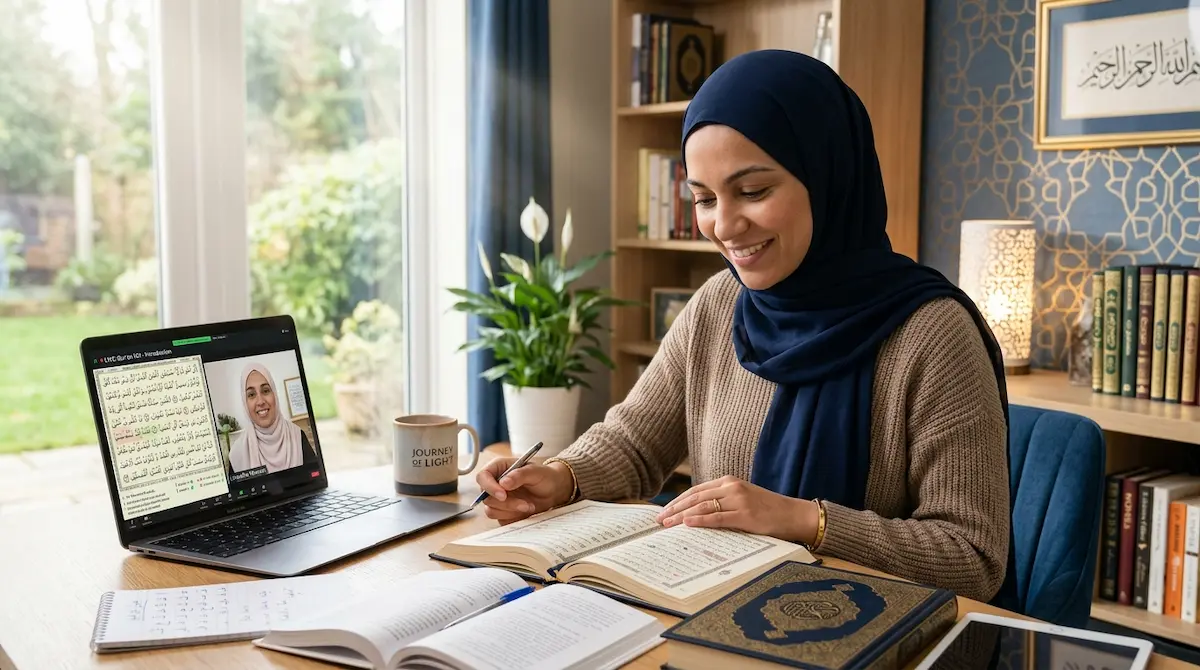
A Qualified Quran Teacher. This is the single most valuable resource for any beginner. A qualified teacher corrects your pronunciation in real time, structures your learning progression, answers your questions, and keeps you accountable. Online Quran academies now make one-on-one access to certified teachers available from anywhere in the world.
Online Quran Classes for Beginners: Structured online Quran classes designed for new Muslims and adult learners provide curriculum, consistency, and qualified instruction in a flexible format. Look for academies that offer free trial classes, certified teachers, and courses specifically designed for non-Arabic speakers.
Beginner-Friendly Apps: Apps such as Quran.com, Muslim Pro, and Tarteel (for Tajweed correction) are excellent daily companions for listening, reading, and practicing, but they work best as supplements to structured teacher-led learning, not replacements.
Translation and Tafsir Resources: Keep a physical or digital copy of a trusted translation. Quran.com provides multiple translations and basic Tafsir notes in one place, free of charge.
New Muslim Learning Communities: Many mosques and Islamic centers offer dedicated new Muslim support groups and beginner Quran study circles. Online communities through platforms like SeekersGuidance also provide structured Islamic learning for beginners at no cost.
Frequently Asked Questions About Learning the Quran as a New Muslim
What is the best Quran translation for beginners in English?
The Clear Quran by Dr. Mustafa Khattab is widely recommended for new Muslims because it uses modern, natural English while maintaining accuracy. Sahih International is another trusted option used in Islamic educational institutions worldwide. Both are available free online at Quran.com. For beginners, the most important quality in a translation is clarity. Choose the one that feels most natural to read.
Should new Muslims read the Quran in English first?
Yes, for most new Muslims, reading in English first is the most effective approach. Understanding the meaning of the Quran builds an emotional and spiritual connection that motivates continued learning. You can and should learn Arabic recitation alongside your English reading, but do not delay understanding while waiting for language proficiency.
Can adults learn the Quran completely from scratch?
Absolutely. Adults learn the Quran from scratch every day, including people who reverted to Islam in their thirties, forties, and beyond. Adult learners often progress faster than children because they bring greater focus, motivation, and life experience to their learning. A qualified Quran teacher who works with adult beginners will adapt the pace and method entirely to your needs.
How long does it take to learn to read the Quran in Arabic?
With consistent daily practice and a qualified teacher, most adult beginners can learn to read basic Quranic Arabic within three to six months. Full fluency in recitation with proper Tajweed typically takes one to two years of regular study. Every learner’s timeline is different; consistency is always more important than speed.
Do new Muslims need a teacher to learn the Quran?
While apps and videos can supplement learning, a qualified teacher is strongly recommended, especially in the early stages. A teacher corrects pronunciation errors that, if uncorrected, become deeply ingrained habits. A teacher also provides structure, accountability, and answers to the questions that inevitably arise during Quran study for beginners. Online Quran academies make qualified, one-on-one instruction accessible from any location in the world.
