 Skip to content




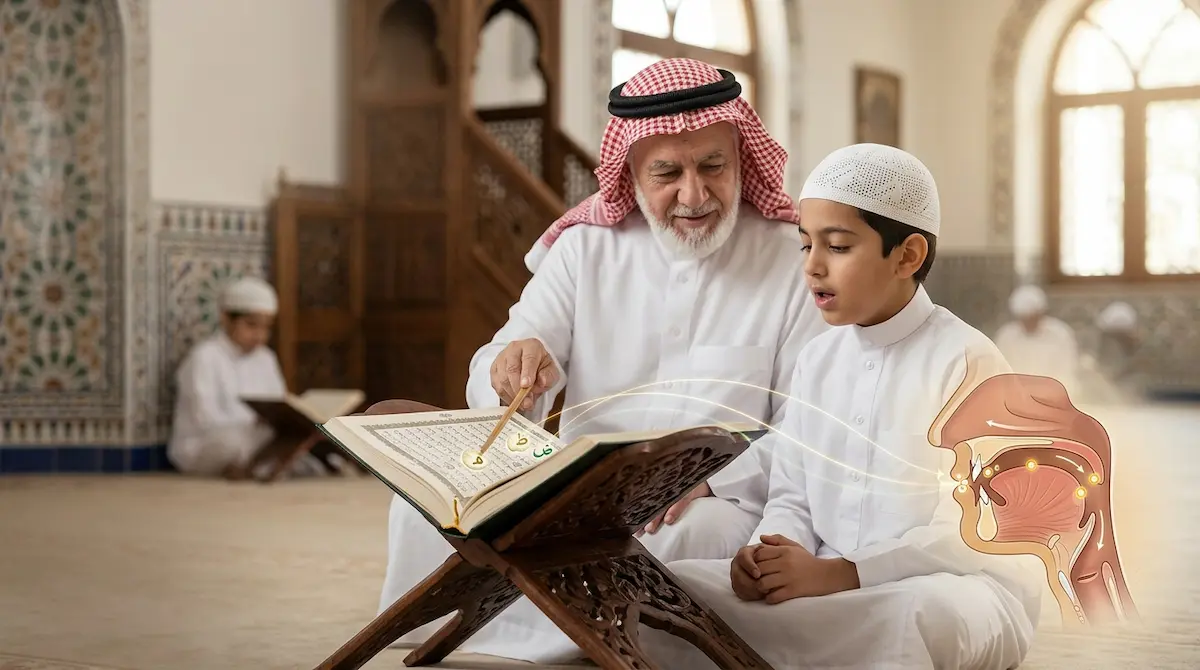
Importance of Tajweed in Quran Recitation begins with understanding one of the most essential foundations of Quranic reading: Tajweed Makharij. Before learning Ghunnah, Madd, or any other Tajweed rule, every Muslim must first know where each Arabic letter originates in the mouth, throat, or nasal passage. These points of articulation are known as Makharij, and they play a crucial role in ensuring accurate Quran recitation. Without proper Makharij, letters can be pronounced incorrectly, changing the sound and potentially affecting the meaning of Quranic words.
This highlights the Importance of Tajweed in Quran Recitation, as correct pronunciation is the key to preserving the beauty, accuracy, and authenticity of Allah’s words. Once Makharij are mastered, learning and applying other Tajweed rules becomes much easier, leading to more confident and precise Quran recitation.
Understanding the Word: What Does Makharij Actually Mean?
The word Makharij (مَخَارِج) is the plural of Makhraj (مَخْرَج), derived from the Arabic root “Kh-Ra-Ja” (خ ر ج), which means “to exit” or “to come out.” Al-Huruf (الحروف) means “the letters.” Put them together and Makharij al-Huruf literally means “the exit points of the letters,” the precise physical locations from which each Arabic letter emerges during speech.
When scholars say a letter has a specific Makhraj, they are identifying the exact spot where airflow stops, narrows, vibrates, or is shaped to produce that sound and no other. Shift even slightly from that spot, and you no longer have the same letter. In Arabic, that shift can be the difference between entirely different words.
This is why Imam Ibn Al-Jazari, one of the greatest scholars in the history of Quranic sciences, made Makharij the cornerstone of his foundational Tajweed text Al-Muqaddimah Al-Jazariyyah. He understood that a reciter who has mastered articulation points has mastered the bedrock of everything else.
Why Tajweed Makharij Highlights the Importance of Tajweed in Quran Recitation
When learners search for “Tajweed Makharij,” they are usually asking one of three things:
What are these articulation points exactly? Where do specific letters come from? And does any of this actually matter in practice?
The Importance of Tajweed in Quran Recitation becomes even clearer when we understand the role of Makharij. Tajweed Makharij is not merely academic knowledge preserved by scholars; it is the foundation upon which every correct Quran recitation is built. Every Tajweed rule, every interaction between letters, and every pause or elongation depends on the accurate pronunciation of letters from their proper points of articulation. Just as a house cannot remain strong without a solid foundation, a recitation cannot be truly correct without mastering Makharij. This is why the Importance of Tajweed in Quran Recitation cannot be overstated without proper Makharij, even a strong understanding of other Tajweed rules may not be enough to ensure accurate and beautiful recitation of the Quran.
The 5 Main Regions of Makharij al-Huruf
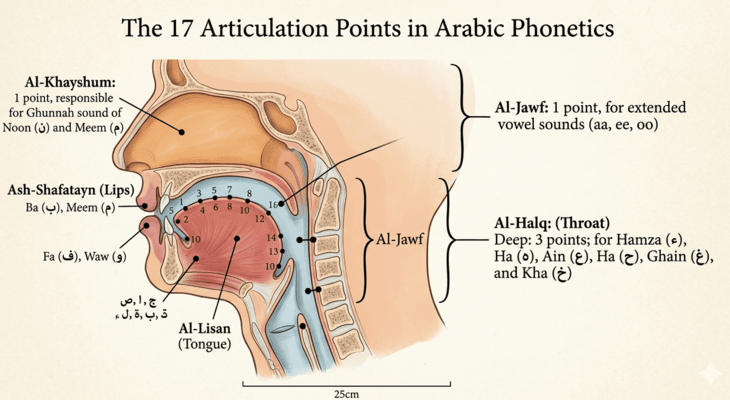
Scholars have organized the 17 detailed articulation points under 5 main regional areas of the vocal tract. Understanding these five regions first gives you the mental map before you zoom into specifics.
1. Al-Jawf (الجوف): The Open Cavity
Al-Jawf refers to the empty, open space inside the mouth and throat, where no physical contact point exists. Sound here resonates freely without the tongue, lips, or throat walls creating obstruction. The long vowel sounds, specifically the prolonged Alif, Waw, and Ya produced during Madd, originate from this open cavity. These are the letters of air and space, and they exist at a different level from all other letters precisely because their articulation requires openness rather than contact.
2. Al-Halq (الحلق): The Throat
The throat region contains three distinct articulation levels, and six Arabic letters originate here. Scholars further divide Al-Halq into three depths:
The deepest part of the throat produces Hamza (ء) and Ha (ه). These are the softest and most airy of the throat letters, emerging from the very base of the pharynx.
The middle section of the throat produces Ain (ع) and Ha (ح). These require controlled muscular tension in the mid-throat, producing a sound that has no real equivalent in English or most other languages, which is why non-native Arabic learners often struggle with them the most.
The upper part of the throat, closer to the base of the tongue, produces Ghain (غ) and Kha (خ). These letters carry a distinctive guttural quality, a slight friction or “rolling” that comes from the back of the throat near where it meets the tongue.
3. Al-Lisan (اللسان): The Tongue
The tongue is the most complex and productive of all the articulation regions. It is responsible for the majority of Arabic letters, with 18 letters originating from various positions across the tongue’s surface. This is also why the tongue is the most difficult region to master for non-Arabic speakers.
Different areas of the tongue interact with different parts of the mouth roof (palate), the upper teeth, the tooth ridges, and even the throat to produce distinct letters. For example, Qaaf (ق) originates from the back of the tongue pressing against the soft palate. Kaaf (ك) comes from a point slightly further forward on the tongue. This small shift is what distinguishes “Qaal” meaning “he said” from “Kaal” meaning “he measured.” Two entirely different words, separated by a few millimeters of tongue position.
Further along the tongue, letters like Lam (ل), Nun (ن), and Ra (ر) come from the tip and front edges of the tongue, interacting with the hard palate or the front teeth ridge. Then the tip and sides of the tongue produce letters like Seen (س), Saad (ص), Zay (ز), Sheen (ش), and others, each from a subtly different position.
This is why Tajweed teachers emphasize the tongue above all else. Mastering Al-Lisan requires patient, deliberate physical practice, often with a mirror, to feel and see where each sound is actually being formed.
4. Ash-Shafatayn (الشفتان): The Two Lips
Four Arabic letters emerge primarily from lip movement. Ba (ب) requires both lips to press firmly together before releasing, creating a brief stop. Meem (م) also requires both lips to close, but with a nasal quality added through the Khayshum. Waw (و) rounds the lips and pushes them slightly forward. Fa (ف) presses the upper teeth against the inner surface of the lower lip.
These lip letters are generally among the easier ones for beginners to master, since the physical action is visible and easy to feel. The challenge comes in distinguishing Ba from Meem when they appear in proximity, and in applying the correct degree of lip pressure and rounding for Waw.
5. Al-Khayshum (الخيشوم): The Nasal Passage
The nasal cavity is responsible for a specific quality of sound called Ghunnah, the nasal resonance that appears in specific Tajweed contexts involving Noon (ن) and Meem (م). No single letter exclusively originates from the nasal passage, but the Ghunnah quality that certain rules require must flow through it. Without engaging the nasal passage during these moments, the Ghunnah is absent, and the recitation is technically incorrect.
The 17 Detailed Makharij: A Breakdown
Within those five main regions, Tajweed scholars have identified 17 precise articulation points. Here they are organized by region:
From Al-Jawf: 1 point, producing the extended vowel sounds.
From Al-Halq (Throat): 3 points covering the deep, middle, and upper throat, producing Hamza, Ha, Ain, Ha, Ghain, and Kha.
From Al-Lisan (Tongue): 10 points across different positions of the tongue’s root, back, middle, side edges, tip, and lower surface, covering 18 letters in total.
From Ash-Shafatayn (Lips): 2 points covering Ba and Meem together with one point, and Fa and Waw with a second point.
From Al-Khayshum (Nasal Passage): 1 point is responsible for the Ghunnah quality of Noon and Meem in specific contexts.
This totals 17 articulation points across five main regions, covering all 29 Arabic letters and the Ghunnah sound.
Why Tajweed Makharij Matters: The Real Consequences of Getting It Wrong
Meaning Changes with Articulation
Arabic is a language where a single letter substitution can fundamentally alter a word’s meaning. This is exactly why the Importance of Tajweed in Quran Recitation becomes so clear when Tajweed Makharij is ignored. When Makharij are not properly observed, these substitutions happen unconsciously and repeatedly, affecting every Salah, every recitation, and every time the Quran is read.
Consider the letters Ain (ع) and Alif (ا). They sound superficially similar to an untrained ear. Ain comes from the middle of the throat with muscular tension. Alif is a pure, open vowel. In Surah Al-Fatiha, the word “An’amta” contains an Ain. Replacing that Ain with a plain Alif produces a phonetically different word. This is a Lahn Jali, a clear error, and it occurs in the most recited chapter of the Quran.
Similarly, confusing Ha (ح) with Ha (ه) changes words throughout the Quran. The letter Daad (ض), which has a unique makhraj with no equivalent in any spoken dialect of modern Arabic, is among the most commonly mispronounced letters globally. Many Arabic speakers from Egypt, the Levant, and even the Gulf recite it differently from its classical Tajweed makhraj. For Quranic recitation, the classical articulation must be followed regardless of dialectal habits.
Salah Validity Is at Stake
Every Muslim recites Surah Al-Fatiha a minimum of seventeen times daily. If the Fatiha contains systematic Makharij errors that change letters or meanings, scholars have discussed the impact on Salah’s validity. This alone is sufficient reason to take Makharij seriously. It is not just about beauty or precision as an ideal. It goes to the heart of whether your worship is being performed correctly.
You cannot Hear Your Own Errors Without Training
The cruel irony of Makharij errors is that most reciters cannot detect them in themselves. You hear what you intend to say, not necessarily what your mouth produces. This is why a qualified teacher is essential, not optional. A trained ear can immediately hear when Qaaf is coming out as Kaaf, when Ain is being replaced by Alif, or when the Daad has drifted into a Dhal sound. You cannot consistently self-diagnose what your ear has never been trained to notice.
Makharij and Sifaat: Two Pillars of the Same Science
Makharij cannot be fully understood in isolation. It works together with Sifaat al-Huruf, the characteristics of letters. Where Makharij answers the question “from where does this letter come?”, Sifaat answers “how does this letter behave?”
For example, the letter Seen (س) and the letter Saad (ص) originate from very similar points on the tongue near the front teeth. Their Makhraj is almost identical. What distinguishes them are their Sifaat: Saad has the quality of Itbaq (closing or elevation of the tongue toward the palate), giving it a heavy, emphatic quality. Seen has Infitah (openness), giving it a lighter, cleaner sound.
If you only mastered Makharij without Sifaat, you would still confuse these letters. Both sciences together give you complete control over every Arabic letter. This is precisely why the study of Tajweed is structured the way it is, with Makharij as the foundation and Sifaat built directly on top of it.
Common Makharij Mistakes and How They Happen
Understanding where errors come from is half the battle of fixing them.
Throat letters are mispronounced as plain vowels. Ain (ع) and Gain (غ) are the most common victims here. English speakers and Urdu speakers alike often produce a plain glottal sound instead of the proper mid-throat tension required for these letters. Years of recitation without correction can deeply embed this habit.
Qaaf and Kaaf confusion. Both letters come from the back of the tongue, just millimeters apart on the soft palate. Without specific attention to the difference in tongue position, they blur together. This error appears in words throughout the Quran.
Daad mispronounced as Dhal or a retroflex D. Daad (ض) has the most unique articulation point in Arabic, produced from the side edge of the tongue against the upper back molars. It is heavy, full, and rich in sound. Dialects across the Arab world pronounce it differently, and this dialectal habit bleeds into recitation. Correcting Daad is a consistent focus in advanced Tajweed study.
Tha (ث), Seen (س), and Sheen (ش) confusion. These three letters are all produced near the front of the mouth with the tongue, but from different precise points and with different airflow characteristics. Non-native speakers frequently merge them into a single sibilant sound.
Nasal passage not engaged for Ghunnah. When Noon or Meem with Shaddah appear, or when Noon Saakinah precedes certain letters, the Khayshum must actively contribute to the sound. Many reciters produce these sounds entirely through the mouth, eliminating the required nasal resonance.
How to Learn Makharij al-Huruf: A Practical Approach
Find a Qualified Teacher First
This is not optional advice. The physical nature of Makharij means it must be heard and corrected in real time. The Importance of Tajweed in Quran Recitation becomes clear here, as online classes with certified Tajweed teachers offer the same practical feedback as in-person study, helping learners correct their Makharij accurately and consistently.
Look for teachers with an Ijazah in Quranic recitation, which certifies that they themselves received their Tajweed through a verified chain of transmission.
Begin with the Five Regions
Do not try to memorize all 17 articulation points simultaneously. Start by understanding which region each letter family belongs to: throat, tongue, lips, nasal, or open cavity. This regional map gives you a working framework. Once you have that, narrow down to individual points within each region.
Use a Mirror
Place a mirror in front of you while practicing. Observe your tongue position, lip movement, and jaw opening. For throat letters especially, pay attention to the muscular tension you can feel, even if you cannot see it directly. Some teachers also recommend placing a hand gently on the throat to feel vibration or tension during certain letters.
Use the Verification Method
Scholars recommend two methods to identify a letter’s Makhraj. First, pronounce the letter as a consonant with a Sukoon after an initial Hamza and Fatha, for example, “Ah-B” for Ba, and note where the sound is cut off. That cutoff point is the Makhraj. Second, stretch the letter with a Fatha, Kasra, or Dammah and notice where the sound originates before it flows into the vowel. Both methods help make the articulation point physically conscious.
Listen Repeatedly to Master Qaris
Sheikh Mahmoud Khalil Al-Hussary’s Muallim recordings remain among the finest learning tools ever produced for Tajweed students. His deliberate, clear recitation was specifically designed for teaching. Sheikh Minshawi and Sheikh Abdul Basit Abd us-Samad model Makharij with exceptional clarity as well. Repeated listening, with active attention to specific letters, trains your ear to recognize correct articulation before your tongue can reliably reproduce it.
Start with Noorani Qaida
If you are building from the ground up, Noorani Qaida is the most widely used and proven system for teaching Arabic letters with their correct Makharij from the very beginning. It moves through the alphabet systematically, introducing articulation concepts before adding vowels, combinations, and eventually Tajweed rules. Children and adults alike benefit from starting here if their foundational pronunciation is uncertain.
Practice in Salah, Not Just in Study Sessions
Whatever letters you work on in a practice session, apply them immediately in your next prayer. This context matters enormously. The pressure and focus of Salah sharpen your attention to each word, and embedding correct Makharij into your Salah recitation converts it from a studied effort into a natural habit faster than any other method.
Makharij and the Quran’s Preservation
There is a larger dimension to Makharij that places it within the grand history of how the Quran has been transmitted across fourteen centuries.
The Quran is unique among all books in human history in that it has been preserved not primarily through writing but through living, oral recitation. Generation after generation of Muslims memorized the Quran and passed it on through the chain of Isnad, teacher to student, going all the way back to the Prophet Muhammad (peace be upon him) himself. The rules of Makharij were embedded in that living chain.
When a student today receives an Ijazah after mastering Tajweed and memorizing the Quran, they receive it through a named chain of teachers that can be traced back through centuries to the Companions of the Prophet and then to the Prophet himself. That chain is what guarantees the pronunciation you produce today matches what was revealed in the cave of Hira.
Makharij is not just a technical skill. It is a link in a sacred chain of transmission that has never been broken.
The Spiritual Return on Mastering Makharij
Everything in this article has a practical, linguistic dimension. But it also carries a spiritual weight that cannot be separated from it.
The Prophet Muhammad (peace be upon him) said: “The one who recites the Quran proficiently will be with the noble, righteous, and obedient angels.” (Agreed upon by Bukhari and Muslim). The word used for proficiency in this Hadith directly points to correct, mastered recitation. Tajweed Makharij is what makes that proficiency possible at the letter level.
Every single letter in the Quran, according to another Hadith, carries ten rewards. But the letter must be the correct letter. A Ba recited from its proper Makhraj, with its lips fully closing, with its correct characteristics, is Ba. A sound approximating Ba from an uncertain position is something less certain. Tajweed Makharij is how you ensure that what you recite is what you intend to recite.
Conclusion: Makharij Is Where Tajweed Begins and Where Recitation Becomes Correct
Tajweed Makharij is not an advanced topic reserved for Huffaz and Quranic scholars. It is the starting point for every Muslim who wants to recite the words of Allah as they were revealed. Without correct articulation points, every other aspect of Tajweed floats on an unstable base. With them, recitation becomes accurate, meaningful, and genuinely connected to the original divine transmission.
Start with the five regions. Find a teacher who can hear you and correct you in real time. Use a mirror. Listen to the masters. And commit to the understanding that every letter of the Quran has an address, and reciting it correctly means going to that address, every single time.
That is what Tajweed Makharij is. And that is precisely why it matters.
