 Skip to content




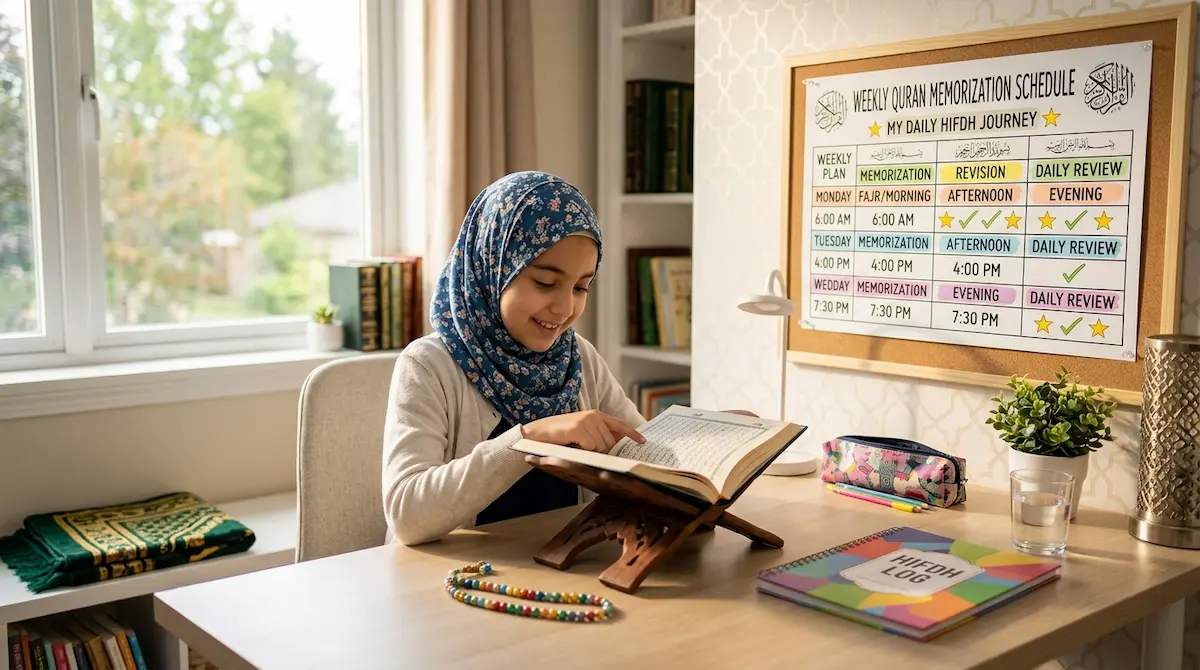
A Quran memorization schedule for kids daily is the single most important tool a parent can give their child on the path to becoming a Hafiz or Hafiza. Without a clear, realistic daily routine, even the most motivated child will lose momentum within weeks. This guide will walk you through age-specific schedules, proven techniques, revision systems, and practical tips that actually work in a real household.
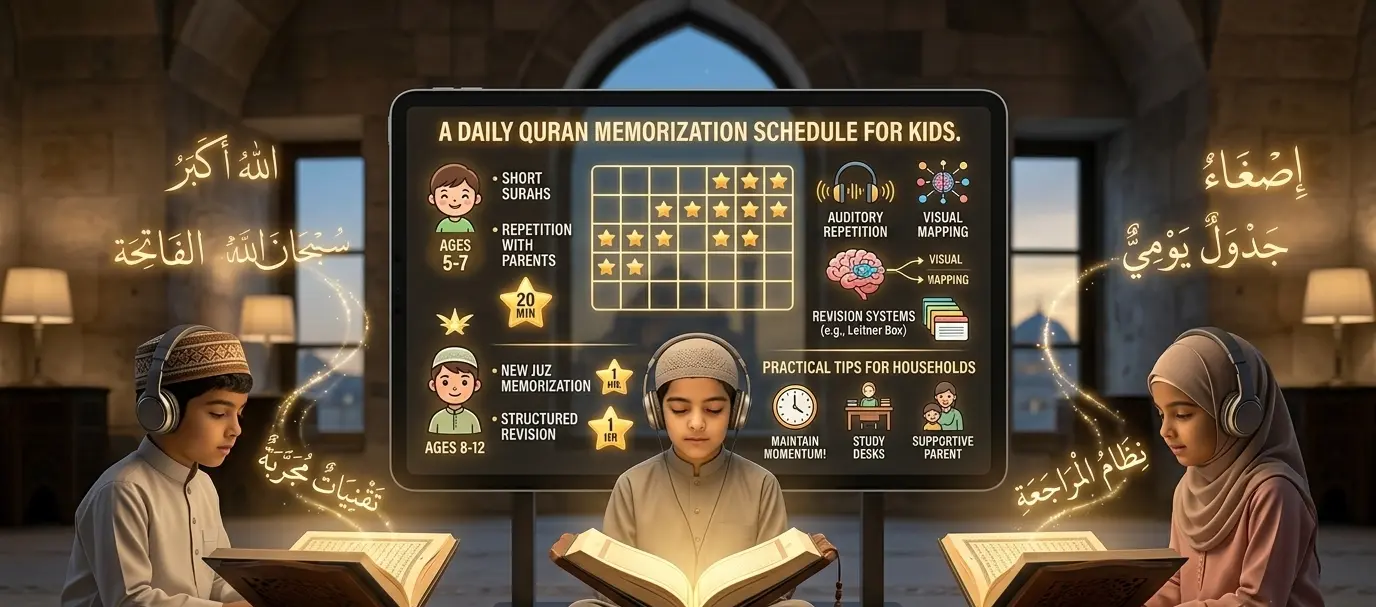
Why Does a Quran Memorization Schedule for Kids Daily Matter?
Most parents make one critical mistake: they rely on their child’s excitement to carry the memorization journey forward. Excitement fades. A structured daily routine does not.
Relying on motivation alone is a recipe for failure. Motivation is an emotion, and emotions fluctuate. What you actually need is a system that works even when your child is tired, busy, or frustrated.
A Quran memorization schedule for kids works daily because it trains the brain through habit. When a child sits down at the same time every day to recite and review, the brain begins to treat it as a non-negotiable part of life, just like eating or sleeping. Over time, the resistance disappears.
Twenty minutes of daily engagement trains neural pathways far more effectively than four hours once a week. This is not just Islamic wisdom; it is how memory actually works.
When Should Kids Start Memorizing the Quran?
The best time to begin Quran memorization for children is typically between the ages of 4 and 6. At this stage, children are more receptive to learning and can easily absorb Quranic verses.
That said, exposure can and should begin much earlier. Exposure to Quranic recitation can begin from infancy, playing with recitation during daily routines, and familiarizing a baby with the sounds of the Quran before they can speak. Structured memorization with a systematic method is appropriate from around age 4 to 5.
Many scholars agree that children should begin learning how to read the Quran around the age of 7, as this is when most children have developed the necessary cognitive and linguistic skills to begin learning and understanding the Quranic text.
The key takeaway: there is no single “right” age. Start with listening and short surahs early, and transition to structured hifz when the child is ready.
The Core Pillars of Any Effective Daily Hifz Plan
Before looking at specific schedules, understand the three building blocks that every strong daily hifz plan is built around.

New Memorization (Sabaq Jadid): This is the fresh portion your child learns each session. It should always happen when the mind is sharpest, which for most children is in the morning after Fajr.
Recent Review (Sabaq): This is a daily review of what was memorized in the last few days. Many children memorize beautifully but forget within a week because they skip this step. Recent review is what moves material from short-term to long-term memory.
Older Review (Manzil): This is a rotation through everything memorized so far. A proven strategy for long-term retention is dividing the Quran into seven sections (Manazil) and reviewing one section daily to complete a full cycle every week.
Allocate roughly 70 percent of hifz time to revision and 30 percent to new memorization. Retention is the true goal.
Daily Quran Memorization Schedule for Kids by Age Group
Ages 4 to 7 — Building the Foundation
Children in this age group have remarkable listening and imitation abilities, but their attention spans are short. The goal here is not speed; it is consistency and enjoyment.
Recommended daily time: 15 minutes
For ages 5 to 7, a daily session of 15 minutes works well: 5 minutes of listening to a recitation, 5 minutes on new words or a few ayahs, and 5 minutes of review. On the weekly level, Saturday can be used for a full revision of half a page, while Sunday can be reserved as a family recitation circle.
Suggested Surahs to begin with:
For ages 3 to 5, focus on short surahs with strong rhythmic patterns: Al-Fatiha, Al-Ikhlas, Al-Falaq, and An-Nas. These surahs are used in daily Salah, which means the child naturally reinforces them five times a day without any extra effort.
Practical tips for this age:
Keep sessions playful. Use hand gestures, repetition games, and praise freely. Never scold a child of this age for forgetting. The emotional association with the Quran at this stage will shape their relationship with it for the rest of their life.
Ages 8 to 10 — Building Real Momentum
Children in this range can handle more structured sessions. They understand the concept of goals and can begin to take partial ownership of their own memorization.
Recommended daily time: 20 to 25 minutes
For ages 8 to 10, a daily session of 20 to 25 minutes works well: 10 minutes on new lines, 10 minutes on revision, and 5 minutes on Tajweed practice. During the week, a midweek test of one page and a Friday review session led by the father during congregational recitation can reinforce progress. Aim for one page per week, adjusting for holidays.
At this stage, introduce the child to their own hifz journal. Let them check off completed ayahs, track their pages, and feel the satisfaction of visible progress. Children who see their own growth are far more likely to stay committed.
Morning routine structure:
After Fajr prayer, sit with your child for 10 minutes of new memorization. In the afternoon after school, spend 10 to 15 minutes on revision. Make it non-negotiable but never punishing. A short snack and a five-minute break before the afternoon session can significantly reduce resistance.
Ages 11 to 13 — The Serious Phase
Preteens are capable of meaningful, sustained Hifz work. They understand purpose, and if the spiritual dimension is nurtured alongside the memorization, this age group can make extraordinary progress.
Recommended daily time: 30 minutes
For ages 11 to 13, a daily session of 30 minutes is appropriate: 15 minutes on new material, 10 minutes reviewing older portions, and 5 minutes discussing the meaning of what was memorized. Two 45-minute sessions per week with a qualified Quran teacher, combined with group family hifz to celebrate milestones, provide excellent structure for this age group.
At this level, introduce basic Tafsir alongside memorization. When children learn the meanings through basic Tafsir, they connect emotionally with the Quran and memorize faster. Understanding why a surah was revealed, or what a particular ayah means, transforms rote repetition into something deeply personal.
A Sample Daily Quran Memorization Timetable for School-Going Kids
Here is a practical timetable that works within a typical school week:
6:00 AM — After Fajr (10 to 15 minutes)
New memorization. The mind is clearest at this hour, free from the distractions of the day. Recite the new ayat slowly, focusing on correct pronunciation and Tajweed. Repeat each ayah 15 to 20 times before moving to the next.
2:30 PM — After School Rest (10 to 15 minutes)
Give the child a snack, let them rest for 15 minutes, and then do hifz before they get distracted by toys or screens. Use this afternoon slot for a recent review, going over what was memorized that morning and the day before.
8:00 PM — After Maghrib or Isha (10 minutes)
An evening session after Maghrib or Isha is ideal for verse recital practice. The child recites what they memorized during the day from memory, without any prompts. This final check locks the material in place before sleep.
Sundays — Weekly Revision Day
No new material. Spend 20 to 30 minutes reviewing everything memorized in the past week. This is also a good day for family recitation, where parents recite alongside children, which multiplies both retention and motivation.
How to Choose the Right Number of Ayahs Per Day
One of the most common reasons children lose confidence in their hifz journey is being given too much too soon. Many learners start with unrealistic goals and then quit due to pressure. Starting small with 2 verses a day and building up gradually is the right approach.
A good rule of thumb:
For a child aged 5 to 7, begin with 1 to 3 short ayahs per day. For a child aged 8 to 10, 3 to 5 ayahs per day is sustainable. For a child aged 11 and above, 5 to 10 ayahs per day is achievable with strong revision habits in place.
Never sacrifice quality for quantity. A child who has memorized 5 ayahs with perfect Tajweed and deep retention is far ahead of a child who has “memorized” 20 ayahs they will forget by Thursday.
The Revision System: How to Make Sure Kids Never Forget
Memorization without revision is like filling a bucket with holes. The most common complaint from parents is, “My child memorized the surah last month, but now cannot recite it properly.” This is almost always a revision problem, not a memory problem.
Use the technique of alternating review: one day, revise recent surahs; the next day, revise older surahs. By following this structured approach, you not only add new verses daily but also protect older ones from slipping away.
A simple revision system for kids:
Day 1 to 3: Review the current week’s new memorization daily.
Day 4 to 7: Review the previous two weeks’ material at least twice.
Weekly: Review one complete juz or a substantial older section of memorized material.
Monthly: Do a full sweep of everything memorized to that point, ideally in one sitting or across two days.
Implement a systematic review schedule: review yesterday’s ayahs before today’s new material, revise last week’s surahs once per week, and conduct a monthly review of everything memorized to date.
The Role of Tajweed in Children’s Memorization
Tajweed is not a separate subject to be learned after memorization. It is the foundation on which correct memorization is built. A child who memorizes with incorrect pronunciation will need to unmemorize and re-memorize later, which is far harder than getting it right from the beginning.
Mastering pronunciation before attempting to memorize is one of the five most effective strategies for children’s Quran memorization. Rules like Ikhfa, Idgham, Ghunna, and Madd are not complicated when taught gradually alongside memorization during the early years.
Encourage your child to listen to a trusted Qari, such as Sheikh Mahmoud Khalil Al-Hussary or Sheikh Abdul Basit Abd us-Samad, whose recitations are widely used for hifz purposes, and to imitate the pronunciation precisely before any new portion is memorized.
How Parents Can Support the Daily Hifz Routine
The most powerful thing a parent can do is recite along with their child, even imperfectly. When a child sees their parent making an effort to learn the same surahs they are memorizing, the motivation and family bonding are immeasurable.
Beyond reciting together, here are practical ways parents can support the daily schedule:
Create a dedicated Hifz corner in the home. A clean, quiet space associated only with the Quran and learning removes distractions and signals to the child’s brain that it is time to focus.
Track progress visibly. A simple chart on the wall where the child can color in each surah they complete provides tangible motivation. Children respond powerfully to seeing their own progress.
Celebrate milestones. When a child completes a juz, acknowledge it. A small celebration, a special dua as a family, or even a handwritten certificate goes a long way in reinforcing the child’s identity as a learner of the Quran.
Reduce screen time around hifz sessions. Devices activate the reward system in the brain in a way that makes slower, quieter activities like memorization feel dull by comparison. Keeping the hour before and after hifz sessions free of screens preserves the child’s focus and willingness.
Common Mistakes to Avoid in a Kids’ Daily Quran Schedule
Setting too ambitious a daily target. Children who are pushed beyond their comfort zone begin to associate the Quran with stress. This emotional association can last for years. Always err on the side of less and consistent rather than more and sporadic.
Skipping revision on busy days. Even on days with tests, sports events, or family commitments, five minutes of revision should happen. Consistency is key, and even on rest days from new lessons, revisions should continue.
Switching teachers or methods too frequently. Every time a child adapts to a new teacher’s style or method, progress slows. Stability in a hifz teacher during the foundational years is extremely important.
Neglecting the spiritual dimension. Hifz is ultimately an act of worship, not an academic achievement. Regularly remind your child of the rewards of memorizing the Quran, the elevated status of a Hafiz in Islam, and the honor it brings to the entire family on the Day of Judgment. Children who understand why they are memorizing are far more resilient during difficult phases.
Online Quran Hifz Classes as a Support Tool
For families where a qualified in-person Quran teacher is not available, online hifz programs have become an excellent alternative. Online Quran academies offer one-on-one sessions with experienced tutors tailored to each child’s pace and progress, along with interactive learning tools and specialized Hifz programs designed to guide children through the memorization process with a focus on memorization, revision, and Quranic recitation practice.
Online classes work particularly well when combined with the daily home schedule described in this guide. The teacher handles correction and progression, while parents reinforce the routine at home. This partnership between a qualified teacher and an involved parent is the most effective model for children’s hifz in the modern world.
FAQs
What is the best age to start a Quran memorization schedule for kids?
There is no single right age. Exposure to Quranic recitation can begin from infancy, while structured memorization with a systematic method is appropriate from around age 4 to 5. Many scholars agree that learning to read the Quran typically begins around age 7, once a child has developed the necessary cognitive and linguistic skills.
How many ayahs should a child memorize per day?
The right number depends on age. For children aged 5 to 7, 1 to 3 short ayahs per day is realistic. For ages 8 to 10, 3 to 5 ayahs per day is sustainable, and for ages 11 and above, 5 to 10 ayahs per day is achievable with strong revision habits in place. Quality and retention always matter more than quantity.
How much time should kids spend on Quran memorization each day?
This varies by age group. Children aged 4 to 7 do well with around 15 minutes daily; ages 8 to 10 benefit from 20 to 25 minutes; and ages 11 to 13 can handle about 30 minutes of structured daily practice, split between new memorization, revision, and Tajweed.
How can parents make sure their child doesn’t forget what they’ve memorized?
Consistent revision is the key. A simple system works well: Review the current week’s new memorization daily, revise the previous two weeks’ material at least twice, go over a full juz or older section weekly, and conduct a complete review of everything memorized so far on a monthly basis.
Are online Quran classes effective for helping kids memorize the Quran?
Yes, especially when a qualified in-person teacher isn’t available. Online Quran academies offer one-on-one sessions tailored to a child’s pace, paired with structured Hifz programs. This works best when combined with a consistent daily routine at home, where the teacher handles correction and progression while parents reinforce practice.
Final Thoughts
A Quran memorization schedule for kids, daily, does not need to be complex to be effective. What it needs to be is consistent, age-appropriate, revision-heavy, and emotionally positive. Start small, protect the joy of the journey, and trust the process.
Every step in this journey earns a reward for both the child and the parent. With love, patience, and proper guidance, your child can grow into a confident, lifelong reciter of Allah’s Book.
The greatest gift you can give your child is not just memorized words but a living, breathing daily relationship with the Quran. That relationship, built one ayah at a time, will be their companion in this world and their light in the next. Through online Quran classes online, families can strengthen this lifelong connection with qualified guidance. Contact us today to begin your learning journey.
