 Skip to content

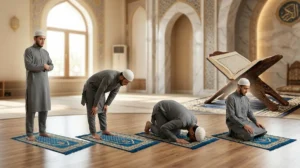



A Hafiz is someone who has completely memorized the entire Quran, while a Qari is a specialist trained to recite the Quran with perfect Tajweed, correct pronunciation, and proper rhythmic flow. Understanding the Difference between Hafiz and Qari Explained helps clarify these two highly respected roles in Islam, as they represent distinct paths in Quranic learning and devotion.
If you’ve ever sat in a masjid during Taraweeh and wondered whether the person leading the prayer is a Hafiz, a Qari, or both, you’re not alone. These two terms are used constantly in Muslim households, Islamic schools, and online Quran programs, yet their actual meanings often get blurred together. Parents enrolling their children in Hifz programs, students beginning their Tajweed journey, and even regular mosque-goers frequently use these titles interchangeably. That’s a mistake worth correcting, because each title comes with its own training, responsibilities, and spiritual weight.
Who Is a Hafiz? The Guardian of the Divine Word
The word Hafiz (حافظ) comes from the Arabic root hafaza, meaning “to preserve” or “to guard against forgetting.” In Islamic tradition, a Hafiz is a person who has committed all 114 Surahs and all 6,236 verses of the Quran to memorise every single word, from Surah Al-Fatiha to Surah An-Nas.
This is not a casual achievement. The Quran spans 604 pages, 30 Juz’, and roughly 77,000 words in classical Arabic. A student pursuing Hifz (Quran memorization) typically spends anywhere from two to seven years in a structured Hifz program, waking before Fajr, memorizing new verses (sabaq), revising recent lessons (sabqi), and constantly reviewing older portions (manzil) to make sure nothing is forgotten.
The title “Hafiz” is an honorific given to someone who has successfully committed all 114 chapters and verses of the Quran to memory, and those who achieve it are highly respected in Muslim communities for their dedication to preserving the sacred text.
The plural form of Hafiz is Huffaz, and throughout Islamic history, the Huffaz have played a critical role in the preservation of the Quran. Long before the printing press existed, it was living human memory that kept the Divine word intact across generations.
Important clarification:
Being a Hafiz does not automatically make someone a master of Tajweed. A student can memorize all 30 Juz’ with imprecise pronunciation, but memorization alone does not guarantee precise recitation if Tajweed training was incomplete. This is a point many families miss when enrolling their children in Hifz-only programs.
Who Is a Qari? The Master of Quranic Recitation
The word Qari (قَارِئ), sometimes spelled Qaari or Qurra, comes from the Arabic verb qara’a (قَرَأَ), meaning “to read” or “to recite.” But a Qari is far more than someone who can simply read Arabic.
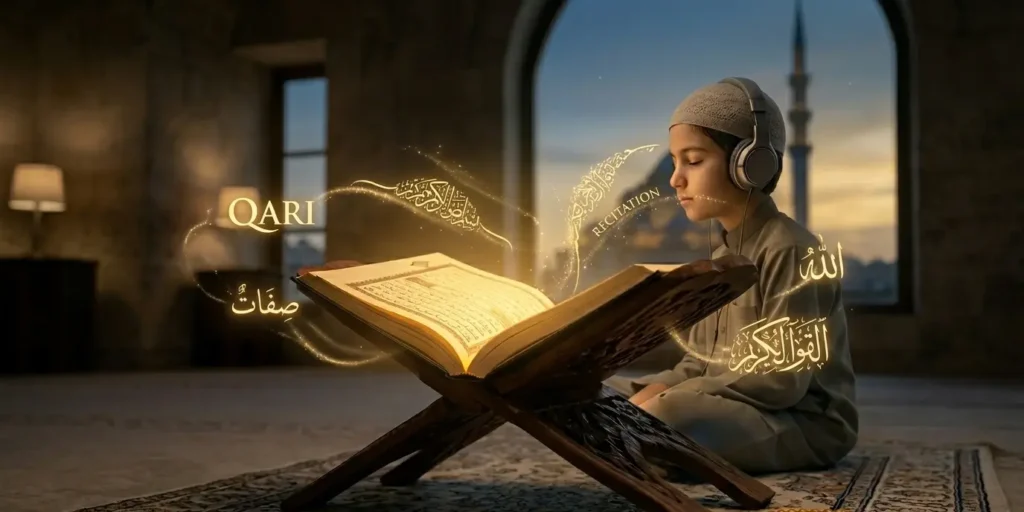
A Qari is a trained specialist whose recitation embodies centuries of preserved oral transmission, applying the complete science of Tajweed during every recitation, not occasionally, but as a disciplined, consistent practice.
A Qari’s training revolves around three core pillars:
Makharij al-Huruf: The precise articulation points of every Arabic letter. There are 17 articulation points in the mouth and throat, and a trained Qari knows exactly where each letter originates.
Tajweed Rules: governing elongations (madd), nasal sounds (ghunna), merging (idgham), and stopping points (waqf). These rules aren’t optional decorations; they are obligatory for correct recitation.
Melodic Recitation (Maqamat): The musical modes used by master Qaris. Many advanced Qaris are also trained in Maqam Bayati, Maqam Hijaz, and other classical Arabic melodic scales that give Quranic recitation its soul-stirring quality.
Qaris are recognized for their captivating recitations that have a profound influence on listeners worldwide, though many who are primarily known for their recitation skills are, in fact, Hafiz as well. Think of legendary names like Sheikh Abdul Basit Abd us-Samad, Sheikh Mahmoud Khalil Al-Hussary, and Sheikh Mishary Rashid Alafasy, all of whom were both Huffaz and master Qaris.
The Core Difference Between Hafiz and Qari Explained
Here is the clearest way to understand it:
Hafiz answers the question: “How much of the Quran do you know?”
A Qari answers the question: “How well do you recite the Quran?”
One role focuses on how the Quran is recited; the other focuses on how much of the Quran is memorized. Understanding this difference helps students choose the right path and set realistic expectations early.
1. The Nature of Their Training
A Qari trains primarily in the science of recitation. Their practice is auditory and phonetic, correcting the tongue’s movement, controlling breath, mastering elongation lengths, and developing voice quality. A good Qari may spend years under a certified teacher (muqri’) before receiving an Ijazah, a formal certificate of authorized recitation with an unbroken chain (sanad) going back to the Prophet Muhammad ﷺ.
A Hafiz, on the other hand, trains the mind. Their days are structured around tikrar (repetition), consistent revision cycles, and the immense mental discipline required to retain the equivalent of a small book entirely from memory. The path to becoming a Hafiz is called the Hifz journey, and it demands emotional resilience as much as cognitive stamina.
2. Tajweed Mastery: A Key Dividing Line
This is where the difference between Hafiz and Qari becomes most practically important. A Qari is required to have a thorough understanding of Tajweed, whereas a Hafiz who has memorized the Quran may not necessarily possess advanced proficiency in these rules.
This doesn’t mean every Hafiz recites poorly. Many Hifz programs do incorporate Tajweed. But the depth of Tajweed knowledge expected from a trained Qari, including understanding the theoretical principles behind each rule, not just applying them by habit, is on a different level. A Qari can explain why a nun sakinah merges into a lam; a Hafiz may apply that rule correctly without being able to articulate the scholarly reasoning behind it.
3. Their Roles in the Muslim Community
Both a Hafiz and a Qari serve the community, but in different capacities.
The Hafiz is the community’s living safeguard of the Quran. Taraweeh contains great significance for the Huffaz; it brings a glorious opportunity for those who have memorized the Quran to revise all the chapters and participate in leading the congregation, completing the entire Quran from memory within one month of Ramadan. Beyond Ramadan, a Hafiz is preferred as an Imam for regular prayers, as referenced in Islamic jurisprudence, the one who has memorized more of the Quran has priority in leading the prayer.
The Qari is the community’s voice of proper recitation. Qaris are called upon during Islamic events, Quran competitions, and Qirat ceremonies. They teach Tajweed classes, correct students’ pronunciation, and set the standard for how the Quran should sound. A Qari is also the one typically invited to recite Tilawat at formal occasions, weddings, Quran Khwani gatherings, and national events in Muslim-majority countries.
4. The Question of Status and Reward
Both roles carry immense spiritual reward, but Islamic scholars have noted distinctions based on hadith.
The Prophet Muhammad ﷺ said: “The one who is proficient in the recitation of the Quran will be with the honourable and obedient scribes (angels), and he who recites the Quran and finds it difficult, stuttering and struggling over it, will have two rewards.” (Sahih Muslim 798)
Meanwhile, for the Huffaz, the Prophet ﷺ is reported to have said that the Hafiz will be crowned with a crown of light on the Day of Judgment, and his parents will be given garments of honor. These are among the most motivating narrations in all of Islamic tradition.
In appointing an Imam, a Hafiz is generally considered to have priority, based on a hadith narrated by Abi Sa’eed Khudri from the Messenger of Allah ﷺ. However, if a Qari who has memorized more Tajweed-perfect Quran is present, scholars note the preference becomes more nuanced.
5. Can One Person Be Both?
Absolutely and ideally, every serious student of the Quran should aim for both. A Qari who has also memorized the Quran recites with a quality of presence and fluency that a non-memorizer cannot fully replicate, because Hifz forces every rule of Tajweed to become automatic when the text is fully internalized.
Some people become both a Qari and a Hafiz, while others focus on only one path, but each path needs effort, patience, and a clear plan. The greatest Quranic reciters in Islamic history, Sheikh Abdul Basit, Sheikh Al-Hussary, and Sheikh Minshawi, were all Huffaz who had also mastered the art of recitation to its highest level.
Many online Quran academies now structure their programs to pursue both simultaneously, pairing Hifz classes with live Tajweed correction sessions, which educators widely consider the most efficient approach for long-term retention and authentic recitation quality.
Hafiz vs Qari A Clear Comparison
| Hafiz | Qari | |
| Primary Focus | Memorization of the full Quran | Recitation with perfect Tajweed |
| Core Skill | Memory, revision, retention | Pronunciation, phonetics, melody |
| Tajweed Depth | Basic to intermediate (varies) | Advanced, scholarly mastery |
| Community Role | Leads Taraweeh, serves as Imam | Teaches Tajweed, recites at events |
| Training Path | Hifz program (Hifzul Quran) | Qirat course, Ijazah program |
| Certification | Hifz completion certificate | Ijazah with sanad |
| Can overlap? | Yes many Huffaz are also Qaris | Yes many Qaris are also Huffaz |
The Seven Qira’at and the Qari’s Deeper World
One dimension that separates a highly advanced Qari from the general understanding is the science of Qira’at the authenticated modes of Quranic recitation. The seven readers are the most famous Qaris from whom the reading of the Quran has been transmitted, with ten total recitations following different schools, each deriving its name from a noted Quran reciter who lived in the second and third century of Islam.
Most Muslims across the world recite in Hafs ‘an Asim, the most widely used style. But trained Qaris may also learn Warsh ‘an Nafi (common in North and West Africa), Qalun, or other authenticated modes. This level of training goes far beyond what any Hifz program covers it is the domain of the dedicated recitation scholar.
A Hafiz, by contrast, typically memorizes the Quran in one recitation style usually Hafs ‘an Asim and their mastery is in retention, not stylistic diversity.
Which Path Should You Choose?
For parents enrolling children and for adult learners starting their Quranic journey, here’s a practical framework:
Start with Tajweed and Noorani Qaida: This is foundational for both paths. Proper letter recognition and basic Tajweed rules prevent bad habits that are extremely hard to unlearn later.
If your goal is Hifz, build strong Tajweed first, then begin a structured memorization program. Look for a Hifz teacher who corrects Tajweed during memorization sessions, not separately.
If your goal is to become a Qari, enroll in a formal Tajweed course leading toward Ijazah. This requires consistent one-on-one sessions with a certified muqri’ and years of structured practice.
If you want both, which is the most rewarding path? Find an institution that integrates Hifz and Tajweed. Many reputable online academies now offer combined programs where Al-Azhar or Medina University-certified teachers supervise both tracks simultaneously.
For beginners and children, it is highly recommended to focus on Qari training and learning Tajweed rules before starting a structured Hifz journey, so that memorization is built on a solid recitation foundation.
Common Misconceptions Worth Clearing Up
Every Hafiz is automatically a Qari: False. Memorization and recitation mastery are separate achievements. A person can know the entire Quran by heart but still mispronounce letters or incorrectly apply Tajweed rules.
Qaris haven’t memorized the Quran: Not necessarily. Many of the world’s most celebrated Qaris are also Huffaz. The title just doesn’t tell you that on its own.
Qari is a higher title than Hafiz: Neither is objectively superior. They represent different specializations, both of which are honored in Islamic scholarship and tradition.
Tajweed is only for Qaris: Incorrect. Tajweed is obligatory (fard ‘ayn) for every Muslim during recitation. The difference is the depth of scholarly understanding expected from a trained Qari.
Final Thoughts
The difference between Hafiz and Qari, explained simply, comes down to this: the Hafiz preserves the Quran in the heart, and the Qari perfects the Quran on the tongue. One without the other leaves something incomplete. Together, they represent the ideal of every Muslim who wishes to have a deep, living relationship with the Book of Allah.
Whether you’re a parent planning your child’s Islamic education, a student deciding between a Hifz program and a Tajweed course, or simply someone who wants to understand what these titles mean when they hear them at the masjid, the answer is now clear. Both paths are noble. Both are needed. And both, in their highest form, lead back to the same place: a heart connected to the Quran.
If you’re looking for quality online Quran classes USA, our experienced teachers are here to help. Contact us today to begin your Quran learning journey with confidence.
Frequently Asked Questions
Can someone be called both a Hafiz and a Qari?
Yes. Many of the world’s greatest Quranic reciters hold both titles. Being a Hafiz means you have memorized the full Quran; being a Qari means you have mastered its recitation with Tajweed. These are complementary, not competing, achievements.
Is Hafiz qualified to lead Taraweeh prayers?
Yes. Leading Taraweeh is one of the most prominent roles of a Hafiz during Ramadan, where they recite the complete Quran from memory over the course of the month in nightly congregation prayers.
What is the difference between Tajweed and Qirat?
Tajweed refers to the rules governing correct Quranic recitation, pronunciation, elongation, pauses. Qirat refers to the different authenticated modes of recitation (such as Hafs, Warsh, and Qalun) that have been transmitted through chains of scholarship going back to the Prophet ﷺ.
How long does it take to become a Hafiz?
It varies widely depending on the student’s age, daily commitment, and method. On average, a dedicated student in a full-time Hifz program can complete memorization in two to five years.
What is an Ijazah in Quranic recitation?
An Ijazah is a formal certificate granted by a qualified Quran teacher to a student who has demonstrated mastery of Tajweed and recitation. It includes an unbroken chain of transmission (sanad) linking the student back to the Prophet Muhammad ﷺ through generations of scholars.
