 Skip to content





Learning how to recite Quran beautifully comes down to three foundations: mastering Tajweed rules, training your breath and voice, and reciting with a genuine understanding of the meaning. Whether you are a beginner still learning the Arabic alphabet or someone who has been reciting for years, there is always a layer of refinement waiting to be discovered.
This guide covers everything from the mechanics of Arabic letter pronunciation to the inner spiritual state that separates recitation that merely sounds correct from recitation that truly moves the heart.
What Does Beautiful Quran Recitation Actually Mean
Beautiful recitation is not about having a naturally gifted voice. The Arabic term “Tarteel,” referenced in Surah Al-Muzzammil (73:4), means to recite slowly, distinctly, and with deliberation. The Prophet Muhammad (peace be upon him) said, ‘Adorn the Quran with your voices,’ which scholars interpret as using your voice to honor the text, not to perform for an audience.
Technically, reciting the Quran beautifully requires correct Makhraj (articulation points), proper Sifaat (letter characteristics), and the application of Tajweed rules like Ghunnah (nasalization), Madd (elongation), and Waqf (pauses). Spiritually, it requires Ikhlas (sincerity) and Khushoo (presence of heart). Both dimensions matter.
Start With Tajweed: The Framework Behind Every Great Reciter
Tajweed is the science that governs how every letter and word of the Quran should be pronounced. The word itself means to improve and to perfect. Without Tajweed, a recitation may be fluent but technically incorrect, and certain changes in pronunciation can actually alter meaning in Arabic.
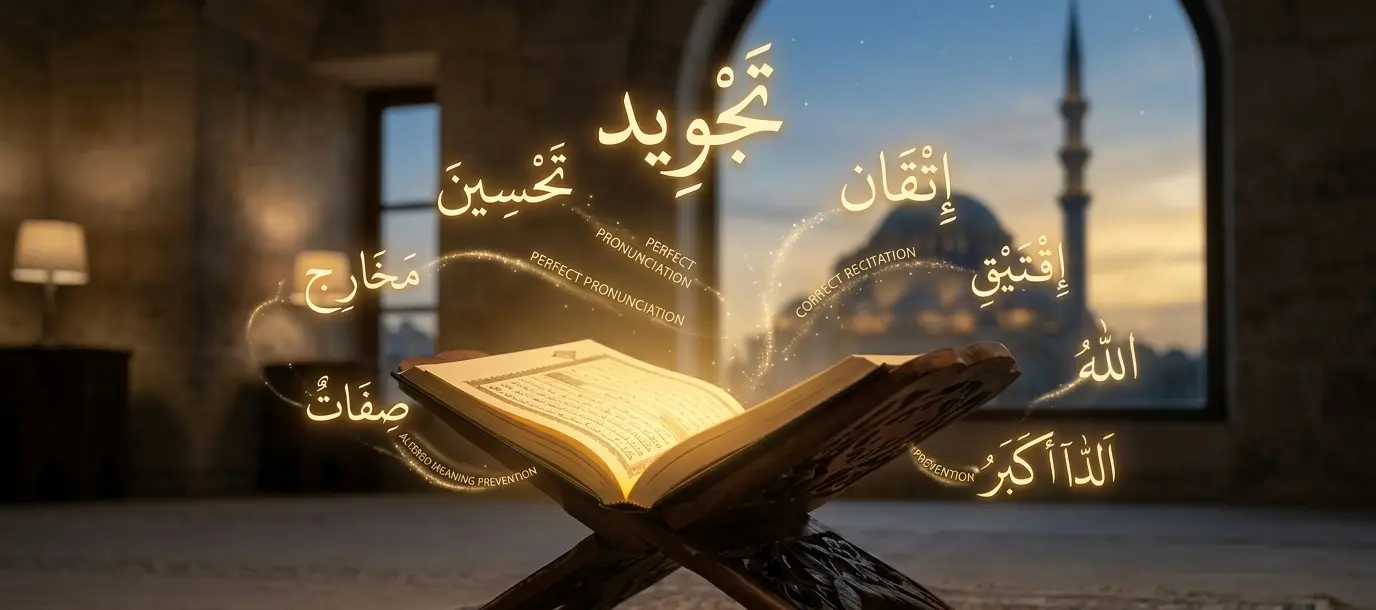
The rules cover everything from how to properly pronounce the heavy letters such as Dhad (ض) and Dhaa (ظ) to when letters should be merged, assimilated, or clearly separated. Start with learning the five broad categories: Izhar, Idgham, Iqlab, Ikhfa, and Qalqalah. A certified Tajweed course with a qualified Ustadh or Ustadha is the most reliable way to learn these, since many errors in Tajweed are nearly impossible to self-diagnose.
Master Makhraj: Where Each Letter Lives
Every Arabic letter originates from a specific point in the mouth or throat, called its Makhraj. If a letter is not produced from its correct point, it will not sound right, regardless of how much effort is applied to tone or melody. For example, the letter Ain (ع) originates deep in the throat, while the letter Taa (ت) is produced when the tip of the tongue touches the upper front teeth.
Practicing Makhraj requires slowing down significantly. Recite one letter at a time, hold it, and feel exactly where the sound is being generated. Many reciters spend weeks on just this step, and the improvement it creates in overall recitation quality is profound.
Learn the Sifaat: The Character of Each Letter
Beyond its origin, each letter also has intrinsic qualities called Sifaat. Some letters are heavy and should fill the mouth, like Qaf (ق) and Saad (ص). Others are light and should feel open and forward, like Kaf (ك) and Seen (س). Mixing up these qualities creates a recitation that sounds flat or monotone, even when the correct letter is being produced.
Listen Extensively to Renowned Qaris
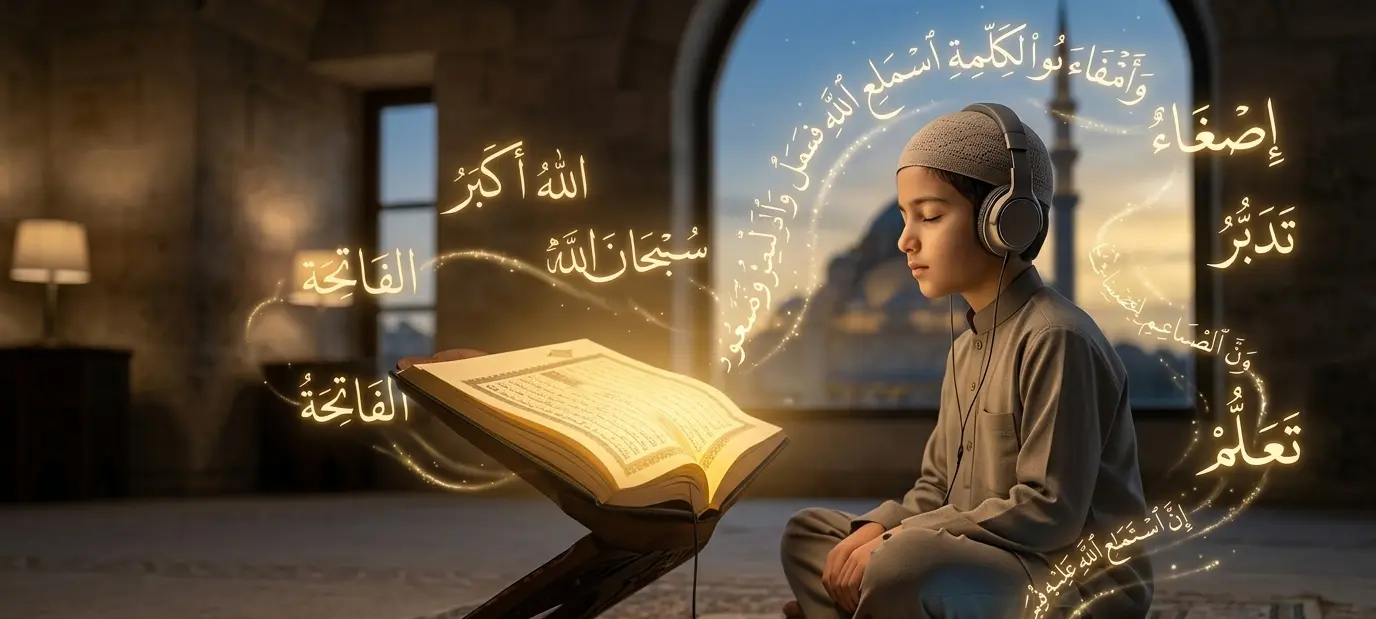
One of the most underrated practices for anyone trying to recite the Quran beautifully is consistent, attentive listening. The scholars of recitation have always emphasized that the ear must be trained alongside the tongue. When you regularly listen to skilled Qaris, your brain builds an internal reference point for what correct and beautiful recitation sounds like.
Listen to a diverse range of reciters rather than only one style. Sheikh Abdul Rahman Al-Sudais, Sheikh Mishary Al-Afasy, Sheikh Ibrahim Al-Akhdar, and Sheikh Maher Al-Muaiqly each represent different legitimate recitation styles (Qira’at) and vocal approaches. Listening to multiple reciters prevents your ear from becoming trained to a single, narrow sound and exposes you to different ways in which valid Tajweed can be applied.
Do not only listen passively. Active listening means following along in the Mushaf (Quran text), pausing when you hear a technique you want to replicate, and then attempting it yourself immediately after. This call-and-response method accelerates learning considerably.
Breath Control Is What Separates Smooth Recitation From Strained Recitation
Running out of breath mid-verse is one of the most common problems reciters face. When breath is insufficient, the voice tightens, tone quality drops, and mistakes in Tajweed become more likely because the reciter is rushing to reach a pause point.
Diaphragmatic breathing, where the breath comes from the belly rather than the chest, gives significantly more capacity and control. Before beginning a session, practice slow abdominal breaths for a few minutes. While reciting, aim to take your breath at natural pause points indicated in the Mushaf by the symbols for waqf (stopping signs). Do not force yourself to continue a verse past your comfortable breath capacity.
Identify Verse Pause Points Before You Recite
Every Mushaf contains guidance on where stopping is obligatory (Waqf Lazim), where it is permissible (Waqf Jaaiz), and where it should be avoided (Waqf Mamnu). Studying these before reciting a passage removes the panic of running out of breath, since you know exactly where your next breathing opportunity will come.
Use Your Voice Intentionally, Not Forcefully
A beautiful recitation does not require a powerful voice. It requires a well-placed, resonant voice. Forcing volume creates strain and actually reduces the beauty of tone. The sweet spot for any reciter is the voice range where tone feels full and stable without effort. For most people, this is a slightly lower pitch than their everyday speaking voice.
Voice modulation, meaning the natural rise and fall of pitch across a verse, is what creates emotional texture in recitation. This is not invented by the reciter but is guided by the meaning and mood of the verse itself. Verses of mercy have a different emotional pull than verses of warning. Let the content direct the natural shape of your voice rather than applying a fixed melodic pattern to everything.
Warm Up Before Long Recitation Sessions
Just as a singer warms up before performing, reciters benefit from vocal warm-up before long sessions. Begin with gentle humming at a comfortable pitch. Then practice a few Surahs you know by heart at a slow, relaxed pace before moving to new material. Warming up protects the voice from strain and results in noticeably better tone quality from the first verse of a formal recitation session.
Understanding the Meaning Is What Creates Emotional Depth
Many reciters work for years on their pronunciation and Tajweed, but feel that something is still missing. Often, what is missing is not technical but spiritual. When you recite without understanding the meaning of what you are saying, your voice delivers the sounds but not the weight behind them.
Study the Tafsir (Quranic commentary) of what you regularly recite. When you read Surah Ar-Rahman and truly understand that every verse ending with ‘Fabee ayyi aalaa’ee rabbikumaa tukadhdhibaan’ is a direct question to both humans and jinn, the recitation of that verse changes completely. The pause becomes more deliberate. The tone carries genuine reflection.
Even learning basic Quranic Arabic vocabulary without becoming a full Arabic scholar produces meaningful improvement. The more words you recognize, the more naturally your voice responds to the content of what you are reciting, which is ultimately what allows you to recite the Quran beautifully rather than mechanically.
Daily Practice With Structure Beats Occasional Long Sessions
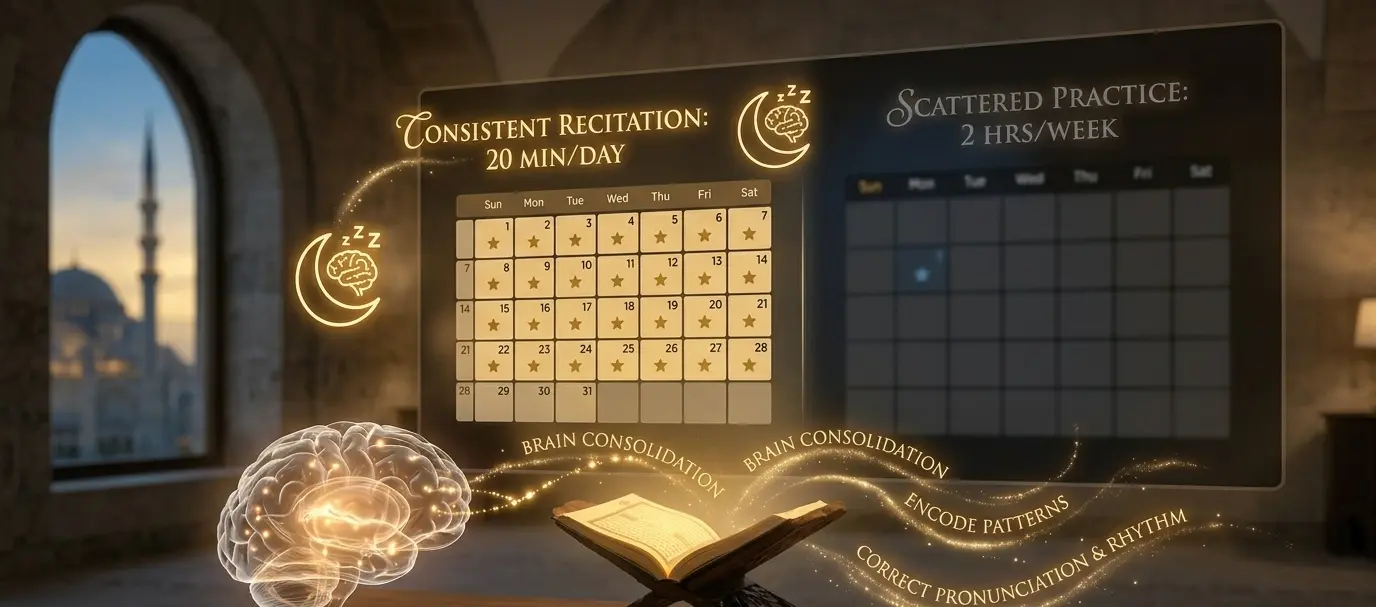
Consistency matters more than duration. Twenty minutes of focused daily recitation will improve your skills faster than two hours once a week. The reason is neurological: the brain consolidates learning during sleep, and consistent daily practice gives it more opportunities to encode the patterns of correct pronunciation and rhythm.
Structure your practice sessions deliberately. Begin each session with a revision of something already memorized to warm up. Then spend time on new material. End each session by recording a short portion of your recitation on your phone. Listening back reveals errors that your tongue has become too accustomed to notice in the moment.
Recite to Someone and Ask for Correction
The Quran was never meant to be a private text. It was revealed and transmitted through auditory chains of students and teachers going back to the Prophet (peace be upon him) himself. Reciting to a knowledgeable listener, whether a qualified Quran teacher or a more experienced family member, creates accountability and catches the errors that self-study misses. Families who want to learn together can also benefit from an online Quran classes family plan for structured and consistent guidance.
If access to an in-person Ustadh is limited, reputable online Tajweed programs with live one-on-one sessions are a legitimate and widely used alternative. The correction that comes from a qualified teacher in real time is irreplaceable.
Prepare Your Mind and Heart Before Every Recitation
The physical and spiritual state you bring into recitation affects its quality in ways that are both practical and intangible. Physically, recite in a clean space, with wudhu, and in a posture of dignity. Slouching or reciting while distracted creates a carelessness that eventually seeps into the quality of pronunciation.
Begin with the Isti’adha (seeking refuge in Allah from Shaytan) and the Basmala as instructed. This is not a ritual formality but a mental reset that helps the reciter transition from the noise of daily life into a state of focus and reverence. Scholars of recitation consistently report that the spiritual preparation before a session has a direct correlation with the depth of the recitation itself.
Work With the Waqf System to Create Natural Pauses
The Waqf system in the Quran is one of its most brilliant features. Rather than punctuation marks in the Western sense, the Quran uses a refined system of pause symbols that guide the reciter through phrasing that brings out the meaning of each passage. Learning to work with these symbols, rather than pausing wherever breath runs out, creates a recitation that sounds purposeful and textually aware.
Many reciters skip this step and recite in a continuous rush. The result is a technically correct but emotionally flat delivery. When you honor the pause points, the Quran begins to communicate through your voice rather than merely passing through it.
Common Mistakes That Hold Reciters Back
One of the most frequent errors is prioritizing speed over accuracy. Many reciters associate fast recitation with knowledge and fluency, but the Quran explicitly commands Tarteel, which means measured and deliberate recitation. Speed is never the goal. Clarity and correctness at any pace are the goal.
Another common mistake is imitating a specific Qari so closely that the reciter loses their own natural voice. Listening to great reciters should inform your technique, not replace your individuality. Your voice has its own resonance and range, and the best recitation you can produce is the most honest expression of that range within the boundaries of correct Tajweed.
Many reciters also neglect the letters that are most similar to sounds found in their native language. Arabic letters like Haa (ح) and Kha (خ), or Ta (ط) and Ta (ت), are easily confused by non-native speakers. These must be actively drilled rather than assumed correct.
Frequently Asked Questions
Can anyone learn to recite the Quran beautifully, even without a naturally good voice?
Yes, and this is confirmed both by Islamic scholarship and practical experience. Beautiful recitation is a trained skill, not an inherited talent. The Prophet Muhammad (peace be upon him) encouraged beautifying the voice with the Quran, and scholars explain this to mean using whatever voice one has, fully and correctly. With consistent Tajweed study and practice, any reciter can achieve a recitation that is correct, clear, and spiritually resonant.
How long does it take to learn to recite the Quran with proper Tajweed?
For most learners studying two to three times per week with a qualified teacher, a foundational grasp of Tajweed rules takes six months to a year. Applying those rules fluently across the entire Quran takes several years of consistent practice. The timeline varies significantly based on prior Arabic knowledge, age, and frequency of practice. There is no shortcut, but there is a clear and well-established path.
What is the best Surah to practice recitation on for beginners?
Short Surahs from Juz Amma (the 30th part of the Quran) are ideal starting points because they are brief, widely memorized, and contain a variety of Tajweed rules in compact form. Surah Al-Fatiha in particular is recommended by every Tajweed teacher because it is recited in every unit of prayer and is short enough for deep, focused practice. Once Al-Fatiha is perfected, moving through the shorter Surahs of Juz Amma gives exposure to progressively more complex Tajweed situations.
Does understanding Arabic improve recitation quality?
It absolutely does, even at a basic vocabulary level. When you recognize words and phrases, your voice instinctively responds to the meaning, creating natural emphasis and emotional tone. Full fluency in Arabic is not required, but spending time on Quranic vocabulary significantly deepens the quality and sincerity of recitation. Many reciters find that their recitation improves noticeably even after learning just the meaning of the Surahs they recite most often.
Is it better to recite loudly or silently during practice?
Reciting aloud during practice is generally more effective because it trains both your pronunciation muscles and your ability to hear your own mistakes. Silent recitation is appropriate during certain conditions in prayer, but as a learning and improvement practice, audible recitation combined with self-recording is the most productive method. Reciting to another person, even occasionally, adds an additional layer of accountability and correction that silent practice cannot provide.
The Journey of Beautiful Recitation Is One of Lifelong Refinement
Learning how to recite the Quran beautifully is not a destination you arrive at and then stop. The greatest Qaris in the world continue studying, seeking correction, and refining their recitation. What matters is direction, not perfection. Each time you slow down to get a letter right or take a moment before reciting to center your intention, you are honoring the text in exactly the way it deserves.
Start with the foundations: Tajweed, Makhraj, and breath control. Layer on consistent listening, deliberate practice, and gradually expanding your understanding of the meaning. Find a teacher, even online, who can correct what you cannot hear yourself. And above all, recite with sincerity, because the beauty that moves hearts is always rooted in truth.
If you want structured guidance on your journey to recite the Quran beautifully, explore our online Quran classes in the USA, including dedicated programs for learners in California and Chicago, with qualified instruction, and take your first lesson as soon as possible. The right moment to begin is always now. Contact us to get started today.
