 Skip to content




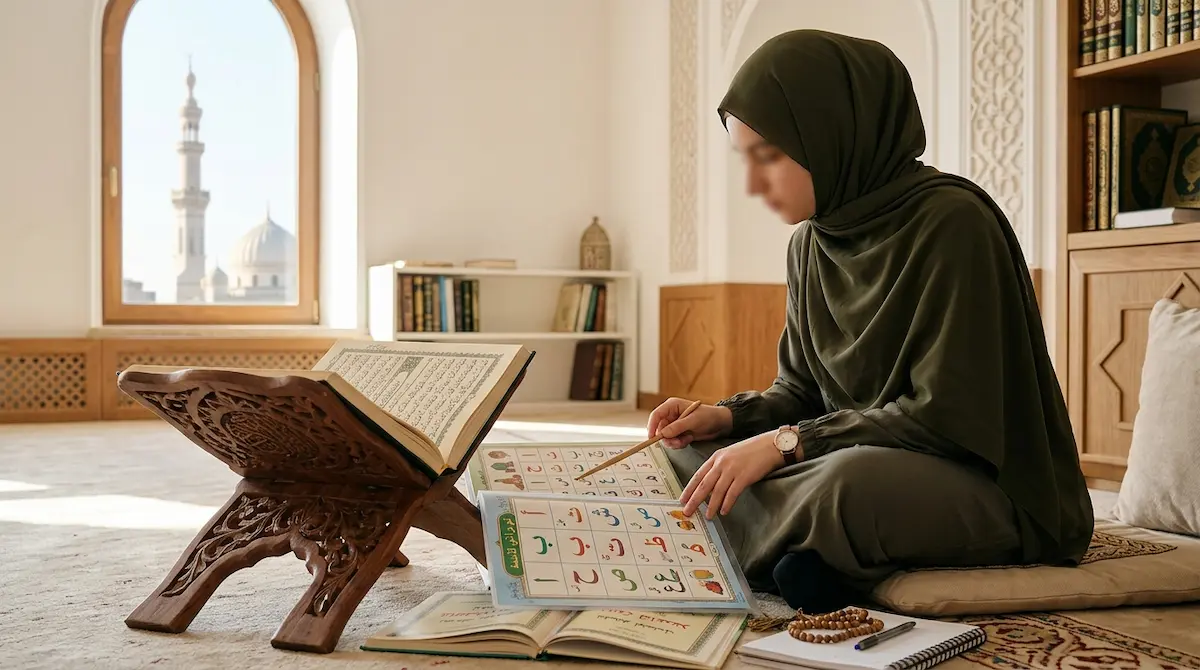
How to start learning Quran from scratch, begin with Noorani Qaida to learn Arabic letters and their pronunciation, then move to basic Quran reading with short vowels, followed by Tajweed rules for correct recitation. Most beginners can read the Quran fluently within 3 to 6 months with consistent daily practice of 20 to 30 minutes and guidance from a qualified teacher. No prior knowledge of Arabic is needed to begin.
How to start learning Quran from scratch Actually Mean
Many people assume learning the Quran from scratch means memorizing it. It does not. Starting from scratch means beginning at the very foundation, learning the Arabic alphabet, understanding how letters connect, recognizing vowel symbols, and eventually reading complete verses with correct pronunciation.
How to read the Quran for the very first time is not as complicated as it feels. The process has been followed by millions of Muslims across generations, in every language and every country. The path is well established. What makes it work is starting correctly and staying consistent.
There is no minimum age and no maximum age for beginning. Children as young as 4 and adults well past 50 have started from zero and reached fluency. The only thing that determines progress is commitment and the quality of guidance.
Step 1: Set Your Intention Before You Open the First Page
This is not a formality. Niyyah (intention) shapes the entire experience of learning the Quran. When you decide to learn for the sake of Allah, the process carries barakah that you will feel over time, in how the words begin to settle in your heart and how the practice becomes part of your daily rhythm rather than a task you drag yourself to.
The Prophet Muhammad (peace be upon him) said: “The best among you is he who learns the Quran and teaches it to others.” (Sahih Bukhari)
Set a clear intention. Write it down if it helps. Return to it on difficult days.
Step 2: Start with Noorani Qaida — The Foundation of Quran Reading
Every beginner, child or adult, starts here. Noorani Qaida is a structured booklet that introduces the Arabic alphabet in a deliberate, progressive sequence. It was designed specifically to teach correct pronunciation from the very beginning, before bad habits form.
What Noorani Qaida covers:
- Recognition of all 28 Arabic letters in their isolated form
- Letters in their beginning, middle, and ending shapes
- Short vowels (harakat): fatha, kasra, and damma
- Long vowels (huroof mad): alif, waw, and ya
- Tanwin (nunation) and its three forms
- Sukoon (letters without vowels) and how to join them
- Shaddah (gemination) and its effect on pronunciation
- Compound letter combinations and joining rules
This is the stage where correct makharij (articulation points) are built. Every Arabic letter comes from a specific point in the mouth, throat, or lips. Rushing through Noorani Qaida produces readers who recognize letters but mispronounce them for years afterward. Patience at this stage pays off in every recitation that follows.
Most students complete Noorani Qaida in 2 to 4 months with regular practice.
Step 3: Learn How to start learning Quran from scratch for the Very First Time
Once Noorani Qaida is complete, the student is ready to open the mushaf and read actual Quranic text. This transition is a significant milestone.
At this stage, the focus is on the following:
Reading fluency: Moving from letter by letter to word by word without stopping at every syllable. This takes practice and repetition. Short surahs from Juz Amma are ideal for building this fluency because they are short, frequently heard in salah, and deeply familiar.
Applying vowel rules: The harakat and symbols learned in Noorani Qaida now appear in real Quranic text. The student applies them in context rather than in isolated exercises.
Recognizing connected letters: Arabic letters change shape depending on their position in a word. A student who completed Noorani Qaida will recognize these shapes, but reading them fluently in a flowing Quranic text is a new skill that develops with practice.
Reciting aloud: Silent reading is useful for comprehension in other contexts, but Quran recitation is an act of worship done with the voice. Reading aloud from the very first session builds the vocal habit correctly.
Start with these surahs in order:
- Surah Al-Fatiha (the opening, every Muslim recites this in salah)
- Surah Al Ikhlas (three ayaat, pure and short)
- Surah Al Falaq
- Surah An Nas
- Surah Al Asr
- Surah Al Kawthar
- Surah Al Fil
- Continue through Juz Amma
These surahs build reading confidence before moving into longer chapters.
Step 4: Understand Tajweed: The Rules of Correct Recitation
Tajweed is the science of reciting the Quran exactly as it was revealed with correct pronunciation, rhythm, and rules for how certain letters behave when they appear together.
Allah says in Surah Al Muzammil (73:4): “And recite the Quran with measured recitation.”
Learning Tajweed does not happen overnight, and it does not have to. It is learned in layers. A beginner does not need to know every rule before reading. The basic rules are introduced gradually as the student progresses through the Quran.
The main categories of Tajweed include:
Makharij Al Huruf: The precise articulation points of each Arabic letter. Without correct makharij, words change meaning. The letters qaf and kaf, for example, come from different points in the throat and cannot be interchanged.
Noon Sakinah and Tanwin rules: Four rules govern how a noon with sukoon or tanwin behaves depending on what letter follows it. These are izhaar, idgham, ikhfa, and iqlab.
Meem Sakinah rules: Similar rules apply to meem with sukoon, ikhfa shafawi, idgham shafawi, and izhaar shafawi.
Madd (prolongation): Certain letters are lengthened for specific counts depending on the type of madd. Natural mad, connected mad, obligatory mad, and permissible mad each have their own length.
Qalqalah: Five letters produce a slight echoing bounce when they carry sukoon. These are qaf, ta, ba, jeem, and dal.
Ghunnah: A nasalization sound produced in the nasal passage when noon or meem carries a shaddah.
A qualified Tajweed teacher walks students through each of these categories systematically and corrects mistakes in real time. This is why Tajweed cannot be learned from reading alone the ear and the voice both need to be trained together.
Step 5: Build a Daily Practice Habit
Consistency matters more than duration. Twenty minutes of daily Quran practice produces better results than two hours once a week. The brain retains phonetic information through repetition across days, not through volume in a single session.
A practical daily schedule for beginners:
- 10 minutes of reading new material with the teacher or from the last lesson
- 5 minutes of revising what was read in the previous session
- 5 minutes of listening to a reciter and following along in the Mushaf
As fluency builds, the ratio shifts toward more new material and less revision per session.
Listening to Quran recitation outside of study time also accelerates learning significantly. Recitation by Sheikh Mahmoud Khalil Al Husary is widely recommended for learners because of his clear, measured pace. Sheikh Abdul Rahman Al Sudais and Sheikh Mishary Rashid Al Afasy are also excellent for ear training. Listening builds familiarity with correct sounds so the student’s own reading naturally gravitates toward them.
Step 6: Find a Qualified Quran Teacher
This is the step that separates fast, correct progress from slow, frustrated progress. Self-study is possible for motivated adults, but it carries real risk: mispronunciations and incorrect Tajweed that go uncorrected for months or years and then require significant effort to undo.
A qualified teacher provides three things that no app or book can:
Immediate correction: When a student mispronounces a letter or applies a Tajweed rule incorrectly, the teacher catches it in the moment. This is how correct habits form.
Structured progression: A teacher knows when a student is ready to move forward and when they need more practice at the current stage. Without this, students either rush past their weaknesses or stay too long at one level.
Ijazah and authentic chain: A teacher with ijazah received their certification through an unbroken chain of transmission going back to the Prophet (peace be upon him). This is the traditional method of Quran transmission, and it guarantees that what is being taught is correct.
When looking for a Quran teacher, ask about their ijazah, ask to hear them recite, and assess how they explain rules. A good teacher is patient, structured, and genuinely invested in the student’s progress.
Online Quran classes make access to qualified teachers much easier than it was even ten years ago. Students can now learn from certified teachers regardless of where they live.
Step 7: Begin Memorization with Short Surahs
Memorization (Hifz) is not just for those pursuing the full title of hafiz. Every Muslim benefits from memorizing portions of the Quran because those portions are recited in salah every day.
Begin with Juz Amma (the 30th juz), which contains the shortest surahs. The recommended memorization technique:
- Read ayahs 10 to 15 times while looking at the text
- Close the Mushaf and recite from memory
- Repeat until the ayah comes without hesitation
- Add the next ayah and chain it to the previous one
- Revise the full surah at the end of each session
Revision is as important as new memorization. What is memorized without regular revision fades within weeks. Daily revision of recently learned surahs and weekly revision of older material keep the memorization strong.
Common Mistakes Beginners Make and How to Avoid Them
Starting without Noorani Qaida: Some beginners skip the Qaida and go directly to reading the Quran. This builds incorrect pronunciation habits that are difficult to fix later. Always complete the Qaida first.
Rushing through letters: Arabic letters require precise articulation. A student who rushes through makharij in the early stages will recite incorrectly for years. Slow down at the foundation.
No teacher or delayed teacher: Starting with apps and YouTube is fine for exposure, but a real teacher is needed for correction. The longer a student goes without a teacher, the more uncorrected habits accumulate.
Inconsistent practice: Learning the Quran requires regularity. Skipping days frequently breaks the retention cycle. Short daily sessions are far better than irregular longer ones.
Embarrassment about starting late: Adults who begin learning at 30, 40, or older sometimes feel ashamed that they do not already know. This shame is entirely unfounded and often delays the decision to start. Every moment you begin is the right moment.
How Long Does It Take to Learn to Read the Quran from Scratch
Most beginners can read basic Quran within 3 to 6 months of consistent study with regular sessions. Here is a realistic timeline:
| Stage | Duration |
| Noorani Qaida completion | 2 to 4 months |
| Basic Quran reading (Juz Amma) | 3 to 6 months |
| Fluent reading of the full Quran | 1 to 2 years |
| Applied Tajweed throughout | Ongoing alongside reading |
| Hifz of Juz ‘Amma | 6 to 12 months |
These timelines assume 3 sessions per week with a qualified teacher and daily personal practice. Students who practice more frequently progress faster. Students with no prior Arabic exposure take slightly longer at the Noorani Qaida stage.
Can Adults Really Learn to Read the Quran from Scratch
Yes, completely and fully. The idea that Quran learning is only for children is one of the most persistent and damaging myths in Muslim communities. Adults learn differently from children; they have stronger motivation, better focus in structured sessions, and more life context to attach meaning to what they are reading. These are advantages, not disadvantages.
The Prophet (peace be upon him) said: “Whoever reads a letter from the Book of Allah will receive a hasanah (good deed) from it, and the hasanah is multiplied by ten.” (Tirmidhi)
This reward applies equally at age 8 and age 58. Every letter recited by an adult who struggled to learn it carries its own weight and reward.
Adults who feel embarrassed to start should know that qualified teachers work with adult beginners regularly and approach this with complete respect and patience. There is no age too old and no level too basic.
Frequently Asked Questions
What is the first thing to learn when starting the Quran?
The first step is learning the Arabic alphabet through Noorani Qaida. This builds the correct pronunciation foundation before any Quranic text is read. Skipping this step and going directly to reading the Quran often results in incorrect pronunciation habits that take longer to fix than learning the Qaida properly from the start.
Can I learn to read the Quran without knowing Arabic?
Yes. Reading the Quran in Arabic script does not require understanding the Arabic language. Millions of non-Arab Muslims read the Quran in Arabic with correct pronunciation without speaking Arabic conversationally. Understanding the meaning comes through translation study and Tafseer, which is a separate layer added after reading fluency is established.
How many times should I practice reading the Quran each day?
For beginners, 20 to 30 minutes of daily practice is ideal. This can be split into a morning and evening session of 10 to 15 minutes each. The key is that the practice happens every single day rather than in large, infrequent blocks. Regularity builds retention and fluency far faster than occasional long sessions.
Is it necessary to have a teacher, or can I learn on my own?
A teacher is strongly recommended, especially for pronunciation and Tajweed. Apps and videos help with exposure and reinforcement but cannot correct your specific errors in real time. Without correction, wrong pronunciation can become fixed and require significant effort to change later. One-on-one classes with a qualified teacher produce the fastest and most accurate results.
What is the easiest surah to memorize first?
Surah Al Ikhlas (three ayaat) is the most commonly memorized first surah due to its short length and deep meaning. Surah Al Kawthar (three ayaat) and Surah Al Asr (three ayaat) are equally good starting points. All three are also recited in daily salah, which gives the memorization immediate practical application.
How do I stay consistent when motivation drops?
Tie your Quran practice to an existing daily habit, such as after Fajr or after Isha salah. When the practice becomes attached to a prayer that already happens every day, it requires less motivation to maintain. Also, track your progress; seeing how far you have come since the first day is a genuine motivator on difficult days.
Final Thoughts
Starting the Quran from scratch is one of the most meaningful decisions a Muslim can make. The path is clear: Noorani Qaida, then Quran reading, then Tajweed, then memorization, each stage building on the one before it.
The students who succeed are not the ones with the most natural ability. They are the ones who started, stayed consistent, found a good teacher, and kept going even when progress felt slow. That describes every person who has ever learned to read the Quran as an adult, and it will describe you, too.
Start today. Even one letter recited sincerely is an act of worship.
