 Skip to content




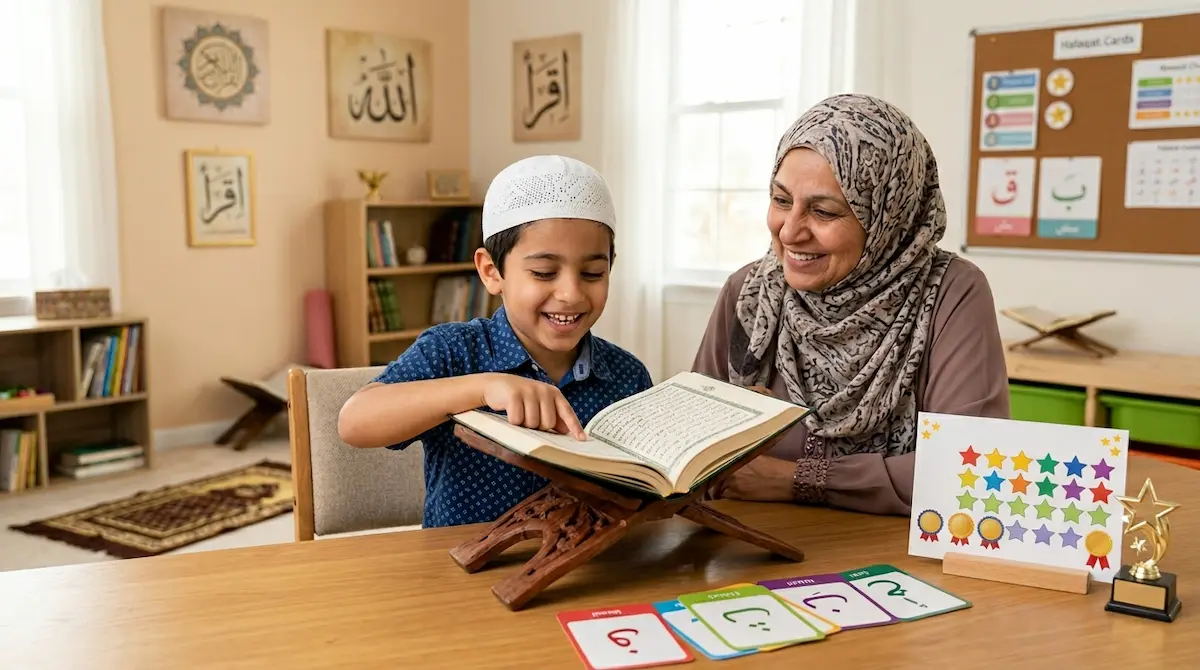
The most effective way to keep kids motivated during Quran lessons is to make learning feel like something they want to do, not something they are forced to do, through consistent routines, meaningful rewards, engaging teachers, and connecting the Quran to their everyday life.
Every parent who has sat beside a child during a Quran lesson knows that moment. Around week three or four, the child who happily opened the Quran in the first week is now slumped in their chair, staring at the ceiling, asking how many minutes are left. It does not mean your child does not love Allah. It means they are a child.
Keeping kids motivated during Quran lessons is one of the most real and consistent challenges Muslim parents face, and it requires far more than just telling your child it is important. It requires strategy, patience, creativity, and an understanding of how children actually learn.
Why Children Lose Interest in Quran Lessons
Before you can solve the problem, you need to understand what is causing it. There is rarely a single reason a child disengages. More often, it is a combination of things working quietly against motivation over time.
Lessons that feel too long, too repetitive, or entirely disconnected from anything a child can relate to will drain enthusiasm fast. A teacher that the child feels no real connection with will make the learning feel like a chore, no matter how qualified that teacher is. A child who genuinely looks forward to their teacher, who feels known by that person and noticed when they improve, will maintain engagement through difficult stretches that would otherwise produce dropout. A technically excellent teacher, the child feels nothing toward will see motivation plateau regardless of instruction quality.
Understanding this reality is the first step toward knowing how to keep kids motivated during Quran lessons in a way that actually lasts.
Build a Consistent Routine Around Quran Time
Children thrive on predictability. When Quran lessons happen at a fixed time every day, they stop being a negotiation and simply become part of life. One of the most effective ways to encourage consistent Quranic learning is by integrating it into your child’s daily routine. Creating specific times during the day dedicated to Quranic study, such as after Fajr prayer or before bedtime, helps normalize Quranic learning as part of daily life rather than an occasional task.
The key is to tie Quran time to an existing anchor in your child’s day, something that already happens without resistance. After Fajr, right after school, or before the evening meal all work well depending on your household rhythm. Short, frequent sessions are better than long, infrequent ones. Linking Quran time with daily prayers or quiet times means predictable routines reduce resistance and make Quran memorization a natural part of the day.
Start with fifteen to twenty minutes for younger children. You are not racing to complete the Quran; you are building a relationship with it that will last a lifetime.
Use Rewards and Positive Reinforcement Thoughtfully
Rewards work, but only when they are used correctly. The goal is not to make your child memorize Surahs for stickers. The goal is to create enough positive association with the learning experience that the intrinsic motivation has time to develop naturally. Recognizing children’s efforts and progress with small rewards can help them stay committed and enthusiastic. Celebrating milestones such as completing a Surah or mastering a Tajweed rule, using praise and encouragement to boost confidence, and offering small rewards like certificates or badges after a productive lesson builds a positive attitude towards Quran learning.
The most important principle here is to reward effort, not just results. A child who struggled through a lesson and kept trying deserves just as much recognition as one who sailed through it with ease. When your child makes progress, be sure to praise their efforts. Set small, achievable goals and gradually increase the difficulty as they progress.
Sticker charts on the wall, a special Quran journal where they track their own progress, a small treat after completing a Juz review, a family outing to celebrate finishing a Surah: none of these require spending money or elaborate preparation. What they require is consistency and follow-through from you.
Make the Lessons Interactive and Fun
Sitting still and reciting repeatedly is hard for adults. For a seven-year-old, it is genuinely exhausting. One of the most powerful ways to keep kids motivated during Quran lessons is to add movement, games, and variety to the session itself.
Transforming Quranic learning into a playful adventure through interactive games that focus on verses, memorization, or even a Quranic treasure hunt not only adds an element of joy but also reinforces lessons memorably. Choosing games that align with a child’s age and learning level ensures they stay engaged while absorbing the teachings.
Reciting with hand gestures, rhythmic chanting, or quiz games keeps children engaged and enthusiastic. Simple activities like calling out an ayah and asking your child to name the Surah, using flashcards for Arabic letters, or taking turns completing each other’s recitation turn the lesson into something the child actively participates in rather than passively endures.
Simple visuals and flashcards turn confusing Arabic letters into a fun, engaging game. Visuals cut through the confusion and make practice at home effective. For younger children, especially, anything they can touch, draw, or move around with their hands deepens retention and keeps attention alive.
Bring Quranic Stories Into the Lesson
Children are storytellers by nature. The moment you frame a lesson as a story, their posture changes, and their eyes open. The Quran is full of extraordinary stories, and these narratives are one of the most underused tools parents have when thinking about how to keep kids motivated during Quran lessons.
Narrating tales of prophets and their journeys and making teachings relatable encourages questions and discussions that enhance understanding. The Quran itself says: “Indeed, in their stories, there is a lesson for those of understanding” (Quran 12:111).
Parents can share simple stories of prophets like Ibrahim (AS), Musa (AS), or Yunus (AS), use illustrated storybooks or animated videos to make lessons engaging, and ask children to retell the story in their own words, which reinforces understanding.
When a child knows the story of Surah Al-Fil before they begin memorizing it, the words are no longer just sounds. They carry images, emotions, and meaning. That connection is what makes memorization stick and keeps the kid motivated for Quran.
Connect Quran to Real Life, Not Just Lessons
Children disengage from anything that feels irrelevant to their world. The Quran should not exist in a separate box labeled “lesson time.” It should weave naturally into conversations, decisions, and daily moments throughout the day.
Using Quranic verses to explain kindness, honesty, and gratitude, and encouraging kids to recite relevant short Surahs during salah while highlighting how the Quran provides guidance for family, school, and friendships, helps children internalize its meaning and relevance. By linking the Quran to real-life situations, children understand its guidance belongs to every part of life.
When your child is struggling with a friend at school, remind them of the verse about patience. When they are grateful for something, connect it to a Surah they have already memorized. These moments do more for long-term motivation than any reward chart because they show the child that the Quran is alive and relevant to everything they experience.
Choose the Right Teacher and Give Your Child a Voice
The teacher relationship is everything. There is no point where Quran’s motivation is solved and requires no more attention. Children change. What worked at seven does not work at ten. A teacher who was perfect at age six may not be the right fit at age ten, and being willing to recognize that and make a change is not a failure; it is good parenting.
A key recommendation is to find a proficient Quran tutor for children, one who can teach them to read accurately without pronunciation errors. Experienced teachers know how to make lessons engaging by using various practical techniques suited for kids.
Beyond the teacher, give your child some ownership over their own learning. Letting the child choose which Surah or verse to memorize first, involving them in deciding the order of review or Quran recitation, and respecting their preferences encourages self-motivation. Children who feel they have a voice in their learning invest far more of themselves in it.
Keep Sessions Short and End on a High Note
One of the most common mistakes parents and teachers make is allowing sessions to drag until the child is clearly checked out. Children have naturally shorter attention spans, especially during online Quran classes. Breaking the session into smaller parts with short breaks, for example, 15 minutes of recitation followed by a 2-minute break, helps reset attention.
End every lesson at a moment of success, not frustration. If your child has just recited an ayah correctly, that is the moment to wrap up with a smile and a word of praise. They will carry that feeling of success into the next session rather than the memory of struggling at the end of a long lesson.
Over time, your child will begin to associate Quran study with encouragement rather than pressure. This positive mindset keeps kids excited about learning.
Model the Behavior You Want to See
No strategy works as reliably as a parent who visibly loves the Quran. Your child watches everything you do. The best way to teach your child to love the Quran is to show them that you love it yourself. Make sure to recite the Quran regularly and encourage your child to do the same.
Letting your kids see you recite the Quran regularly means your devotion will encourage them to develop a love for the Quran too.
Play recitations by well-known Qaris during family time. Keep a Quran within reach in the living room, not only in the bedroom. Make dua together before lessons begin. These small habits shape a child’s entire relationship with the Quran long before they are old enough to understand why.
Use Technology as a Tool, Not a Replacement
Online Quran classes, Quran learning apps, animated Islamic content, and online islamic programs have transformed what is available to Muslim families today. Used wisely, technology is one of the most effective tools available for keeping kids motivated during Quran lessons.
Incorporating videos, animations, and interactive games helps children have fun while learning about the Quran. This can motivate them to continue their studies and develop a lifelong love for the holy book.
The critical word is wisely. Apps and videos should supplement the lesson, not replace the teacher-student relationship or the quiet discipline of sitting with the Quran. Use them to introduce new concepts, reinforce what has already been learned, or celebrate a milestone. Keep them as a bonus rather than the default.
Be Patient Through the Hard Weeks
There will be weeks your child resists every technique you try. They will complain, negotiate, and make Quran time feel like a battle. This is normal. Accepting that attention and enthusiasm may fluctuate, adjusting expectations based on energy levels and mood, and encouraging effort even when progress is slow, maintains positivity and long-term motivation.
Learning the Quran takes time and effort. Do not get discouraged if your child does not seem interested at first. Just keep exposing them to the Quran, and they will eventually develop a love for it.
The parent who stays calm, keeps showing up, and refuses to turn Quran time into a daily conflict is doing something far more important than any teaching technique. They are modeling what it looks like to persevere in the path of Allah, and their child is watching every single day.
A Final Word
Knowing how to keep kids motivated during Quran lessons is ultimately about understanding your child, staying consistent, and trusting the process. No single strategy works for every child in every season of their life. What works is the combination of a loving environment, a connected teacher, a reliable routine, and a parent who genuinely believes this journey is worth every difficult morning.
The child who memorizes the Quran in a house full of patience and love will carry it very differently from one who memorized under pressure. Build the love first, and the memorization will follow.
