



There is something profoundly different about a prayer performed in the stillness of the night, when the world is quiet and your heart is fully present. Tahajjud prayer — the voluntary night prayer of Islam — is one of the most spiritually rewarding acts of worship a Muslim can practice. Yet many sincere Muslims have never been properly taught how to perform it correctly, step by step, with full understanding of what they are doing and why.
This guide exists to change that.
This guide exists to change that. Whether you are learning for the first time or looking to correct and deepen a practice you have already started, this is your complete resource for tahajjud prayer how to perform it step by step — with clarity, authentic Islamic references, and practical guidance you can apply tonight .For those who want structured learning with a qualified instructor, online Tahajjud classes are also available. You can enroll today and begin guided, personalized instruction from the comfort of your home.
What Is Tahajjud Prayer?
Tahajjud is a voluntary night prayer in Islam, also known as Qiyam al-Layl — meaning “standing in the night.” It is performed after the Isha prayer and before the Fajr prayer, ideally during the last third of the night when, according to authentic hadith, Allah (SWT) descends to the lowest heaven in a manner befitting His majesty and calls out to His servants, asking who among them is seeking forgiveness, provision, or relief.
Unlike the five obligatory daily prayers, Tahajjud is a nafl (voluntary) act of worship. This means it is not a religious obligation — but its reward, spiritual weight, and significance in the Sunnah of the Prophet Muhammad ﷺ are immense. It is among the most beloved voluntary acts to Allah and one of the most consistent practices of the Prophet ﷺ throughout his life.
Performing tahajjud prayer how to perform it step by step — with proper intention, preparation, and sincerity — transforms it from a routine act into a deeply personal conversation between the worshipper and their Creator.
Importance and Virtues of Tahajjud Prayer
The Quran itself calls believers toward night worship. In Surah Al-Isra (17:79), Allah says — and the meaning is — that the night prayer is an additional offering for the believer, and that through it Allah may raise them to a praised station. This is one of the most direct Quranic encouragements for voluntary night worship.
The hadith literature is equally clear. The Prophet Muhammad ﷺ is reported in Sahih Muslim to have described the night prayer as the most virtuous prayer after the obligatory ones. In Jami’ at-Tirmidhi, he ﷺ described Allah’s closeness to His servant during the last third of the night as unparalleled at any other time.
The spiritual benefits of consistent Tahajjud practice include forgiveness of sins through sincere dua and repentance, a deepened sense of connection with Allah (SWT), strengthening of iman (faith) through regular devotion, the development of patience, humility, and inner discipline, and a clarity of mind and heart that many practitioners describe as profoundly calming.
These are not abstract promises. Muslims who establish a consistent Tahajjud routine often speak of noticeable shifts in their spiritual state, their relationship with the Quran, and their capacity for patience in daily life.
Best Time to Perform Tahajjud Prayer
Timing matters deeply in Tahajjud. The prayer can be performed at any point between Isha and Fajr, but the most virtuous and recommended time is the last third of the night.
To understand what this means practically: divide the period between Maghrib and Fajr into three equal parts. The final portion of that time — in the hour or two hours before Fajr — is the last third of the night. This is when the spiritual atmosphere of Tahajjud is at its richest.
The classical understanding — supported by hadith in Sahih al-Bukhari and Sahih Muslim — is that a person sleeps after Isha, then rises before Fajr to pray. This is why Tahajjud literally relates to the concept of abandoning sleep for worship. Sleeping before the prayer is considered part of its Sunnah practice, though scholars note that if a person fears they will not wake up, they may pray before sleeping as well.
A practical approach for those beginning to learn tahajjud prayer step by step is to set an alarm roughly 90 minutes before Fajr, allow a few minutes to become fully awake, and then begin the prayer. Consistency matters far more than duration — even two rak’ahs performed sincerely and regularly hold immense value.
Prerequisites Before Performing Tahajjud
Purification — Wudu
No prayer in Islam is valid without ritual purification. Before beginning Tahajjud, you must perform wudu (ablution) — washing the hands, mouth, nostrils, face, arms, head, ears, and feet in the prescribed manner. If you wake from sleep, wudu is required regardless of whether you performed it before sleeping.
Clean Prayer Space
The place where you pray must be clean and free from impurity. A prayer mat is commonly used, though any clean surface is acceptable. Ensure your clothing is also clean and covers the required parts of the body for prayer (awrah).
Intention — Niyyah
The intention for Tahajjud does not need to be spoken aloud. It is a sincere resolve in the heart that you are performing this voluntary night prayer for the sake of Allah (SWT) alone. The sincerity of this intention is what separates a spiritually alive prayer from a mechanical routine.
Facing the Qibla
As with all Islamic prayers, you must face the direction of the Kaaba in Makkah — the Qibla. If you are unsure of the direction, use a compass or a reliable Qibla application.
Tahajjud Prayer Step-by-Step Method
This is the core of what every learner needs. If you have been searching for tahajjud prayer how to perform it step by step, this section gives you a clear, authentic, and complete walkthrough of every movement, recitation, and position involved.
Making Intention (Niyyah)
Stand facing the Qibla. In your heart, make the intention to perform Tahajjud — voluntary night prayer — for the sake of Allah (SWT). You may say internally or quietly: “I intend to pray two rak’ahs of Tahajjud for Allah.”
The number of rak’ahs you intend to pray in this set should be clear in your mind before you begin.
Performing Wudu
If you have not already performed wudu after waking, do so now. Ensure it is performed correctly and completely before returning to your prayer space.
Starting the Prayer
Raise both hands to the level of your earlobes (or shoulders, according to some scholars) and say “Allahu Akbar” — this is the Takbir al-Ihram, the opening declaration that marks the formal beginning of the prayer.
After the opening Takbir, it is recommended to recite the opening supplication (Du’a al-Istiftah) quietly. One widely narrated version from Sahih al-Bukhari is the beautiful supplication beginning with “Allahumma lakal-hamd…” — a profound expression of praise and acknowledgment of Allah’s greatness. This dua is among the most meaningful ways to open the Tahajjud prayer and is one of the authentic Sunnah practices of the Prophet ﷺ.
Then recite the Ta’awwudh (“A’udhu billahi min ash-shaytanir-rajim”) and the Basmala before beginning your recitation.
First Rak’ah
Surah Al-Fatihah: Recite the opening chapter of the Quran in its entirety. This is obligatory in every rak’ah of every prayer in Islam.
Additional Quran Recitation: After Al-Fatihah, recite any portion of the Quran you know. In Tahajjud, longer recitations are encouraged and more spiritually rewarding — the Prophet ﷺ was known to recite extended portions of the Quran during his night prayer. For beginners, reciting any surah you have memorized, even a shorter one, is perfectly valid.
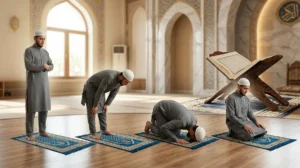
Ruku: Bow forward with your back flat and hands on your knees, saying “Allahu Akbar” as you descend. In this position, say “Subhana Rabbiyal Adheem” (Glory be to my Lord, the Most Great) three times or more.
Rise from ruku saying “Sami’Allahu liman hamidah” (Allah hears those who praise Him), then say “Rabbana lakal-hamd” (Our Lord, to You belongs all praise) while standing upright.
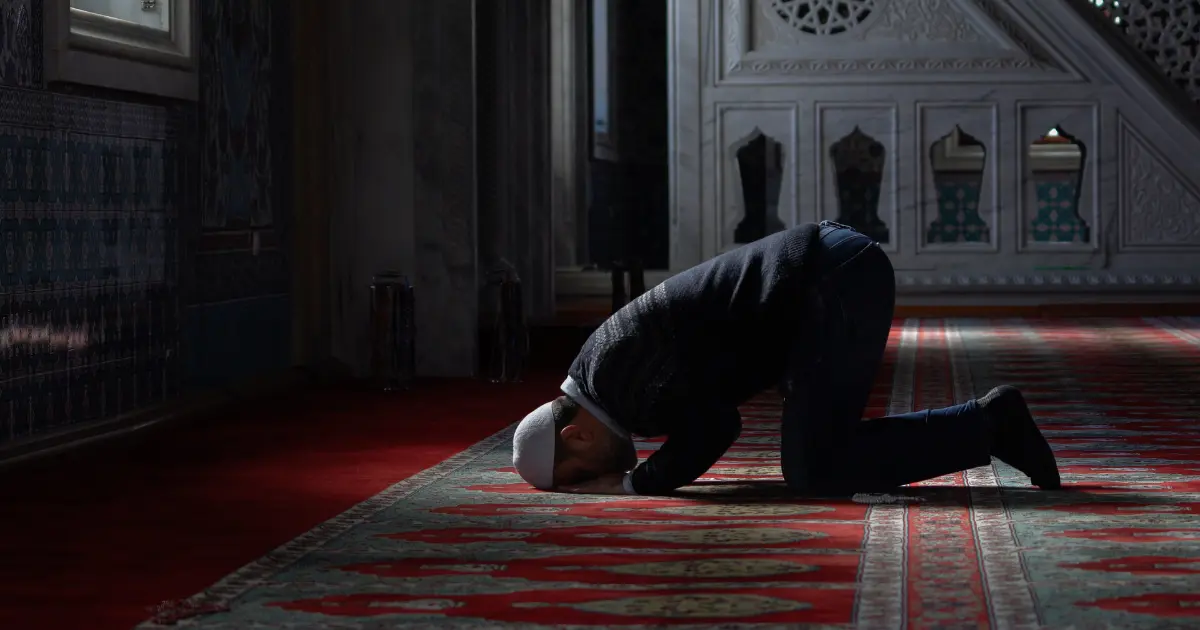
Sujood: Say “Allahu Akbar” and descend into prostration, placing your forehead, nose, both palms, both knees, and the tips of all toes on the ground. Say “Subhana Rabbiyal A’la” (Glory be to my Lord, the Most High) three times or more.
Rise from the first sujood, sit briefly, then perform the second sujood in the same manner. Rise from the second sujood saying “Allahu Akbar” — this completes one rak’ah.
Second Rak’ah
Stand for the second rak’ah. Recite Surah Al-Fatihah again, followed by an additional Quranic recitation. Then perform ruku and two sajdahs exactly as in the first rak’ah.
After the second sujood of this rak’ah, sit in the Tashahhud position. Recite the full Tashahhud (“At-tahiyyatu lillahi was-salawatu…”) and then the Durood (salutation upon the Prophet ﷺ) and the Masnoon dua that follows.
Completing the Prayer
After the Tashahhud and its accompanying supplications, end the prayer with Tasleem — turning your head to the right and saying “Assalamu Alaikum wa Rahmatullah,” then to the left with the same phrase.
Your first set of Tahajjud is now complete.
Dua After Prayer: This is one of the most powerful moments in Tahajjud. Remain seated, raise your hands, and speak to Allah (SWT) from your heart. Ask for forgiveness, seek guidance, express gratitude, make your personal requests. The time after Tahajjud — before Fajr — is among the most spiritually potent moments for dua in the entire day.
Number of Rakats in Tahajjud Prayer
One of the most frequently asked questions about tahajjud prayer is how many rak’ahs are required or recommended. The honest answer, grounded in authentic hadith, is that Tahajjud is flexible.
The Prophet Muhammad ﷺ is reported to have prayed between two and thirteen rak’ahs during his night prayer, depending on the narration. The most commonly cited practice is eight rak’ahs followed by three rak’ahs of Witr — but this is a recommended pattern, not a rigid requirement.
The minimum is two rak’ahs. You may pray two, four, six, eight, or more — always in sets of two. What matters most is not the quantity but the quality: the sincerity, presence of heart, and consistency of the practice.
For beginners learning tahajjud prayer step by step, starting with two rak’ahs and building gradually over time is the wisest approach. A small, consistent practice is more beloved to Allah than a large, irregular one.
Witr Prayer After Tahajjud
Witr is a special prayer — odd-numbered in rak’ahs (one, three, or five) — that is recommended to be the last prayer performed before Fajr. If you are performing Tahajjud, Witr should come after it, not before.
The Prophet ﷺ said — as narrated in Sahih al-Bukhari — to make Witr the last of the night prayers. This means if you plan to pray Tahajjud, you should not pray Witr after Isha and then sleep — or if you do, you can still pray Tahajjud without repeating Witr, though scholars have noted the preferred practice.
For those establishing a Tahajjud routine, the practical recommendation is: pray Isha, sleep, wake for Tahajjud in the last third of the night, complete your Tahajjud rak’ahs, then close with Witr before Fajr.
Duas and Recitations in Tahajjud
Tahajjud is, at its heart, an extended conversation with Allah. The recitations and supplications within and around the prayer are what give it its deep spiritual texture.
Quran recitation in Tahajjud is ideally longer and more contemplative than in obligatory prayers. Reciting with proper tajweed, reflecting on meaning, and allowing verses to land in the heart is the spirit of night worship. Surahs like Al-Baqarah, Al-Imran, and the Musabbihat (those beginning with Subhan or Sabbaha) are frequently referenced in the context of night prayer, but any portion of the Quran recited sincerely is appropriate.
The Opening Dua (Du’a al-Istiftah) — particularly the narration beginning “Allahumma lakal-hamd, Antal-Qayyimus-sama…” — is one of the most beautiful and recommended supplications for Tahajjud specifically.
Dhikr after Tahajjud — including SubhanAllah, Alhamdulillah, and Allahu Akbar — settles the heart and extends the spiritual presence of the prayer into the moments before Fajr.
Personal Dua is the soul of Tahajjud. Use your own language, your own words, your own needs. Ask for what matters most to you. This is the time when the distance between a servant and their Lord feels smallest.
Common Mistakes in Tahajjud Prayer
Even sincere worshippers can fall into habits that reduce the quality or correctness of their Tahajjud. Being aware of these helps you avoid them from the beginning.
Incorrect timing is one of the most common issues — praying too early in the night, or not making the effort to pray in the last third when the spiritual reward is greatest.
Missing or vague intention weakens the prayer spiritually. The niyyah should be clear, sincere, and directed specifically toward Tahajjud.
Rushing through the prayer defeats its entire purpose. Tahajjud is meant to be unhurried, contemplative, and present. Long ruku, extended sujood, and genuine reflection in recitation are central to its spirit.
Lack of consistency is perhaps the most common pitfall. Many people pray intensely for a week and then stop. The Prophet ﷺ himself said that the most beloved deeds to Allah are those done consistently, even if small. Two rak’ahs every night is worth far more than twenty rak’ahs done once.
Neglecting dua after the prayer means missing one of the most spiritually valuable parts of the entire practice.
Benefits of Learning and Practicing Tahajjud
The benefits of a regular Tahajjud practice are recognized in both Islamic teaching and human experience.
Spiritual growth comes naturally from sustained engagement with voluntary worship. Each night spent in Tahajjud builds a layer of taqwa — God-consciousness — that gradually reshapes how a person thinks, speaks, and acts.
Inner peace and emotional clarity are consistently reported by those who establish this practice. Something about the quiet, the solitude, and the sincerity of night prayer creates a stillness that is difficult to find elsewhere.
Strengthening of discipline extends beyond prayer itself. Waking before Fajr regularly, maintaining wudu, and organizing time around worship builds a kind of spiritual and personal discipline that carries into every area of life.
Closeness to Allah — this is the central promise and the central reward. Every step taken toward learning tahajjud prayer and performing it consistently is a step toward a deeper, more personal relationship with the Creator.
Tahajjud in Sunnah and Authentic References
The foundation of everything in this guide rests on authentic Islamic sources. Tahajjud is not a cultural practice or regional tradition — it is a firmly established Sunnah supported by the Quran, the hadith collections of Sahih al-Bukhari and Sahih Muslim, and the scholarly consensus of Islamic jurisprudence across all major schools of thought.
The Prophet Muhammad ﷺ performed Tahajjud so consistently that his feet would reportedly become swollen from the length of his night prayers. When asked why he prayed so much given that his past and future were forgiven, he ﷺ replied — as narrated in Sahih al-Bukhari — that should he not be a grateful servant?
This narration alone captures the spirit of Tahajjud. It is not performed out of fear or obligation — it is an expression of love, gratitude, and nearness.
Who Can Learn This Tahajjud Prayer Guide?
This guide and the online learning programs associated with it are designed for every sincere Muslim who wants to understand and practice Tahajjud correctly.
Beginners who have never performed the night prayer and want a clear, complete, step-by-step foundation. Students of Islamic studies who want to deepen their practical worship alongside their academic knowledge. Reverts to Islam who are building their prayer practice from the ground up and want authentic, accessible guidance. Busy professionals who want to establish a meaningful spiritual practice that fits around their schedules — Tahajjud’s flexibility in rak’ahs and timing makes this very achievable. Anyone who has been praying Tahajjud but wants to correct their method, deepen their understanding, or reinvigorate a practice that has become inconsistent.
Online Tahajjud Prayer Learning Program
For those who want structured guidance beyond a written resource, online classes dedicated to tahajjud prayer how to perform it step by step provide live instruction, personalized feedback, and a curriculum built entirely on Quran and Sunnah. These programs offer step-by-step guided sessions where a qualified Islamic instructor walks you through every element of the prayer with demonstrations, corrections, and explanation rooted in Quran and Sunnah. Live one-on-one instruction is available for students who want personalized attention and the ability to ask questions in real time. Recorded sessions allow students in different time zones to access the same quality of teaching at a time that works for them. The curriculum is beginner-friendly and structured progressively — beginning with prerequisites and intention, moving through each step of the prayer in detail, and extending into duas, recitations, Witr, and the development of a sustainable night worship routine.
Why Choose an Online Tahajjud Learning Course
The value of structured, instructor-led learning cannot be overstated for something as important as prayer.
Qualified Islamic instructors with formal credentials ensure that everything taught is grounded in authentic scholarship — not personal opinion or cultural habit. Quran and Sunnah based teaching means every step, every recitation, and every ruling is traceable to verified Islamic sources. Practical demonstration allows students to see the prayer performed correctly before attempting it, which dramatically accelerates confident, accurate learning. Flexible scheduling accommodates students across Pakistan, the USA, the UK, Canada, Australia, and every part of the world. Global access from home removes the barrier of geography entirely — wherever you are, if you have a sincere intention and an internet connection, you can learn.
Student Support and Learning Experience
A strong learning experience goes beyond just delivering content. Personalized guidance ensures that each student’s specific questions and challenges are addressed directly. Practice sessions give students the opportunity to perform what they have learned under instructor observation and receive real feedback. Progress tracking helps students see how far they have come and what remains to be refined. Ongoing support means that once a student completes the course, they are not left alone — access to materials, instructors, and community continues.
Frequently Asked Questions
What is Tahajjud prayer?
Tahajjud is a voluntary night prayer in Islam, performed between Isha and Fajr — ideally in the last third of the night. It is one of the most spiritually significant nafl (optional) acts of worship in the Islamic tradition, consistently practiced by the Prophet Muhammad ﷺ throughout his life.
How many rak’ahs are in Tahajjud?
There is no fixed minimum beyond two rak’ahs. The Prophet ﷺ is reported to have prayed varying numbers during his night prayer, with eight rak’ahs being a commonly cited practice. You may pray two, four, six, or eight rak’ahs — always in sets of two — followed by Witr.
Can Tahajjud be prayed without sleeping first?
The most rewarding and Sunnah-aligned practice involves sleeping after Isha and then rising for Tahajjud. However, Islamic scholars have indicated that if someone fears they will not wake up, they may perform Tahajjud before sleeping. Praying it without sleep is still valid and carries reward.
What is the best time for Tahajjud?
The last third of the night — roughly the final hour or two before Fajr — is the most virtuous time. This is when, according to authentic hadith in Sahih al-Bukhari and Sahih Muslim, Allah (SWT) draws near to His servants in a manner befitting His majesty.
Is Tahajjud obligatory or voluntary?
Tahajjud is a Sunnah — a voluntary practice. It was an established and deeply consistent practice of the Prophet ﷺ, making it among the most highly recommended voluntary acts, but it is not obligatory like the five daily prayers.
Can beginners learn Tahajjud online?
Absolutely. Online Tahajjud prayer courses are specifically designed for beginners. You do not need prior knowledge of advanced Islamic jurisprudence. A desire to learn, a willingness to practice, and access to a qualified instructor are all that is required to start.
Enroll in an Online Tahajjud Prayer Course Today
Learning tahajjud prayer how to perform it step by step through qualified instruction is one of the most meaningful investments a Muslim can make in their spiritual life. This is not just information — it is a transformation in how you connect with Allah (SWT) during the most sincere hours of your day.
Start learning from qualified instructors with an authentic, structured curriculum built on Quran and Sunnah. Choose from flexible live or recorded classes, one-on-one sessions, or group learning. Access the program from home, from anywhere in the world, at a pace that works for your life.
Enroll Now and begin your first Tahajjud lesson. Get Started Today with a free consultation or introductory session. Contact an Instructor to discuss your learning needs and find the right program for you.
The last third of the night is waiting. Start learning today.
Key Takeaways
Tahajjud is a voluntary night prayer performed between Isha and Fajr, ideally in the last third of the night. It consists of a minimum of two rak’ahs prayed in sets, followed by Witr as the final prayer before Fajr. Prerequisites include valid wudu, a clean prayer space, sincere niyyah, and facing the Qibla. Each rak’ah includes Surah Al-Fatihah, additional Quran recitation, ruku, and two sajdahs. The prayer closes with Tashahhud, Durood, and Tasleem — followed by heartfelt personal dua. Consistency in small amounts is more valuable than occasional large efforts. Online learning programs make it possible to learn tahajjud prayer step by step from qualified instructors anywhere in the world.