 Skip to content



Every sincere Quran learner eventually encounters the word Ijazah in Quran. But very few people fully understand what it means, why it carries such weight, and how it shapes the entire tradition of Quran education.
Understanding what is Ijazah and why does it matter is the foundation of authentic Quran learning. It is not simply a piece of paper. It is a living chain that connects every reciter directly to the Prophet Muhammad (PBUH) through an unbroken line of verified scholars.
This article covers everything you need to know about Quran Ijazah, from its meaning and types to how you can earn one and why it remains relevant in today’s world.
Why Ijazah in Quran is the Highest Form of Quran Teacher Certification?
Quran Ijazah is a formal authorization granted by a certified Islamic scholar to a student who has successfully recited or memorized the Quran under direct supervision. The word Ijazah in the Quran comes from Arabic and means permission or authorization.
It matters because the Quran has always been preserved through oral transmission, not just written text. Every Ijazah comes with a Sanad, which is a documented chain of teachers and students stretching back through Islamic history to Prophet Muhammad (PBUH) himself.
Who receives it? Any sincere student who completes the required recitation or memorization under a qualified teacher who holds their own verified Ijazah.
Why does it matter? Because it guarantees that the Quran being recited today is identical to what was revealed over 1,400 years ago. It protects against errors, preserves Tajweed accuracy, and maintains the integrity of Islamic scholarship across generations.
In short, Ijazah is the highest form of Quran teacher certification and the most trusted proof of authentic recitation.
Whether you are exploring Quran learning for your child for the first time or you are an adult, You can get Online Quran Classes free trial USA.
What Is Ijazah?
Ijazah is a certified authorization issued by a qualified scholar confirming that a student can recite or teach the Quran correctly. It includes a verified Sanad connecting the student to Prophet Muhammad (PBUH) through an unbroken chain of teachers, making it the gold standard of Quran recitation credentials.
This definition is important to memorize because it captures both the academic and spiritual dimensions of what Ijazah represents.
What Does the Word Ijazah Mean in Islam?
The Arabic word Ijazah comes from the root verb ajaza, which means to permit, allow, or authorize. In classical Islamic scholarship, Ijazah was used across multiple disciplines including Hadith sciences, Fiqh, and Quran recitation.
In each of these contexts, the meaning is consistent. A recognized authority listens to a student, evaluates their knowledge or skill, and grants them formal permission to transmit that knowledge to others.
In the context of the Quran, Ijaza specifically refers to the permission to recite or teach the Quran using the certified method passed down through the scholar’s own chain of transmission.
This is why Ijazah meaning in Islam carries such profound weight. It is not just a credential. It is an act of trust, responsibility, and scholarly endorsement.
Why Does Ijazah Matter in Quran Learning?
The importance of Ijazah in Quran goes far beyond academic recognition. It touches the very heart of how the Quran has been preserved and transmitted throughout history.
Preserving Authentic Quran Transmission
The Quran was never meant to be preserved through written text alone. From the very first revelation, it was transmitted orally from the Prophet Muhammad (PBUH) to his Companions, and from the Companions to the generation that followed them.
This oral tradition is what makes the Quran unique among all religious scriptures. The Ijazah system is the formal mechanism that keeps this oral chain intact, verified, and traceable.
Without Ijazah, there would be no reliable way to distinguish authentic recitation from recitation that has gradually drifted from its original form. Every certified reciter in the world today is connected to this chain, and that connection is what guarantees preservation of the Quran across centuries.
Maintaining Tajweed Accuracy
Tajweed rules govern the precise pronunciation of every letter in the Quran. They determine how long vowels are held, how certain letters are modified in specific contexts, and how breath is managed throughout recitation.
These rules cannot be learned from a book alone. They must be heard, practiced, and corrected by someone who already applies them correctly. This is why direct teacher-student interaction is at the core of the Ijazah process.
When a scholar grants a Tajweed Ijazah, they are certifying that the student’s recitation has been evaluated and meets the established standard. This protects the recitation accuracy of the Quran from generation to generation.
Connecting Students to the Prophetic Tradition
The most spiritually significant dimension of Ijazah is the connection it creates between the student and Prophet Muhammad (PBUH).
Every Ijazah includes a Sanad, a documented list of every teacher and student in the chain between the current student and the original source. This chain can be traced directly to the Companions who sat with the Prophet and learned the Quran from him personally.
This is not a metaphorical connection. It is a documented, verifiable, human link to the Prophetic tradition that has been maintained without interruption for over fourteen centuries.
Understanding Sanad and the Chain of Transmission
Two terms come up repeatedly in any serious discussion of Ijazah. Those terms are Sanad and Isnad, and understanding them is essential.
Sanad refers to the chain of transmitters through which a piece of knowledge has been passed. In Quran recitation, the Sanad lists every teacher and student in sequence from the current holder back to Prophet Muhammad (PBUH).
Isnad is a closely related term that refers to the act of tracing or citing that chain. When a scholar mentions their Isnad, they are verifying their chain of authority and demonstrating its authenticity.
Why does the chain of transmission matter so much? Because it creates accountability at every level. Each person in the chain learned directly from the person above them and was certified by them before passing the knowledge forward. If any link in the chain is broken or unverified, the entire transmission loses its authority.
This system is one of the most sophisticated knowledge verification systems in human history, and it is what makes the Quran the most authentically preserved text ever known.
Types of Quran Ijazah
Ijazah in the Quran is not a single uniform certification. There are distinct types depending on the area of Quran study being completed.
Ijazah in Quran Recitation
This is the most common type of Ijazah and the one most students pursue first. To earn it, a student must recite the entire Quran from cover to cover in front of a certified scholar, applying proper Tajweed throughout.
The scholar listens carefully during every session, corrects any errors immediately, and continues until satisfied that the student’s recitation meets the required standard. Upon completion, the scholar grants the Ijazah along with their documented Sanad.
This type of Ijazah confirms that the student can recite the Quran correctly and is authorized to teach recitation to others.
Ijazah in Hifz (Memorization)
Ijazah for Hifz is specifically for students who have memorized the entire Quran. A student seeking this Ijazah must recite the complete Quran from memory in front of a certified scholar, without referring to the written text at any point.
The scholar tests not only memory accuracy but also the consistency of Tajweed throughout the recitation. This Ijazah is considered one of the highest honors in Islamic education and reflects years of extraordinary dedication.
Ijazah in Qira’at
Qira’at refers to the ten recognized methods of Quran recitation, each with its own chain of transmission, rules, and scholarly tradition. Ijazah in Qira’at is the most advanced level of Quran certification.
The most widely practiced Qira’ah today is Hafs an Asim. However, dedicated students of Islamic scholarship often pursue Ijazah in Qira’at, which requires years of specialized study under scholars who hold their own verified Ijazah in those specific methods.
Students seeking authentic Quran learning can benefit from structured Ijazah programs guided by qualified scholars. A well-designed Quran Academy program can help learners progress confidently toward earning an Ijazah. Explore our Quran Ijazah Program, Tajweed Course, and Hifz Program to find the right path for your learning goals.
Who Can Grant an Ijazah?
This question has a clear and non-negotiable answer. Only a scholar or teacher who themselves holds a valid Ijazah with an authentic documented Sanad has the authority to grant an Ijazah to others.
This is the central principle that maintains the integrity of the entire system. A person cannot pass on what they do not possess. If a teacher has not received a verified Ijazah from a certified scholar, they have no chain to transmit, and any certificate they issue carries no scholarly authority.
Qualified Ijazah grantors are typically senior Quran scholars, certified Sheikhs, experienced Huffaz with verified chains, or instructors associated with established Islamic institutions in countries such as Egypt, Saudi Arabia, Pakistan, Jordan, and Morocco.
When searching for a teacher to grant Ijazah, always ask to see their Sanad. A legitimate scholar will have no hesitation in sharing it.
Requirements for Receiving a Quran Ijazah
The specific requirements vary based on which type of Ijazah you are pursuing, but the following general standards apply across all categories.
For Ijazah in recitation, you must be able to recite the entire Quran with consistent and accurate Tajweed from beginning to end. For Ijazah in Hifz, you must have the complete Quran memorized and be able to recite it from any point the scholar selects.
Beyond technical skill, most scholars also require that students demonstrate a solid understanding of Tajweed theory. Applying the rules by habit is not enough. You should be able to explain why each rule applies in context.
Students must also bring patience and consistency to the process. The Ijazah journey is not a short-term course. It is an extended period of mentorship that demands respect for the tradition and commitment to the process.
How to Get an Quran Ijazah
The process of earning an Ijazah follows a clear sequence. Here is a step-by-step breakdown.
Step 1: Learn Tajweed Properly Begin by studying Tajweed rules under a qualified teacher who can correct your pronunciation in real time. This foundation is non-negotiable before pursuing any type of Ijazah.
Step 2: Master Full Recitation or Complete Memorization Depending on your goal, you need to either develop the ability to recite the full Quran with proper Tajweed or complete the memorization of all thirty chapters.
Step 3: Find a Certified Scholar with a Verified Sanad Locate a teacher who holds their own authentic Ijazah and is willing to take you through the full recitation process. Verify their credentials and ask to review their Sanad before committing.
Step 4: Begin Regular Recitation Sessions You will recite portions of the Quran to your teacher in scheduled sessions. The teacher listens actively, identifies errors, and guides corrections throughout the process.
Step 5: Complete the Full Quran Recitation The process continues until you have recited the entire Quran to your teacher’s satisfaction with consistent Tajweed accuracy throughout.
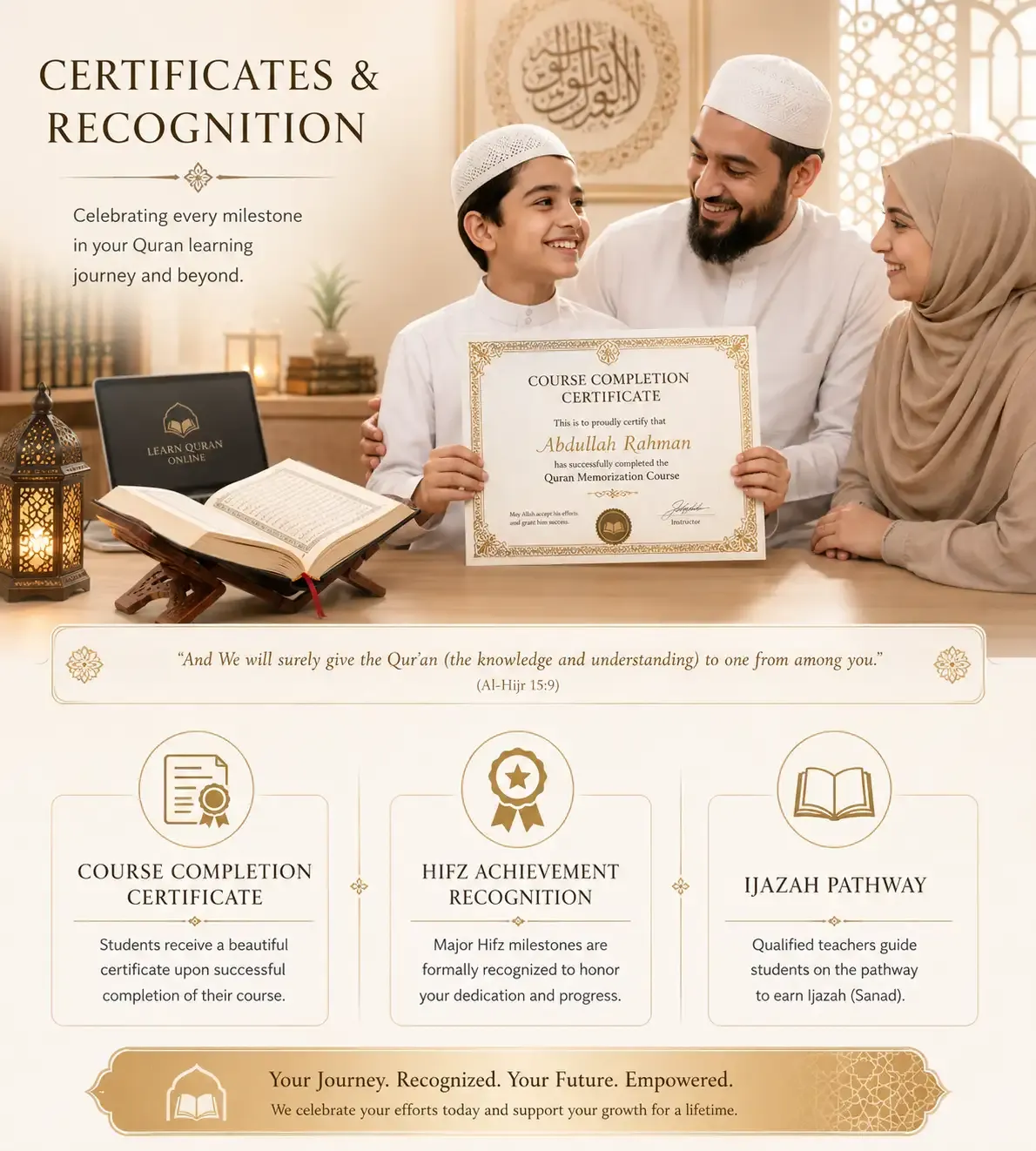
Step 6: Receive Your Ijazah Certificate and Sanad Upon successful completion, the scholar issues a formal Ijazah certificate that includes their Sanad, your name, and the date of certification. You are now authorized to recite and teach with that chain.
How Long Does It Take to Earn an Ijazah?
The timeline varies considerably depending on your existing level of knowledge and how consistently you study.
Complete beginners who are starting from the basics of Arabic letters and Tajweed should expect a journey of three to six years or more. This includes time to learn Tajweed, develop fluent recitation, and then complete the formal Ijazah recitation process under a scholar.
Hifz students who have already memorized the Quran are in a much stronger position. For many Huffaz, the Ijazah in Hifz process focuses primarily on refining Tajweed rather than building memorization. This means the formal recitation process can often be completed within six months to two years.
Tajweed learners who can already recite the Quran fluently but need to complete it formally in front of a scholar typically require one to two years of focused work, depending on session frequency and the scholar’s availability.
Online learners can expect similar timelines to in-person students as long as sessions are conducted live and consistently. The key factor is not the medium but the regularity of practice and the qualification of the teacher.
Ijazah vs Regular Quran Certificate
Many students are unsure how a Quran Ijazah certificate differs from a standard completion certificate issued by a school or institute. The table below makes the distinction clear.
| Feature | Ijazah | Regular Quran Certificate |
| Purpose | Authorize recitation and teaching | Confirm course completion |
| Authority | Granted by certified scholar | Issued by educational institution |
| Sanad | Documented chain to Prophet (PBUH) | No chain of transmission |
| Recognition | Globally recognized by Islamic scholars | Limited to issuing institution |
| Teaching Permission | Authorizes holder to teach and grant Ijazah | Does not grant teaching authority |
| Verification Process | Full Quran recitation before scholar | Coursework or examination completion |
| Spiritual Significance | Direct Prophetic lineage | No connection to prophetic tradition |
The conclusion is straightforward. A regular certificate confirms academic participation. An Ijazah confirms verified mastery through a living scholarly tradition.
Can You Teach Quran Without an Ijazah?
This question deserves a balanced and honest answer because it comes up frequently among both students and educators.
From a purely legal Islamic perspective, there is no ruling that explicitly prohibits teaching Quran without an Ijazah. Many sincere and knowledgeable teachers have served their communities for years without holding a formal Ijazah, and their contribution to Quran education has been genuine and valuable.
However, the absence of an Ijazah means the absence of a verified Sanad. A teacher without their own authenticated chain cannot transmit one to their students. This limits the depth of authenticity that their teaching carries within the broader tradition of Islamic scholarship.
For teachers working in informal community settings, this may be an acceptable reality. But for anyone seeking to teach professionally, to prepare students for their own Ijazah, or to build a career in Quran education, holding an Ijazah is not just recommended. It is effectively essential.
Parents choosing a Quran teacher for their children should also consider Ijazah as an important quality indicator. It provides meaningful assurance that the teacher’s recitation has been formally verified.
Many students pursue an Ijazah not only to improve their recitation but also to preserve the authentic tradition of Quran teaching. Learning under qualified instructors can provide the guidance needed to achieve this goal. Explore our Online Quran Academy and Quran Ijazah Program to begin your journey with certified scholars today.
Online Quran Ijazah Programs: Are They Valid?
As global connectivity has expanded, so has the accessibility of Quran education. Online Quran Ijazah programs are now offered by academies and scholars around the world, and a natural question arises about their validity.
The answer from contemporary Islamic scholars is clear. Online Ijazah is valid when conducted through live, real-time sessions between the student and a certified teacher. The medium of communication does not invalidate the process. What matters is the authenticity of the teacher’s own Sanad and the integrity of the live recitation sessions.
Traditional in-person learning and online learning share the same essential requirement. The student must recite directly to the teacher, the teacher must actively listen and correct, and the teacher must hold a verified Ijazah to transmit.
What does not qualify is any self-paced course, recorded lesson series, or program where the student never recites live to a certified scholar. Watching videos of Quran recitation, no matter how skilled the reciter, does not fulfill the requirements of the Ijazah process.
Modern technology has made it possible for students in any country to connect with certified scholars they could never have accessed previously. This is a genuine benefit that has expanded access to authentic Quran education globally. The key is always to verify the teacher’s credentials before enrolling in any online Ijazah program.
Common Misconceptions About Quran Ijazah
Several widespread misconceptions prevent students from pursuing Ijazah or lead them to misunderstand what it represents. Here are the most important ones to address.
Any Hafiz can grant an Ijazah Memorizing the Quran is a tremendous achievement, but it does not automatically authorize someone to grant an Ijazah. Only a Hafiz who has also received their own verified Ijazah with an authentic Sanad holds that authority. Without a verified chain, there is nothing to transmit.
Ijazah is only for advanced scholars or religious professionals Ijazah is open to any committed student regardless of their profession or background. It requires dedication, not religious expertise. Many ordinary Muslims around the world have earned their Ijazah while living regular family and professional lives.
Online Ijazah is not authentic As discussed above, online Ijazah conducted through live sessions with a certified scholar is fully valid. The format does not determine authenticity. The teacher’s qualifications and the integrity of the live recitation process do.
It takes a lifetime to earn an Ijazah While the process requires real effort, many students complete their Ijazah within one to three years depending on their existing level of knowledge. Huffaz in particular can often complete the process much faster than beginners.
Women cannot receive or grant Ijazah This is completely false. Women have held and transmitted Ijazah throughout the entire history of Islamic scholarship. Many of the greatest Quran scholars and Hadith transmitters in Islamic history have been women. Female scholars continue to hold and grant Ijazah today.
Benefits of Earning an Ijazah
Benefits for Students
Earning an Ijazah gives students verified confidence in their recitation. They know their Quran recitation has been evaluated and approved by a qualified scholar, not just self-assessed. This confidence transforms the quality and consistency of their daily recitation practice.
Benefits for Huffaz
For a Hafiz, an Ijazah is the natural completion of their memorization journey. It takes their achievement beyond personal accomplishment and connects it to the broader tradition of Quran preservation. Ijazah in Hifz also opens the door to teaching Hifz to the next generation with full scholarly authority.
Benefits for Quran Teachers
Teachers who hold an Ijazah carry unquestionable credibility in their field. Families trust them. Students respect them. And their teaching carries a depth of authenticity that non-certified teachers simply cannot offer. Quran teacher certification through Ijazah is the most meaningful credential available in this field.
Benefits for Children
Children who begin the Ijazah journey early develop extraordinary discipline, love for the Quran, and a deep connection to Islamic tradition. These qualities shape their character, strengthen their identity, and create habits of learning that serve them throughout their entire lives.
Benefits for Adults
Adult learners who pursue Ijazah often describe it as one of the most fulfilling achievements of their lives. It is never too late to begin. Adults who earn their Ijazah report a profound renewal of their relationship with the Quran and a deepened sense of purpose in their religious practice.
Frequently Asked Questions
What is Ijazah in Quran?
Ijazah is a formal authorization granted by a certified scholar to a student who has recited or memorized the Quran correctly under direct supervision. It includes a documented Sanad connecting the student to Prophet Muhammad (PBUH) through an unbroken chain of verified scholars and teachers.
How do you get an Ijazah in Quran?
You get an Ijazah by learning Tajweed properly, mastering full recitation or memorization of the Quran, finding a certified scholar with a verified Sanad, reciting the entire Quran to that scholar across multiple live sessions, and receiving the formal certificate upon successful completion
Who can grant an Ijazah?
Only a scholar or teacher who themselves holds a valid Ijazah with a documented and authentic Sanad has the authority to grant one. A teacher without their own verified chain cannot transmit Ijazah to others.
How long does it take to earn an Ijazah?
Beginners typically require three to six years or more. Huffaz who already have the Quran memorized may complete the process in six months to two years. Consistent study under a qualified teacher is the most important factor in determining the timeline.
Can I get an Ijazah online?
Yes. Online Ijazah is valid when conducted through live sessions with a certified scholar who holds their own authentic Sanad. Pre-recorded courses or self-paced programs without live recitation to a qualified scholar do not meet the requirements.
What is the difference between Sanad and Ijazah?
Sanad is the documented chain of teachers and students through which Quran recitation has been transmitted across generations. Ijazah is the formal certificate of authorization that grants permission to recite or teach, and it always includes the Sanad as part of its documentation. One is the chain, the other is the permission that comes with it.
Is Ijazah required to teach Quran?
It is not required by Islamic law, but it is strongly recommended for anyone teaching professionally or preparing students for their own Ijazah. Without an Ijazah, a teacher cannot transmit a verified Sanad, which limits the scholarly authenticity of their teaching lineage.
Can women receive Ijazah in Quran?
Absolutely and without any reservation. Women have received and granted Ijazah throughout the entire history of Islamic scholarship. There is no restriction based on gender. Many highly respected female scholars hold Ijazah in recitation, Ijazah in Hifz, and Ijazah in Qira’at and have transmitted this knowledge to generations of students worldwide.
Conclusion
The tradition of Ijazah, stands as one of the most remarkable achievements in the history of human knowledge. For over fourteen centuries, it has kept the Quran exactly as it was revealed, protecting every letter, every rule of pronunciation, and every nuance of recitation through an unbroken human chain.
Understanding what is Ijazah and why does it matter is not merely an academic exercise. It is an invitation to participate in something far greater than any individual achievement. When you pursue an Ijazah, you are not just earning a credential. You are taking your place in a living tradition of preservation that stretches directly back to Prophet Muhammad (PBUH).
Whether you are a beginner just starting your Quran journey, a Hafiz looking to formalize your achievement, or a teacher seeking to strengthen your authority and authenticity, the path of Ijazah is open to you.
The chain is unbroken. Qualified scholars are ready to listen to your recitation and connect you to this extraordinary tradition. Take the first step by joining our Quran Ijazah Program.
Book your class today — and start hearing the words of Allah the way they were meant to be heard.
