 Skip to content



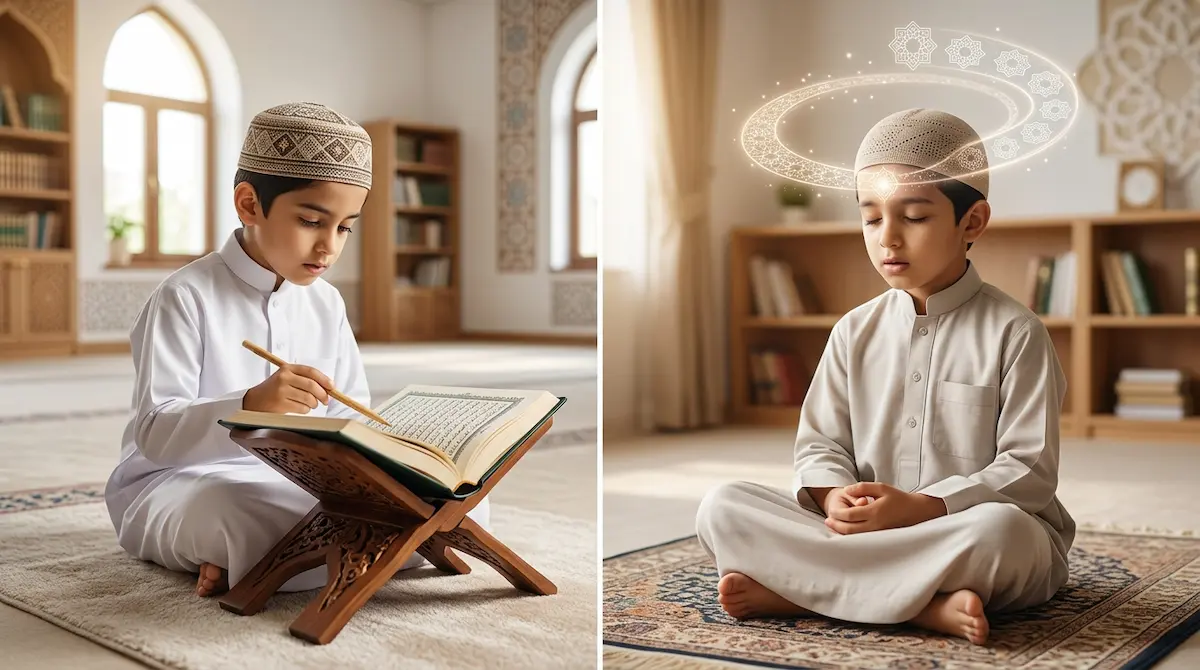
You want your child to connect with the Quran. But when you hear terms like “hifz” and “nazra” thrown around at the masjid or in parent groups, you freeze up. What is the difference between Hifz and Nazra, and more importantly, which one is right for your child right now?
Here’s the short answer: Nazra teaches reading fluency. Hifz teaches memorization.
Think of Nazra as learning to read a book smoothly. Hifz is memorizing that book word for word, cover to cover.
But the real question isn’t just definitions. It’s about time, money, your child’s age, their learning style, and your family’s schedule.
What Exactly is Nazra?
Nazra (also spelled “nazira” or “naazirah”) comes from the Arabic word “nazara,” meaning “to look at” or “to see.”
In practical terms, nazra means reading the Quran directly from the mushaf (the written text) using proper pronunciation rules.
Here’s what Nazra actually looks like in practice:
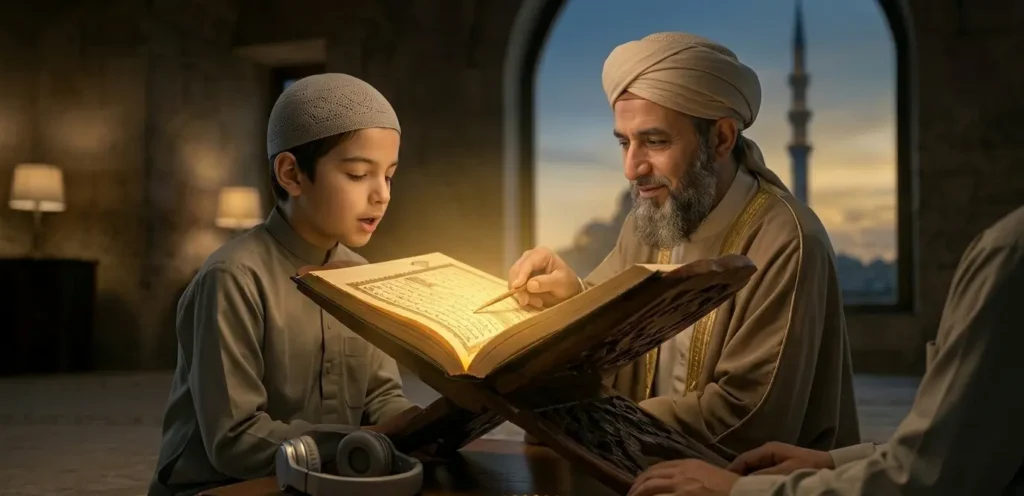
A student sits with a Quran teacher. The teacher points to Arabic letters and words. The student reads aloud while looking at the page. The teacher corrects pronunciation, but the student never memorizes anything.
The goal is simple: read the Quran correctly without stumbling over letters or breaking tajweed rules.
Who typically does Nazra: Children ages 4-8 are the sweet spot, but adults starting from zero also begin here.
How long does Nazra take?
- For children (30 minutes daily): 1.5 to 3 years
- For adults (1 hour daily): 6 to 18 months
- Intensive summer programs (3-4 hours daily): 3-6 months
Nazra builds three core skills:
- Letter recognition – identifying Arabic letters in their different forms
- Sound production – pronouncing letters from their correct articulation points (makharij)
- Smooth connection – joining letters and words without awkward pauses
A student completes nazra when they can pick up any Quran, open to any page, and read fluently with correct tajweed. No memorization required. Just pure reading skill.
What Exactly is Hifz?
Hifz literally means “protection” or “preservation.” In Islamic tradition, hifz refers to memorizing the entire Quran – all 114 surahs, all 6,236 verses, word for word.
A person who completes hifz earns the title Hafiz (male) or Hafiza (female), meaning “guardian” of the Quran.
Hifz is a completely different beast from Nazra. Here’s what it involves:
A student first learns to read fluently (usually through nazra first). Then they transition to memorization. Each day brings:
- Sabaq (new lesson): Memorizing new verses (typically 0.5 to 2 pages daily)
- Sabqi (recent revision): Reviewing material from the last 5-7 days
- Manzil (old revision): Cycling through previously memorized juz (sections)
How long hifz takes?
| Schedule | Daily Hours | Typical Completion Time |
| Full-time hifz school | 5-7 hours | 2-3 years |
| Part-time (after school) | 2-3 hours | 4-6 years |
| Weekend only | 4-5 hours total | 8-12 years |
| Adult hifz (flexible) | 1-2 hours | 5-8 years |
The reality check: About 30-40% of students who start hifz complete it according to Islamic education studies. The dropout rate is high, not because kids aren’t capable, but because families underestimate the commitment.
What is the Difference Between Hifz and Nazra
The following 7 core differences are here:
1. Learning Objective (Reading vs. Memorizing)
Nazra: You learn to recognize and pronounce Arabic text. The Quran stays on the page. Your eyes do the work.
Hifz: You transfer the entire Quran from the page into your memory. The Quran lives inside you. Your brain does the work.
Think of it this way: Nazra teaches you how to drive a car. Hifz teaches you how to build that car from memory.
2. Time Investment
Nazra: Months to a few years. You see progress weekly. Small daily practice (20-45 minutes) works fine.
Hifz: Years of daily commitment without long breaks. Missing 3-5 days can erase weeks of progress. You need 1.5+ hours daily minimum for any real traction.
3. Age Appropriateness
Nazra: Ages 4+ can start. The main requirement is basic focus (5-10 minute attention span). Fine motor skills for pointing to letters help but aren’t mandatory.
Hifz: Ages 7-12 is the ideal window for full-time hifz. Children under 7 struggle with memorization discipline. Adults over 25 can still do hifz, but expect it to take 2-3x longer.
4. Tajweed Requirements
Nazra: You must learn basic tajweed (pronunciation rules) or you’ll read incorrectly and develop bad habits that are hard to break later. However, advanced rules like ghunnah levels and madd lengths aren’t critical for nazra completion.
Hifz: You need solid tajweed before starting memorization. Why? Because you’re memorizing sounds, not just words. If you memorize with incorrect pronunciation, unlearning is harder than learning correctly the first time.
5. Teacher Qualifications
Nazra: A qualified reader with basic tajweed knowledge can teach nazra. They don’t need formal ijazah (certification). Many college students and masjid volunteers teach nazra effectively.
Hifz: Your teacher should have an ijazah in hifz or be actively working toward one. They need experience diagnosing memory problems and structuring revision schedules. A bad nazra teacher slows you down. A bad hifz teacher can make you quit entirely.
6. Daily Practice Structure
Nazra structure:
5-10 minutes: Quick review of yesterday’s pages
20-30 minutes: New reading practice with teacher
Total: 25-40 minutes
Hifz structure:
20-30 minutes: Old revision (manzil) – reciting memorized juz without looking
10-15 minutes: Recent revision (sabqi) – last week’s new memorization
30-45 minutes: New lesson (sabaq) – memorizing fresh verses
Total: 60-90 minutes minimum
7. Long-term Retention Expectations
Nazra: Once you learn to read fluently, you generally don’t lose this skill. Even after months away, you can pick up a Quran and read decently after a short warm-up. Reading is like riding a bike.
Hifz: Without daily revision, you will forget. A 2019 study of huffaz showed that without regular practice, retention drops 40-60% within two years. Most huffaz need 20-40 minutes of daily revision throughout their lives to maintain their memorization, including regular qirat practice to keep both memory and recitation quality sharp.
Which One Should Your Child Start With?
The traditional and most effective path is clear: Nazra first, then hifz.
Here’s why this sequence works:
A child who can’t read fluently will struggle immensely with memorization. Imagine trying to memorize a poem in a language you can’t pronounce correctly. That’s hifz without nazra. It’s possible but painful.
The recommended sequence by age:
Ages 4-6: Start with letter recognition and basic nazra. 15-20 minutes daily. Focus on making it fun. No pressure.
Ages 6-9: Complete nazra if not already done. Aim for reading fluency by age 8-9. Once fluent, parents can decide about hifz.
Ages 7-12 (fluent readers): Start hifz if the child shows interest and can focus for 45+ minutes. Start with Juz Amma (last section) which has shorter surahs for early wins.
Ages 10+ (not yet fluent): Focus on finishing nazra first. Don’t rush into hifz. A 12-year-old who reads poorly will hate memorization.
Can you skip nazra and go straight to hifz?
Yes, but I don’t recommend it unless you have no other options. Some hifz schools accept non-readers and teach reading alongside memorization. This works for about 20% of students. The other 80% get frustrated and quit.
If you must skip nazra, expect the first 6-12 months of hifz to be painfully slow. You’re essentially learning two skills at once.
Can Adults Do Hifz or Nazra?
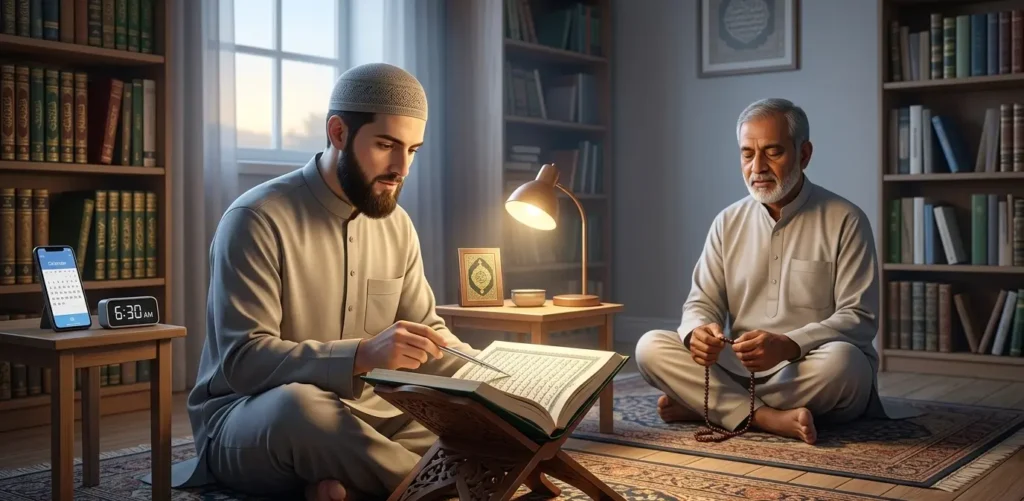
Short answer: Yes to both. But let’s be real about what to expect.
Nazra for adults: Absolutely do this. No question. Adults can complete nazra in 6-12 months with consistent effort. Thirty minutes daily gets you there. Many converts start here. It’s completely achievable.
Hifz for adults: Possible but requires serious lifestyle changes. Here’s the honest picture:
- Working full-time? Expect 5-8 years minimum
- Have young kids? Add 1-2 more years
- No Arabic background? Complete nazra first (adds 6-12 months before starting hifz)
What works for adult hifz:
- One juz at a time – Focus on memorizing one section completely before moving on
- Morning memorization – Do your new lesson before work when your brain is fresh
- Commute revision – Listen to your memorized portions while driving
- Find an accountability partner – Weekly check-ins with another adult doing hifz
- Lower your pace – Memorize half a page daily instead of 1-2 pages
Success rate for adult hifz: About 15-20% of adults who start complete the full Quran. But partial hifz (memorizing 5-10 juz) is much more common and still carries immense reward.
How to Choose a Qualified Teacher
Finding good teachers in the US can be tough, especially outside major cities like Chicago, Detroit, NYC, or Houston. Here’s what works.
Red flags to watch for:
- No clear curriculum or timeline expectations
- Can’t tell you what your child should achieve in 3 months
- Only meets once weekly (insufficient for hifz progress)
- No regular assessments or progress reports
- Changes teacher frequently
Questions to ask before enrolling:
- “What is your ijazah or certification?”
- “How do you handle students who struggle with memory?”
- “What’s your revision system?”
- “Can I sit in on one class?”
- “What percentage of your students complete nazra/hifz?”
Typical US costs (2025-2026):
- Online group nazra classes: $50-100/month
- Online 1-on-1 nazra: $80-150/month
- Online 1-on-1 hifz: $120-300/month
- In-person weekend masjid programs: $50-150/month
- Full-time hifz academy: $400-1,000/month
Common Myths About Hifz and Nazra
Myth 1: “You need to be Arab to do hifz”
False. Most huffaz worldwide are non-Arabs. Indonesia, Pakistan, India, and Turkey produce more huffaz than all Arab countries combined.
Myth 2: “Nazra is only for kids under 10”
False. Adults start nazra all the time. It’s actually easier for adults because you understand why you’re learning and can focus better.
Myth 3: “Hifz means you can’t go to regular school”
False for part-time hifz. Thousands of American kids do hifz after school and on weekends. Full-time hifz academies exist, but they’re not required.
Myth 4: “You don’t need tajweed for nazra”
Dangerously false. Learning nazra without tajweed builds bad pronunciation habits. Fixing these later takes 3-5x longer than learning correctly the first time.
Myth 5: “Once you forget hifz, you lose all reward”
False. Islamic scholars agree that the effort and intention carry reward even if retention fades. That said, huffaz have a responsibility to maintain what they memorized.
Key Takeaways
- Nazra teaches reading fluency from the mushaf. Hifz teaches complete memorization of the Quran.
- Nazra takes months to a few years. Hifz takes years of daily commitment.
- Children should typically complete nazra first (ages 4-9) before starting hifz (ages 7-12 optimal).
- Adults can absolutely do nazra in 6-12 months. Adult hifz is possible but requires 5-8 years and serious discipline.
- Tajweed matters for both, but hifz requires advanced mastery before starting.
- **Expect to pay $50-150/month for nazra** and $100-400/month for hifz in the US market.
- The dropout rate for hifz is 30-40%+ primarily because families underestimate time commitment.
- Daily revision is required for life after hifz to maintain memorization. Nazra doesn’t require ongoing practice once fluent.
- Online options work well for both paths, especially for families outside major Muslim population centers.
- Start with realistic expectations rather than aiming for perfection. Partial progress in either path is better than no progress.
Frequently Asked Questions
Can a child do hifz without learning nazra first?
Yes, but it’s harder. The child learns reading and memorization simultaneously. Most Islamic educators recommend completing nazra first for better success rates.
How many hours daily for hifz while attending regular school?
Two hours minimum: one hour for new memorization, one hour for revision. Many successful part-time huffaz do 2.5-3 hours daily after school.
What’s the youngest age to start nazra?
Age 4 is reasonable for basic letter recognition. Age 5-6 is ideal for formal nazra with a teacher.
Does nazra have an official completion certificate?
Most programs don’t offer formal certification. Completion means your child can fluently read any page of the Quran independently.
Can you become a Hafiz online?
Yes. Several reputable online academies offer complete hifz programs with ijazah upon completion. Verify teacher credentials before enrolling.
How much does online hifz cost in the US?
$100-400 monthly for 1-on-1 instruction. Group classes are cheaper ($50-150) but progress slower.
What percentage of hifz students actually finish?
Estimates vary: 30-60% completion rate for full-time programs. Part-time programs see lower completion rates (20-40%).
Can a non-Arabic speaker do nazra?
Absolutely. Nazra doesn’t require understanding Arabic meaning. You’re learning to pronounce the script, not translate it.
Do you need to memorize tajweed rules for nazra?
No. You need to apply them correctly while reading. Memorizing rule names isn’t required for nazra completion.
How long does nazra take for a 7-year-old?
With 30 minutes daily, most 7-year-olds complete nazra in 18-24 months.
What’s the best age to start hifz?
Age 8-10 is the golden window. Old enough for discipline, young enough for strong memory retention.
Can you do nazra and hifz simultaneously for different Surahs?
Yes, some students do. But it’s mentally taxing. Most educators recommend focusing on one path at a time.
Do girls and boys learn hifz differently?
The methodology is identical. Some parents prefer female teachers for girls, especially after puberty. Many online academies offer both options.
What happens if you forget some of your hifz?
You work to re-memorize those portions. Daily revision prevents this. Forgetting doesn’t remove the Hafiz title, but active effort to maintain is expected.
Is Hifz harder than Nazra?
Significantly harder. Hifz requires 5-10x more time investment and ongoing maintenance. Nazra is a one-time skill acquisition.
Conclusion
Whether your child is just starting with letter recognition or ready to begin hifz, the right path depends on their age, pace, and your family’s schedule, not on rushing toward a finish line. Start with nazra, build fluency, and let hifz follow when your child is truly ready.
If you’re looking for structured, qualified support for either journey, explore our online Quran classes USA, with experienced teachers for both nazra and hifz. Contact us today to find the right program for your child.
