 Skip to content




A Complete Guide for Muslim Families in the USA
The most important decision Muslim parents will ever make is to choose the right online Quran teacher for their kids—and it’s not as simple as picking whoever shows up first in a Google search.
The Quran is the literal word of Allah ﷻ. Its recitation carries precise rules, its transmission carries a sacred chain going back to the Prophet Muhammad ﷺ, and its teacher carries enormous responsibility. The wrong teacher doesn’t just slow your progress — they can embed mispronunciations and bad habits that take years to unlearn. The right teacher, on the other hand, can transform your relationship with the Quran entirely.
This guide walks you through every factor that matters — qualifications, teaching style, red flags, the right questions to ask, and what a reputable Quran Academy in the USA should be offering you — so you can make this decision with clarity and confidence.
Why the Choice of Quran Teacher Matters More Than You Think
There’s a famous saying among Islamic scholars “This knowledge is Deen — so be careful from whom you take your Deen.”
This wasn’t said about worldly education. It was said specifically about religious knowledge — the kind of knowledge that shapes how you worship, how you recite, how you understand Allah’s words, and how you transmit that knowledge to your own children.
A great Quran teacher is not just an instructor who drills Tajweed rules. They are a mentor who
-
- Nurtures your love for the Quran, not just your technical ability to recite it
-
- Corrects your Makharij al-Huruf (articulation points of Arabic letters) before errors solidify into habits
-
- Understands your personal learning style — whether you’re a visual learner, an auditory learner, or someone who needs more repetition
-
- Connects with your child emotionally and spiritually, keeping them motivated through difficult surahs
-
- Represents good Islamic character (Akhlaq) in every interaction
The technical and the spiritual cannot be separated in Quranic education. Keep both in mind as you evaluate your options.
Step 1 — Define Your Learning Goals Before You Start Searching
Before evaluating a single teacher, get clear on what you actually need. The right teacher for a 6-year-old learning Noorani Qaida is completely different from the right teacher for a 40-year-old convert memorizing Juz Amma, or a teenager pursuing full Hifz.
Common Quran Learning Goals and the Teacher Type Each Requires
Noorani Qaida / Basic Arabic Reading Children and absolute beginners need a teacher who specializes in early childhood Islamic education, uses engaging age-appropriate methods, and has patience as their defining quality. Certification in foundational Arabic instruction matters here.
Tajweed Al-Quran (Rules of Recitation) You need a teacher who holds a formal Tajweed qualification — ideally an Ijazah in the narration of Hafs an Asim (the most widely used Quranic recitation in the Muslim world). They should be able to explain Sifaat al-Huruf, Ahkam al-Noon al-Sakinah, Ahkam al-Meem al-Sakinah, and rules of Madd with precision and clarity.
Hifz (Quran Memorization) Only a certified Hafiz or Hafiza should teach Hifz. This is non-negotiable. Hifz requires daily new memorization, daily revision (Murajaah), and a teacher who can catch the subtle errors in long passages that a student’s own ear might miss entirely.
Tafsir (Quranic Exegesis) This requires a teacher with formal training in Islamic sciences — ideally a graduate of Al-Azhar University, Dar al-Ulum, or another accredited Islamic institution — who has studied classical Tafsir works like Ibn Kathir, Al-Tabari, or Al-Qurtubi.
Arabic Language Some students want to understand the Quran directly in Arabic. This requires a teacher qualified in Modern Standard Arabic (Fusha) and Classical Quranic Arabic grammar (Nahw and Sarf).
Knowing your goal narrows the field significantly. Don’t skip this step.
Step 2 — Verify Qualifications and Credentials (This Is Non-Negotiable)
This is where many families make their biggest mistake — taking a teacher’s word for their qualifications without verifying anything. In an online environment, anyone can claim anything. Your job is to ask and verify.
The Ijazah — Why It’s the Gold Standard
An Ijazah is an Islamic certification that authorizes a scholar to teach and transmit Quranic knowledge. It is granted by a qualified Sheikh after a student has recited the entire Quran from memory with accurate Tajweed. Critically, every Ijazah holder has a chain of transmission (Isnad) that connects — teacher to teacher — all the way back to the Prophet Muhammad ﷺ.
This isn’t just a credential. It’s the preservation mechanism through which the Quran has remained unchanged for over 1,400 years.
When evaluating a teacher, ask directly “Do you hold an Ijazah, and in which narration?” A qualified teacher will answer this clearly and confidently. Legitimate Ijazah certificates are verifiable documents.
Other Credentials to Look For
-
- Al-Azhar University graduate — Al-Azhar in Cairo, Egypt is the world’s oldest and most prestigious Islamic university. A teacher trained there has undergone rigorous multi-year study in Quranic sciences, Arabic linguistics, and Islamic jurisprudence.
-
- Dar al-Ulum certificate — Graduates from Dar al-Ulum institutions (Pakistan, India, UK, and elsewhere) have similarly robust Islamic educational backgrounds.
-
- Formal Tajweed degree — Some teachers hold specific Tajweed certifications from recognized Islamic educational bodies, even if they don’t hold a full Ijazah. This is acceptable for foundational Tajweed instruction.
-
- Teaching experience — Ask how many years the teacher has been teaching, what age groups they’ve worked with, and whether they have experience teaching non-Arabic speakers specifically (important for US-based students).
A Less Qualified Teacher with More Experience vs. A Highly Qualified Teacher with None
Here’s a nuance worth understanding: when you choose the right online Quran teacher, a deeply experienced teacher with five years of classroom practice and strong Tajweed knowledge will often outperform a theoretically over-qualified teacher who has never taught before. Both qualification and experience matter. Ideally, you want both — but if forced to choose, experience with proven results edges ahead of credentials alone at the foundational level.
Step 3 — Assess Teaching Style and Personality Fit
A teacher who is technically brilliant but emotionally cold, impatient, or culturally disconnected from American Muslim life can still derail a student’s Quranic journey. The fit matters enormously — especially for children.
What to Observe During a Trial Class
-
- Patience under pressure Does the teacher calmly repeat a difficult Makhrij multiple times, or do they show frustration?
-
- Engagement techniques For children, does the teacher use visual aids, interactive whiteboard tools, encouragement, and a warm tone — or do they just drill mechanically?
-
- Clarity of explanation Can the teacher explain a complex Tajweed rule like Ikhfa in simple English that a non-Arabic speaker can understand?
-
- Adaptability Does the teacher adjust their pacing and method based on how quickly or slowly the student is grasping the material?
-
- Islamic character (Akhlaq) Is the teacher punctual, professional, respectful, and genuinely invested in the student’s progress?
The Importance of Cultural and Linguistic Fit for US-Based Students
This point is underappreciated. Many online Quran teachers are based in Egypt, Pakistan, or other Muslim-majority countries and may have limited experience with the specific challenges American Muslim students face — balancing public school life, navigating Islamic identity in a non-Muslim environment, and learning in a second (or third) language.
The best teachers for US-based students understand the American Muslim experience. They can give examples relevant to life in New York, Texas, or California. They know how to support a child who goes to public school in Ohio and attends online Quran classes in the evenings. That cultural awareness makes a real difference in student motivation and retention.
Step 4 — Know the Red Flags (And Take Them Seriously)
Just as important as knowing what to look for is knowing what to walk away from. Here are the warning signs that a teacher or platform is not what they claim to be.
Red Flags in Online Quran Teachers
Unrealistic promises Any teacher or platform claiming “Learn the entire Quran in 30 days” or “Master Tajweed in one week” is either dishonest or fundamentally misunderstands what Quranic learning involves. Tajweed mastery takes months of consistent practice. Hifz takes years. Walk away from anyone selling shortcuts.
Inability to verify credentials If a teacher becomes evasive, defensive, or vague when you ask about their Ijazah or formal qualifications, that evasion is your answer.
No trial class offered Every legitimate, confident Quran teacher and academy will offer a free trial class. If a platform refuses or makes it unnecessarily difficult to try before committing, question why.
No structured curriculum A qualified teacher should be able to tell you exactly what you’ll learn, in what order, over what timeframe. Vague answers like “we’ll just go at your pace and see what happens” indicate a lack of professional structure.
Poor communication and punctuality A teacher who frequently arrives late, cancels without notice, or communicates poorly between sessions is showing you their professional standards. Those standards won’t improve after enrollment.
Gender boundary violations For female students, a teacher who is inappropriate in any way — in language, in the topics they raise, or in the boundaries of their interaction — must be reported and removed immediately. Reputable academies have zero tolerance policies and female teacher options for all female students.
Suspiciously low prices with no explanation While affordability is important, rock-bottom pricing sometimes reflects uncredentialed teachers or severely compromised class quality. Ask what the pricing model includes.
Step 5 — Ask the Right Questions Before Enrolling
Most families skip this step because they feel awkward interviewing a religious teacher. Don’t. The right teacher will welcome your questions — it shows you take your child’s education seriously.
10 Essential Questions to Ask Any Online Quran Teacher
-
- Do you hold an Ijazah, and in which narration (Hafs, Warsh, etc.)?
-
- Where did you receive your formal Islamic education?
-
- How many years have you been teaching Quran online?
-
- What age groups do you have experience teaching?
-
- Have you taught students from the United States before? Do you understand their schedules and context?
-
- What curriculum or structured syllabus do you follow?
-
- How do you handle a student who is struggling or losing motivation?
-
- How do you communicate progress to parents between sessions?
-
- What is your rescheduling and cancellation policy?
-
- Can I observe or participate in a free trial class before committing?
A teacher who answers all ten questions clearly, specifically, and confidently has just demonstrated their professionalism before the first lesson even begins.
What Services Does a Quran Academy in the USA Provide?
Many Muslim families searching for Quran education don’t fully understand the range of services a well-structured Quran academy should offer. This matters because you want to choose an academy that can serve your family’s needs as they evolve — not one you’ll outgrow in six months.
Core Quran Education Services
Noorani Qaida for Beginners The starting point for all Quranic learners — children and adults alike. Noorani Qaida teaches the Arabic alphabet, letter forms, joining letters, and basic pronunciation rules before any actual Quran reading begins. A quality US Quran academy will have teachers specifically trained for this foundational stage.
Quran Reading with Tajweed The primary service of any Quran academy — teaching students to recite the Quran correctly according to the rules of Tajweed. This includes Makharij al-Huruf, Sifaat, rules of Noon Sakinah and Tanween (Idghaam, Ikhfa, Iqlab, Izhar), rules of Meem Sakinah, and the various types of Madd (elongation). Programs typically run from beginner to advanced levels.
Hifz Program (Quran Memorization) A structured, teacher-supervised program for memorizing the entire Quran (30 Juz). This is among the most demanding programs a Quran academy offers and requires daily sessions, strict revision schedules, and a certified Hafiz or Hafiza as the supervising teacher. Reputable US-based academies offer Hifz programs adapted to American school schedules — including evening and weekend session options.
Tafsir Classes In-depth study of the meanings, context, and scholarly interpretation of Quranic verses. This goes far beyond translation — it involves understanding Asbab al-Nuzul (reasons for revelation), Nasikh and Mansukh (abrogated and abrogating verses), and the linguistic nuances of Classical Arabic. Tafsir classes are typically offered at intermediate and advanced levels.
Arabic Language Courses Many Muslims want to understand the Quran directly — without relying on translations. A comprehensive Quran academy in the USA will offer Arabic language courses covering the Arabic alphabet, vocabulary, Nahw (grammar), Sarf (morphology), and conversational Modern Standard Arabic — all building toward Quranic comprehension.
Islamic Studies Beyond Quran, a full-service academy will offer structured Islamic Studies covering Aqeedah (Islamic creed and theology), Fiqh (Islamic jurisprudence — Salah, Zakat, Sawm, Hajj), Seerah (biography of the Prophet ﷺ), Hadith sciences, and Islamic history. This is particularly valuable for children growing up as Muslims in non-Muslim-majority environments like the United States.
Specialized Services a Quality US Quran Academy Should Offer
Female Teachers for Female Students This is essential, not optional. A reputable academy will have qualified female Quran teachers available for girls and women who prefer — or whose families require — female-only instruction. At Quran Academy USA, female instructors are available for all programs at all levels.
Programs for Converts (Reverts) to Islam Converts often come to Quranic education as adults, starting from zero, sometimes without family support, and with unique emotional and spiritual needs. A quality US Quran academy will have teachers specifically experienced in supporting converts — with patience, cultural sensitivity, and zero judgment about starting late.
Children’s Quran Programs Age-specific programs for children aged 4–5 and above, using child-appropriate teaching methods including interactive whiteboards, visual aids, storytelling, and gamified revision techniques that keep young learners engaged and motivated.
One-on-One vs. Small Group Classes Both formats serve different needs. One-on-one sessions provide maximum personalized attention and fastest progress. Small group classes offer peer motivation, lower cost, and a community feel that some students find encouraging. A full-service academy will offer both options.
Flexible US Time Zone Scheduling This is a practical necessity for families spread across Eastern, Central, Mountain, and Pacific time zones. Morning slots for stay-at-home parents. After-school slots for children in New York, Houston, Chicago, Los Angeles, and everywhere in between. Evening slots for working adults. Weekend intensives for students with busy weekday schedules.
Progress Reporting and Parental Monitoring Parents should receive regular, structured progress reports — not just vague reassurances that their child is “doing well.” Quality academies provide detailed feedback on specific Tajweed rules mastered, areas requiring improvement, memorization milestones reached, and recommended home practice.
Free Trial Classes No commitment. No pressure. A genuine free trial class lets students and parents evaluate the teacher, the teaching methodology, the platform technology, and the overall fit before paying a single dollar.
Completion Certificates Upon completing a course or program, students should receive a formal certificate of completion — a tangible recognition of their achievement that can be meaningful for children and adults alike.
How Quran Academy USA Meets Every Standard on This List
At Quran Academy USA, we built our academy around the specific needs of Muslim families living in the United States — because we understand that your situation is different from families in Muslim-majority countries, and your educational needs reflect that reality.
Our Teacher Verification Standards
Every instructor at Quran Academy USA holds verified credentials — Ijazah holders, Al-Azhar graduates, and certified Hafiz and Hafiza teachers who have been rigorously screened before joining our faculty. We don’t post job listings and hire anyone who applies. Our teachers are vetted through a multi-stage process including credential verification, Tajweed assessment, trial teaching sessions, and background screening.
Our Full Range of Services
We offer every service listed above under one platform — Noorani Qaida, Tajweed, Hifz, Tafsir, Arabic Language, and Islamic Studies — for students of all ages from 4 to 70+, across all 50 US states, in every time zone.
Our Commitment to Female Students
We have a full team of qualified female instructors for girls and women seeking female-only Quranic education — at every level, in every program.
Our Support for American Muslim Life
Our teachers understand American Muslim life. They understand the school schedules in California and New York, the time zone challenges in Arizona and Florida, the unique position of Muslim children attending public schools in Tennessee and Michigan, and the spiritual journey of converts across the South and Midwest.
Start with Zero Risk
Book a free trial class with Quran Academy USA today. Meet your teacher. Experience the lesson. Ask every question on your list. We’re confident enough in the quality of our teachers and our curriculum that we don’t need a paid commitment before you’ve seen exactly what we offer.
Frequently Asked Questions
How do I know if an online Quran teacher is actually qualified?
Ask specifically for their Ijazah certificate or formal educational credentials, and request verification. Legitimate teachers will provide this without hesitation. If a teacher becomes vague or evasive, that’s a clear red flag.
Is a native Arabic-speaking teacher always better?
Not necessarily. A native Arabic-speaking teacher with poor English communication skills may actually be less effective for American students than a highly qualified non-native teacher who is fluent in English and culturally familiar with the US Muslim community. Both qualification and communication ability matter.
How many classes per week does a student need?
For children learning Quran reading or Tajweed, 3–5 sessions per week of 30–45 minutes each is typically recommended. For Hifz students, daily sessions are necessary. Adults learning Tajweed can make strong progress with 3 sessions per week of 45–60 minutes.
What if my child doesn’t connect with their first teacher?
This happens and it’s completely normal. At Quran Academy USA, we make it easy to switch teachers if the fit isn’t right — no questions asked, no awkward conversations. Finding the right match is part of our responsibility, not yours.
Can adults with no prior Arabic knowledge start learning Quran online?
Absolutely. Our beginner programs are specifically designed for adults starting from zero — including converts to Islam with no prior exposure to Arabic or Quranic text. You’re never too old, and it’s never too late.
What does a typical Quran Academy USA session look like technically?
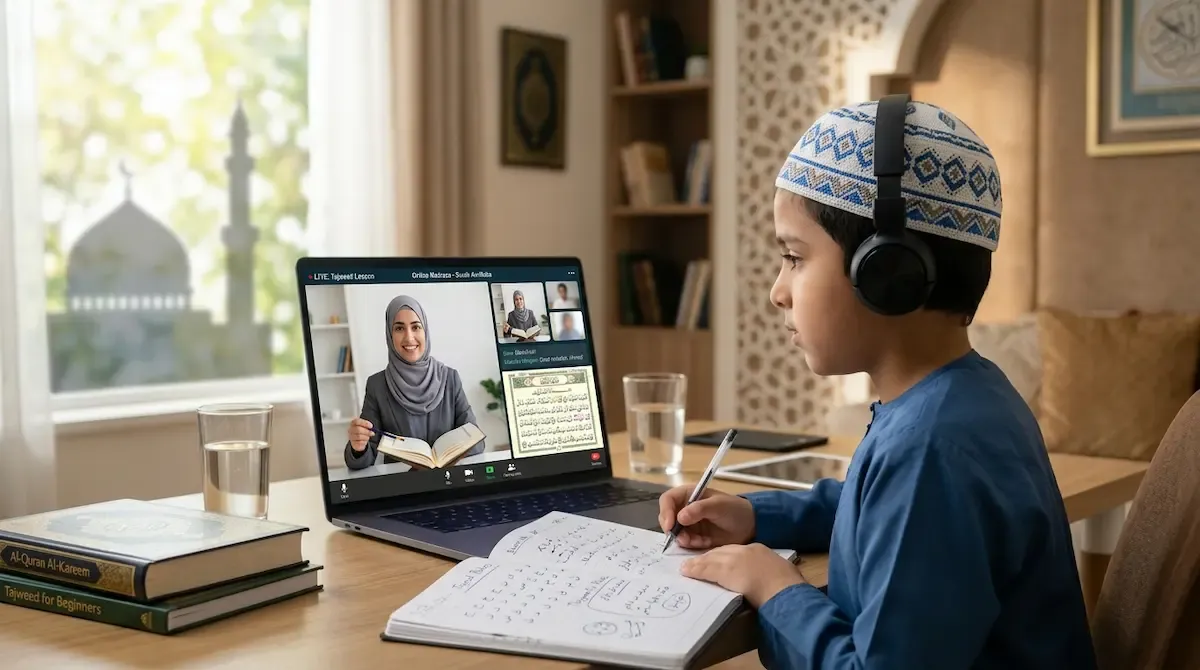
Sessions are conducted live via Zoom or our dedicated platform, with screen sharing, interactive digital whiteboard access, and audio/video in both directions. Sessions are optionally recordable for student review. A stable internet connection and a computer, tablet, or smartphone is all you need.
How do I get started with Quran Academy USA?
Simply book your free trial class through our website. Select your preferred time slot, your program of interest, and whether you’d like a male or female teacher. We’ll match you with the most suitable instructor and confirm your trial session within 24 hours.
The Right Teacher Changes Everything
Learning the Quran with the wrong teacher is like trying to build a house on a cracked foundation. The problems don’t show immediately — but they compound over time, and fixing them later costs far more effort than getting it right from the start.
The right teacher — verified credentials, genuine teaching experience, strong Islamic character, cultural awareness of American Muslim life, and real care for your progress — doesn’t just teach you the Quran. They open the door to a lifelong relationship with the Book of Allah ﷻ.
At Quran Academy USA, that’s the only kind of teacher we have.
Book your free trial class today and find the teacher who was meant for your journey.
