 Skip to content

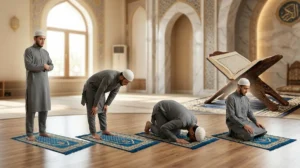
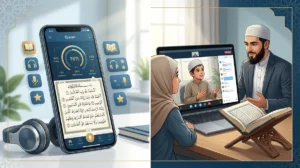
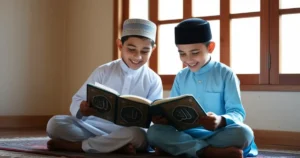
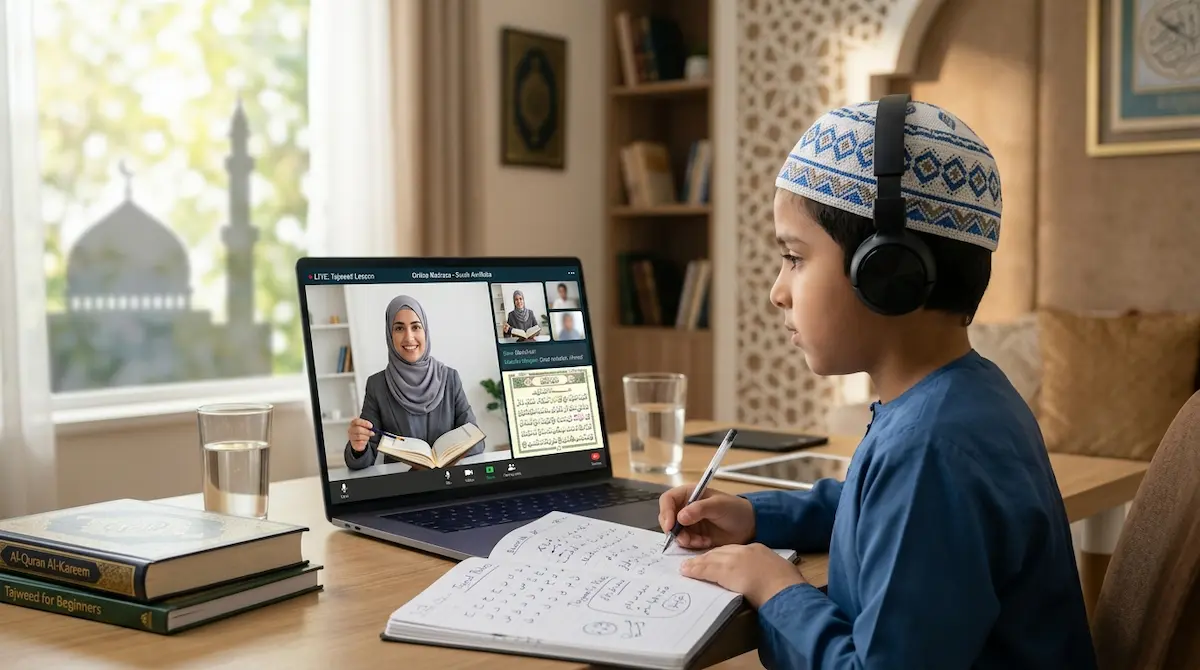
An online madrasa is a structured Islamic learning institution that delivers Quran education, Tajweed training, Arabic language instruction, and Islamic studies through live internet-based sessions. It operates exactly like a traditional madrasa in curriculum and teaching methodology, but removes the geographic barrier entirely. Students in New York, London, or Toronto can learn from qualified teachers based in Egypt, Pakistan, or Saudi Arabia without leaving their homes.
The demand for online madrasa education has grown significantly over the past decade. Muslim communities in Western countries face a real shortage of qualified local Islamic teachers, and weekend mosque classes often cannot provide the structured, consistent instruction children need to progress. An online madrasa fills that gap directly.
How Does an Online Madrasa Work?
How are online madrasa classes actually delivered?
A student logs into a scheduled video session, typically through Zoom, Skype, or a dedicated learning platform that the academy provides. The teacher shares their screen, uses a virtual whiteboard, and guides the student through the lesson in real time. Sessions are usually 30 to 60 minutes long and scheduled according to the family’s time zone.
Most online madrasas follow this standard process:
- Registration and placement assessment. The student takes a short free trial class where the teacher evaluates current level, age, and learning goals.
- Teacher matching. The academy assigns a suitable teacher based on the student’s gender preference, level, and preferred schedule.
- Scheduled weekly sessions. Most programs run two to five sessions per week, depending on the chosen course track.
- Progress tracking and parent reports. Parents receive regular updates on their child’s recitation accuracy, memorization progress, and behavior during class.
- Certification upon completion. Students who complete Hifz or Tajweed courses receive certificates, and advanced students may earn an Ijazah from their teacher.
The structure is consistent whether a family lives in Michigan, Manchester, or Melbourne. Time zone scheduling is handled by the academy and is one of the primary reasons US-based Muslim families choose online madrasa over locally sourced tutoring.
What Does an Online Madrasa Teach?
Quran Recitation and Tajweed
The core subject in any online madrasa is Quran recitation. Students begin with the correct pronunciation of Arabic letters, then progress to full recitation with Tajweed rules. Tajweed is the science of reciting the Quran with proper articulation, rhythm, and elongation as it was revealed. Without Tajweed instruction, many self-taught reciters develop deeply embedded errors that are difficult to correct later.
A structured Tajweed curriculum covers:
- Makharij al Huruf (correct letter pronunciation points)
- Sifaat al Huruf (characteristics of each letter)
- Rules of Noon Sakinah and Tanween (Idghaam, Ikhfa, Iqlab, Izhaar)
- Rules of Meem Sakinah
- Madd rules (elongation rules)
- Waqf and Ibtida (stopping and starting rules)
Hifz (Quran Memorization)
Hifz programs are among the most requested courses in any online madrasa. A dedicated Hifz track structures memorization systematically, starting with shorter Surahs from Juz Amma before progressing to longer chapters. Online Hifz programs work well because the one-on-one format allows the teacher to listen carefully, correct errors immediately, and maintain the student’s revision schedule consistently.
Noorani Qaida for Beginners
Noorani Qaida is the foundational literacy tool used to teach children the Arabic alphabet and basic reading rules before they begin the Quran. Most online madrasas use this as the entry point for students aged four and above who have no prior Arabic reading ability.
Islamic Studies and Arabic Language
Beyond the Quran, a well-structured online madrasa also offers Islamic studies covering pillars of faith, prophetic stories, fiqh basics, and age-appropriate aqeedah. Conversational and classical Arabic courses are offered separately for students who want deeper language comprehension alongside their Quran education.
Age-Specific Learning Roadmap: When Should Your Child Start?
One question parents ask most often is when to begin. The answer depends on the child’s readiness more than a fixed age, but the following roadmap reflects what experienced online madrasa teachers recommend based on typical developmental stages.
Age 3 to 5: Pre-Quranic Preparation
At this stage, formal reading instruction is premature for most children. The focus should be on exposure and love for the Quran. Short Surahs learned by listening, Islamic nursery content, and basic duas form the ideal curriculum. Some online madrasas offer structured pre-Quran readiness classes specifically designed for this age group.
Age 5 to 7: Noorani Qaida and Tajweed Basics
This is the ideal window to begin formal instruction. Children at this age absorb phonetic patterns quickly, and correct pronunciation habits form before bad ones take root. A good online madrasa starts here with Noorani Qaida, Arabic alphabet recognition, and basic Tajweed rules introduced through repetition and play-based reinforcement.
Age 7 to 10: Full Quran Reading and Hifz Track
By seven, most children can sustain a consistent reading and memorization schedule. This is the prime age for beginning Hifz. The brain’s memorization capacity at this stage is exceptional, and children who begin Hifz between seven and ten consistently outperform those who start later in terms of retention and speed.
Age 10 and Above: Advanced Tajweed, Tafsir Introduction, and Arabic
Older students benefit from a more analytical approach. Advanced Tajweed with detailed rule explanation, introductory Tafsir, and structured Arabic language learning becomes appropriate. Adult learners fall into this category, too. Online madrasas increasingly serve adults who grew up without formal Islamic education and are catching up in adulthood.
Online Madrasa vs In-Person Classes vs Home Teaching: Which Is Better?
| Factor | Online Madrasa | In-Person Madrasa | Home Teaching (Parent) |
| Teacher Qualification | Ijazah certified, specialist | Varies widely | Depends on parent’s level |
| Scheduling Flexibility | High — any time zone | Fixed, location-dependent | Flexible but inconsistent |
| Cost | Moderate | Low to moderate | Free but limited |
| Consistency | Structured, trackable | Structured | Often irregular |
| Quality Control | Academy monitored | Varies by institution | None |
| Best For | Families in Western countries | Families near Islamic centers | Supplementary revision only |
| US Availability | Nationwide | Major cities only | Universal |
What to Look for in an Online Madrasa Teacher
What qualifications should an online Quran teacher have? The single most important credential is an Ijazah. An Ijazah is a formal certification that proves the teacher has learned the Quran under a qualified scholar and has been authorized to teach with a chain of transmission going back to the Prophet Muhammad (PBUH). A teacher without an Ijazah may still be competent, but there is no verified quality standard.
Beyond certification, consider:
- Native or near-native Arabic speaker: Tajweed is a phonetic science. Native speakers carry the correct sounds naturally, which matters significantly in one-on-one teaching.
- Female teacher availability: Many families prefer female teachers for young girls. Reputable online madrasas offer this option explicitly. Always confirm before enrolling.
- Trial class policy: Any trustworthy academy offers a free trial class without requiring payment or a long-term commitment upfront. A trial reveals teaching style, patience level, and technical setup quality.
- Experience with young learners: Teaching a seven-year-old Quran requires different skills than teaching an adult. Ask specifically about the teacher’s experience with your child’s age group.
How to Spot a Fake Online Madrasa
The online Islamic education market has grown rapidly, and unfortunately, so have fraudulent or unqualified providers. Muslim families in the USA, UK, and Canada are primary targets. Watch for these warning signs:
- No teacher credentials listed anywhere on the website: Legitimate academies display teacher qualifications, photos, and background information publicly.
- Unusually low pricing with no trial: Rock-bottom rates combined with no trial class often indicate unqualified freelancers posing as certified teachers.
- No refund or cancellation policy: Reputable madrasas have clear written policies. Absence of any policy is a serious red flag.
- Pressure to pay for multiple months upfront immediately: Ethical academies earn loyalty through quality, not upfront financial lock-in.
- No parent progress reports: Any genuine online madrasa communicates regularly with parents. Complete silence after enrollment is unacceptable.
- Teachers who cannot answer basic Tajweed questions: During a trial class, ask the teacher a simple Tajweed question. A qualified teacher answers immediately and clearly.
Parent Involvement: How to Support Your Child Without Knowing Arabic
A common concern among Western Muslim parents is that their own limited Arabic or Quranic knowledge disqualifies them from helping their child. This is not true. Parent involvement in online madrasa learning does not require Arabic fluency.
Here is what parents can do regardless of their own level:
- Be present for the first few classes to observe teaching style and ensure your child is comfortable.
- Create a consistent class environment by designating a quiet space with good lighting and minimal distractions during session time.
- Review the teacher’s feedback notes after each class and follow up on the assigned revision.
- Play Quran recitation audio around the home regularly. Children absorb what they hear repeatedly.
- Celebrate milestones: completing a Surah, finishing Noorani Qaida, or memorizing a new Juz. Recognition builds intrinsic motivation.
- Communicate with the teacher directly about any behavioral, emotional, or academic concerns. Online madrasas with dedicated parent communication channels make this straightforward.
Tech Setup: What Do You Need for Online Madrasa Classes?
What device and internet connection does an online madrasa require? The technical requirements are minimal. Most online madrasas run sessions on Zoom, Skype, Google Meet, or their own branded platforms. A stable broadband connection, a device with a camera and microphone, and a quiet room are sufficient for a high-quality learning experience.
Recommended setup:
- Device: Tablet or laptop preferred over smartphone for younger children. Larger screen supports better focus.
- Internet speed: Minimum 5 Mbps stable connection to avoid audio lag during recitation correction.
- Headset: A basic headset with a microphone significantly improves audio clarity for Tajweed correction compared to built-in device speakers.
- Platform: Most academies send a Zoom link. Some use proprietary apps. Confirm the platform before the first class and test it in advance.
- Parental monitoring: For children under ten, sitting nearby during early classes helps the child feel settled and allows parents to observe teaching quality firsthand.
FAQs:
What is the difference between an online madrasa and an online Quran tutor?
An online madrasa is a structured institution with multiple teachers, a defined curriculum, progress tracking, and administrative oversight. An online Quran tutor is typically a freelance individual teacher. Madrasas offer more consistency, accountability, and structured progression, while individual tutors may offer more flexibility but with less institutional quality control.
At what age should a child start an online madrasa?
Most online madrasas accept students from age four or five onward for Noorani Qaida and pre-reading preparation. The ideal age to begin structured Quran recitation is between five and seven. Hifz programs are most effective when started between seven and ten years old, though children and adults of any age can benefit from online madrasa education.
How much does an online madrasa cost per month?
Pricing varies based on session frequency, class format, and academy location. One-on-one sessions typically range from $30 to $80 per month for two to three classes per week [STAT]. Group classes are generally cheaper. US-based Muslim families should compare multiple academies and always take a free trial before committing financially.
Can adults learn the Quran through an online madrasa?
Yes. A significant portion of online madrasa students are adults learning as beginners or improving recitation they learned informally in childhood. Adult learners benefit from one-on-one formats that move at their own pace. Many online madrasas offer adult-specific programs with teachers experienced in working with non-native Arabic-speaking learners.
Is online madrasa education as effective as in-person learning?
For Quran recitation and Tajweed specifically, research on digital language learning indicates that consistent one-on-one online instruction produces comparable outcomes to in-person teaching when the teacher is qualified and sessions are regular [STAT]. The key variable is consistency of attendance and parental reinforcement at home, not the delivery medium itself.
Conclusion: Is an Online Madrasa the Right Choice?
An online madrasa gives Muslim families in the United States and across the Western world access to qualified, structured Islamic education that local options often cannot provide. From Noorani Qaida for a five-year-old to advanced Tajweed for an adult, the curriculum is comprehensive, the teaching is certified, and the flexibility fits modern family life without compromise.
The key is choosing carefully. Verify teacher credentials, take the trial class, check the curriculum structure, and trust your instincts about how a teacher communicates with your child. A good online madrasa does not just teach the Quran. It builds a relationship between the student and the Book that lasts a lifetime.
If you are ready to begin, start with a free trial class. One session is enough to know whether the fit is right.
